


Checklist: What belongs in a good agency briefing?
Many companies feel overwhelmed when creating an agency brief - especially if previous agency projects were disappointing or the collaboration did not produce the desired results. An unclear start can lead to misunderstandings, frustration and unnecessary costs. But with the right structure and clear guiding questions, the risk can be minimized. This overview shows you how to structure your briefing in a targeted and successful way - so that your agency really understands you and your goals are achieved.
A good agency briefing is the common thread in every successful marketing project.

All the information you need for your agency briefing
- Definition: What is an agency briefing?
- What forms of agency briefing are there?
- The advantages of a good agency briefing
- Why is it worth investing time in a good agency briefing?
- What are the most common internal problems companies face?
- Agency briefing checklist
- The perfect agency briefing to download
- Frequently asked questions about the agency briefing
The most important facts about the agency briefing in brief
- Many companies feel overwhelmed when it comes to agency briefings, which often leads to misunderstandings, frustration and avoidable costs.
- A clearly structured briefing with precise goals, target groups and requirements forms the indispensable basis for targeted and efficient advertising measures
- A professional agency briefing clarifies the task transparently for all parties involved and provides guidelines on the basis of which relevant marketing channels and objectives can be defined
- The more comprehensive the briefing is, the more concrete and time-efficient the creation of the marketing strategy can be
Definition: What is an agency briefing?
An agency briefing summarizes all the important information for a planned cooperation between company and agency. All relevant information on objectives, project requirements, competitors and target groups is recorded in writing for both parties. The agency briefing forms the basis of the collaboration.
What forms of agency briefing are there?
The advantages of a good agency briefing
A good agency briefing ensures clear communication and prevents misunderstandings, as all project goals, expectations and requirements (e.g. budget) are clearly set out.
It enables structured and efficient collaboration, saves time and resources and facilitates the planning of processes, budgets and deadlines.
The agency gains a deep understanding of the company, its target group and brand values, which promotes the development of tailor-made, creative solutions.

Are you looking for an agency that communicates openly with you?
Transparent and honest communication is the key to successful collaboration. We are not simple yes-men, with us you will experience open, clear and trusting communication - so that you always know where your project stands, what you really need and how we can achieve the best results together with you. Get to know us - personally, reliably and fairly.
Why is it worth investing time in a good agency briefing?
Yes, creating a comprehensive briefing can be time-consuming. However, good preparation not only ensures that misunderstandings are avoided and everyone involved shares the same expectations, but also gives you as a company a much clearer idea of the desired collaboration, the relevant marketing channels and the most important KPIs. During the briefing process, internal questions are clarified and goals are specified - this not only helps the agency, but also your own team to make strategic decisions with confidence and make the success of the project measurable. A well thought-out briefing is therefore a win-win situation for both sides and forms the basis for efficient, creative and targeted collaboration.
What are the most common internal problems in companies? This often stands in the way of perfect preparation for a new marketing project
Strategic goals, target groups and expectations are not clearly defined.
Important departments and stakeholders are not sufficiently involved.
The briefing is prepared hastily and superficially and too late.
Requirements are imprecise or contain too many irrelevant details.
Important data on the company, market and previous measures are missing.
Briefings are often only communicated verbally, which makes traceability difficult.
Agency briefing checklist
Aspect | Questions you should ask yourself |
|---|---|
👀 Key details |
|
🎯 Goals & expectations |
|
👤 Target audience |
|
⏰ Budget & timeline |
|
🚀 Marketing objectives, services & channels |
|
🧐 Previous marketing measures |
|
🥊 Competition |
|
🗣️ Brand & Communication |
|
✏️ Content & Assets |
|
✅ Approval process |
|
🔎 Reporting & performance monitoring |
|
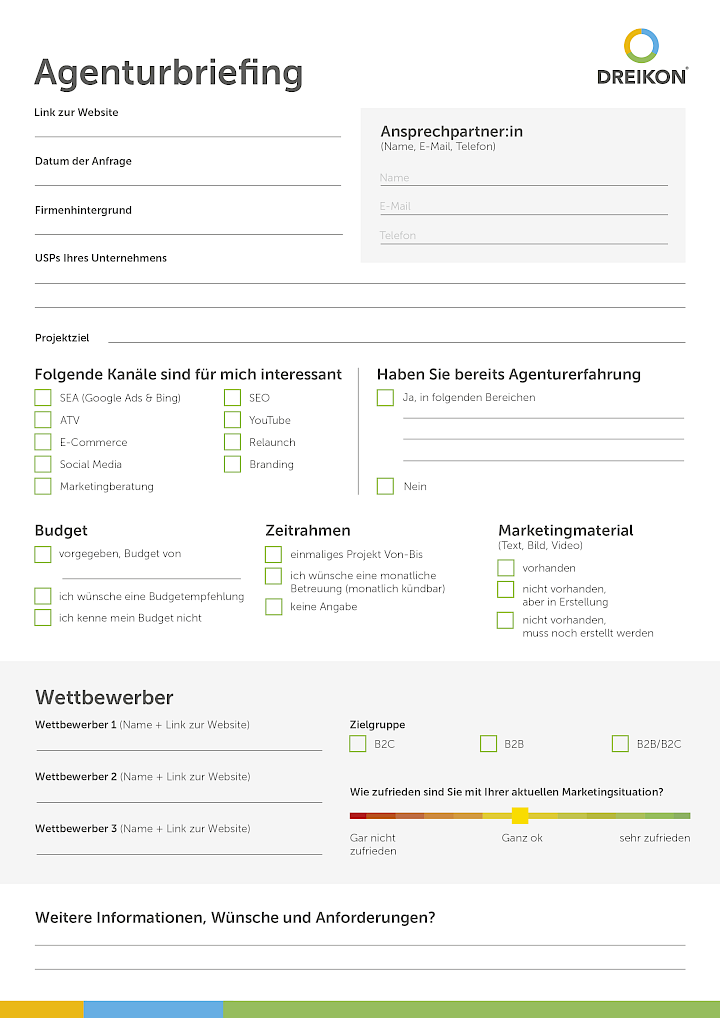
The perfect agency briefing to download Simply download and fill out digitally
When does it make sense to rebrief an agency?
Especially if you have already had bad experiences with agencies, feel overwhelmed in the briefing process or see opportunities to increase efficiency, a rebriefing can be decisive for the success of the project. A rebriefing always makes sense if requirements have changed or the previous results do not meet your expectations.
In these situations, a new agency briefing makes sense:
- Unclear requirements: If you have the feeling that the agency has not understood your request correctly or misunderstandings arise, a rebriefing helps to create clarity and bring everyone involved up to the same level.
- Changed goals or framework conditions: If your goals, priorities or the market environment change during the course of the project, a rebriefing is necessary to adjust the strategy and measures.
- Feedback &
Frequently asked questions about the agency briefing
Provide a clear project description, background information about your company, your target audience, the desired outcomes, your budget and the timeframe. If there is any information you are unsure about, please state this exactly as it stands. Agencies often find it helpful to have rough estimates to get a sense of the project’s scope. However, a good agency will always offer advice during a meeting to address your questions and concerns. After all, it is not solely your responsibility to develop a coherent marketing concept from the information provided.
Use the SMART criteria (Specific, Measurable, Achievable, Relevant, Time-bound) to define your goals precisely and transparently. An agency can assist you in specifying these criteria, as they often bring experience and benchmark data from similar projects and are trained in interpreting target audiences, data anomalies and trends.
Describe your target audience based on demographic characteristics, interests, needs and, where applicable, behaviours. In e-commerce, purchasing power and device type are also particularly relevant. Your agency will always ask for further information if anything is missing.
Please provide a realistic budget range and a rough timeline so that the agency can plan accordingly. Here too, a range (e.g. from–to) is helpful if you don’t yet have specific figures.
Don’t worry – you don’t have to decide this on your own. It helps if you give some thought in advance to which marketing channels are best for reaching your target audience – though this isn’t a must. You can look forward to the advice and recommendations of your advertising agency here.
The key here is transparency. Be open about where uncertainties lie and ask the agency for help in clarifying or researching them. If, for example, you are unable to estimate the ad spend at all, it can also be helpful to deliberately seek recommendations from the Google Ads agency rather than ruling out options from the outset.
Formulate your requirements as specifically as possible and necessary, set out all key points in writing, and schedule regular meetings. However, remain open to your agency’s input – after all, they are just as interested in the project’s success and achieving the communication goals as you are.

Enough theory - we look forward to receiving your briefing!
Simply use the download template from this article or send us an email with the most important information about your project. We look forward to getting to know you and working with you to develop ideas into real campaigns that work! Don't want to take any risks? Get to know us at your leisure, our introductory meeting is free of charge and without obligation.








About the author Timo Wormuth
Timo Wormuth is a partner and managing director of the digital agency DREIKON. His passion for digital systems began as a child and still characterises his work today. With many years of experience in digitalisation, IT and management consulting, he supports clients in strategic decisions relating to communication and digital processes.