A man and a woman are sitting at a table looking at a laptop
Reading time:5 minutes
Written by: Matthias Kampmann

AI visibility: How can I be found in ChatGPT?

05.02.2026 — 

How does your content get into the candidate pool of LLMs (AI Search)? Before content is considered by AI models such as ChatGPT, Gemini or Perplexity, it must be crawlable, indexed and retrievable extremely quickly in real time. Only then can it be included in the so-called candidate pool - the prerequisite for visibility and citations in AI search responses.

Your ranking doesn't matter if the AI doesn't trust you.

Matthias Kampmann, Managing Partner DREIKON GmbH & Co. KG
Lea Sandmann, Team Lead and SEO expert

Your visibility is at stake!

AI is currently replacing search - and is deciding who is mentioned at all. If you prioritise AI SEO incorrectly, you will not only slowly lose rankings, but will also abruptly disappear from responses, purchasing decisions and market presence. Let us check free of charge whether your website is still relevant for AI search - before your competitors are.

The most important facts in brief:

  • Visibility in AI search starts before ranking: content must be technically retrievable, extremely fast and clearly positioned in order to get into the candidate pool of LLMs at all.
  • Brand and external validation are more important than keywords: AI primary bias and independent third-party sources influence selection and citation more than classic on-page optimisation.
  • Structure beats keyword density: Semantically structured content with a high density of facts, FAQs and clear metadata is more easily extracted by LLMs and cited more frequently.
  • Timeliness and trust determine usage: Fresh content, visible expertise and verifiable statements are key factors for single-response systems such as AI Search.
  • SEO remains the basis, AI optimisation is the further development: organic rankings ensure access, while AI-optimised content generates the actual visibility through relevance, structure and trust.
Employee explains on whiteboard how customers can become visible in ChatGPt

That's what it's all about if you want to be found in ChatGPT & Co:

  1. Becoming visible in ChatGPT means: From rankings to relevance and trust
  2. Overview: Key factors for visibility in AI Search (LLMs)
  3. The most common misconceptions about AI visibility
  4. Are you still wondering why you are not finally visible in ChatGPT?

Becoming visible in ChatGPT means: From rankings to relevance and trust

AI Search replaces search result lists with a summarised, synthetic response. The central principles have changed:

  1. Selection replaces ranking
  2. Trust replaces click-through rate
  3. Structure replaces keyword density

Those who optimise systematically at an early stage build sustainable competitive advantages. The shift towards AI-based answers is irreversible - but can be strategically shaped.

Overview: Key factors for visibility in AI Search (LLMs)

No.

Factor

Brief description

Why relevant for LLMs

Goal / Recommended action

1

Selection Rate & Primary Bias

Pre-existing associations that connect AI models with your brand

Influences selection and citation probability even before live retrieval

Strengthen brand attributes in a targeted manner, build consistent on-page and off-page signals

2

Server Response Time

Time to first server response (TTFB)

Narrow retrieval windows exclude slow pages

TTFB < 200 ms, high-performance hosting, caching & CDN

3

Metadata relevance

Titles, meta descriptions and URLs

Initial relevance assessment before content parsing

Integrate key concepts into the title & description

4

Product feeds (e-commerce)

Structured product data for LLMs

Direct integration into transactional responses

Provide complete product feeds (price, availability, specs)

5

Content structure

Semantic HTML, lists, tables

Facilitates extraction and citation of individual passages

Clear H structure, high fact density, machine-readable structure

6

FAQ coverage

Questions and answers in natural language

Directly corresponds to the prompt structure of LLMs

Collect real user questions and update them regularly

7

Content freshness

Up-to-date content

Current content is prioritised

Revise content at least every 3 months

8

Third-party mentions (webutation)

External mentions & reviews

External validation increases trust in purchase intention

PR, backlinks, profiles on review platforms

9

Organic rankings

Position in classic SERPs

Increases chances of entry into the candidate pool

Top 10 rankings for long-tail & question keywords

10

Demonstrated expertise

Authors, certificates, evidence

Trust is crucial for individual responses

Place credentials, case studies & evidence in a visible location

11

User-generated content

Mentions in communities

Users check AI responses via social proof

Build a presence on Reddit, YouTube & specialist forums

Note: The effect of AI SEO measures varies greatly depending on the website, industry and initial situation. Incorrect prioritisation can lead to resources being channelled into measures that are ignored by AI systems and even lose visibility in the long term. Particularly in the context of AI search, wrong decisions can often only be recognised late - when rankings, mentions or market shares have already been lost. Details on the factors mentioned can also be found in this article: https://www.growth-memo.com/p/state-of-ai-search-optimization-2026

Lea Sandmann, Team Lead and SEO expert

Avoid strategic mistakes with a well-founded, professional evaluation!

The relevance of individual AI and SEO factors differs significantly depending on the industry, business model and website - blanket strategies fall short here.
As a certified SEO agency, we use data to analyse which levers are really decisive for your visibility in classic search and AI search.
This allows you to invest specifically in measures with measurable impact instead of in general best practices.
Get to know us in a free and non-binding introductory meeting and find out what potential your website has.

SEO optimises rankings. AI Search decides visibility.

Matthias Kampmann, Managing Partner DREIKON GmbH & Co. KG

Guide: Understanding AI SEO step by step

Step 1: Strengthen brand associations in a targeted manner (selection rate & primary bias)

AI models already have preconceptions about brands before the live search, for example with regard to quality, price level or expertise. The challenge is therefore for ChatGPT & Co. to associate your brand with the desired attributes even before the live retrieval phase.

  • Analysing which attributes your brand is currently associated with.
  • Strengthen these associations through clear positioning on your website and consistent messages in content, PR and off-page measures.
  • Systematically establish your brand as an independent entity in the thematic context.
Step 2: Optimise server performance

LLMs work under very tight latency specifications. Slow server responses prevent your content from being taken into account. Your pages must be fast enough to be included in the real-time retrieval at all.

  • Reduce the server response time (TTFB) to under 200 ms.
  • Avoid unnecessary redirects and computationally intensive processes.
  • Use caching mechanisms, CDNs and high-performance hosting.
Step 3: Provide relevant metadata

Titles, meta descriptions and URL structures are key signals for relevance assessment by LLMs. Your content must match the user query exactly in terms of language and topic.

  • Integrate central concepts and search intentions directly in the title tag and write precise meta descriptions to summarise the content.
  • Use speaking URLs.
Step 4: Use product feeds (e-commerce)

In e-commerce, structured product feeds enable direct integration into AI responses. AI models can incorporate your products directly, up-to-date and reliably into purchasing decisions.

  • Submit structured product catalogues to LLM platforms (formats such as JSON, CSV, TSV or XML).
  • Ensure complete product attributes (price, availability, images, ratings, specifications).
  • If possible - submit the Agentic Commerce Protocol (ACP).
Step 5: Structure content clearly and machine-readable

LLMs extract and cite individual text passages, not complete pages. Your content must therefore be easy to analyse and cite.

  • Use clean semantic HTML with a clear H-tag hierarchy.
  • Provide clear and meaningful information, e.g. via lists for enumerations, tables for comparisons, clearly delineated sections.
Step 6: Strategically build FAQ sections

The language of FAQs corresponds to the natural question in LLM prompts. Your content should respond directly to real user questions in AI Search.

  • Use real user questions in natural, dialogue-based language: Support requests, sales conversations, community platforms and forums
  • Keep FAQ content up to date and tag via schema.org
Step 7: Ensure content is up to date

The topicality of content is a strong relevance signal for AI models. Your content must be prioritised as up-to-date, reliable and relevant.

  • Update relevant content at least every three months.
  • Make real adjustments to content (data, examples, statements).
  • Label updates transparently ("Last updated on ...").
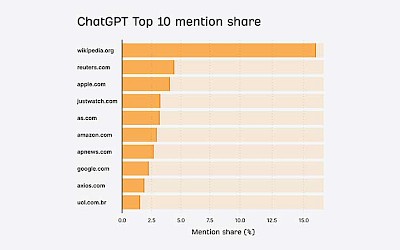
Comparison of the 10 most important domains for AI visibility in ChatGPT
Step 8: External mentions (webutation)

External validation is much more valuable for AI models than self-communication. The majority of your brand mentions in AI Search come from independent third-party sources.

  • Mentions on are important: Trade and industry media, review and comparison platforms, news and publisher websites.
  • Contextual backlinks from thematically authoritative domains.
  • Complete profiles on relevant review platforms.
Step 9: Strengthen organic visibility in search engines

Many LLMs rely on traditional search engines for live research.The better your organic visibility, the higher the probability of an AI citation.

  • Unlike in the early SEO days: Optimise not only for head keywords, but for long-tail keywords, questions and semantic variants.
  • Ensure stable top 10 rankings around your core topics to secure brand authority.
Step 10: Make demonstrable expertise visible

AI Search delivers a single answer - trust is crucial. Users must therefore trust your brand even with a single AI answer.

  • Show expertise, e.g. via author profiles with qualifications and professional experience.
  • Place certificates prominently.
  • Back up statements with trustworthy sources.
Step 11: Include user-generated content

Users are increasingly checking AI answers based on real experiences. Your brand should also be present where AI answers are checked.

  • Establish a presence on platforms such as Reddit, YouTube and specialist forums.
  • Encourage authentic testimonials and discussions.
  • Observe where your target group seeks social validation.

Video summary of how to become visible in ChatGPT step by step

To activate this YouTube video, you must agree to the marketing cookies.

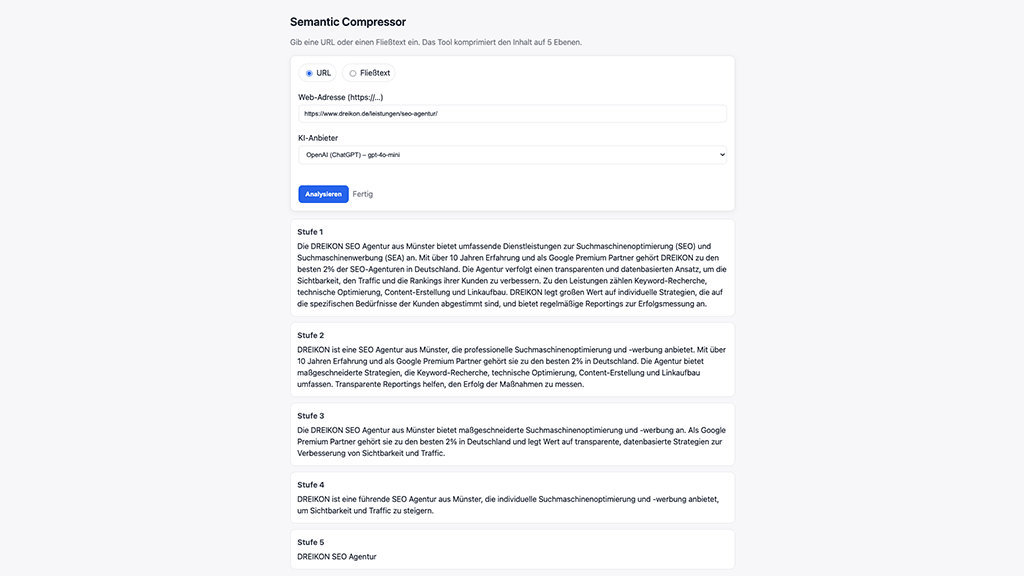
We provide you with our free tool for semantic compression. Semantic compression means that AI systems summarise a lot of content from different sources into a single, condensed answer. This is so important for AI Search because only content that is clearly structured, unambiguous and trustworthy will be included in this summarised answer in the first place.

Why is semantic compression important for your brand?

The advantage for your brand is that its content is more easily selected, correctly interpreted and more frequently summarised in AI answers because it provides clear statements instead of interpretable text areas.
Good semantic compression thus increases the likelihood that the brand will not only be mentioned, but also perceived as an authoritative source for a topic.

The most common misconceptions about AI visibility

  1. "We rank well, so we are also visible in AI"
    High Google rankings do not guarantee mentions in AI responses.
    LLMs select content selectively - often independently of traditional rankings.
  2. "AI simply uses our website"
    In many cases, AI systems do not even access websites live or cite without sources. Without strong brand and third-party source signals, your website simply won't be found.
  3. "More content solves the problem"
    Quantity is no substitute for relevance. Unstructured or overly offensive keyword-driven content is often ignored by AI systems.
  4. "SEO will take care of it"
    Traditional SEO is necessary, but not sufficient. AI visibility follows other mechanisms: Selection instead of ranking, trust instead of click-through rate.
  5. "AI objectively shows the best results"
    AI does not evaluate neutrally, but on the basis of training data, preconceptions and external signals. If you don't actively influence these mechanisms, you leave visibility to chance.
  6. "We are too specialised / too small for ChatGPT & Co."
    Niche providers in particular can benefit greatly - if they are clearly structured as an entity. Without clear positioning, however, they are completely overlooked.
  7. "We don't see any losses, so everything is fine"
    AI Search reduces clicks without rankings dropping immediately. The loss of visibility often remains invisible for a long time.
  8. "Once optimised is enough"
    AI systems continue to learn. If you don't continually optimise, you lose relevance - even with good content.
  9. "Tools show us how visible we are"
    Many tools only measure AI visibility to a very limited extent, which means that companies usually make decisions based on incomplete or incorrect data.
  10. "AI SEO is a future topic"
    For many industries, it is already a present topic. Those who wait will later optimise against established competitors and established models.
Lea Sandmann, Team Lead and SEO expert

Act now before the AI decides!

AI Search doesn't give second chances. Have a free and non-binding initial consultation to check how visible your website really is for AI systems - and which strategic steps are crucial now.

Are you still wondering why you are not finally visible in ChatGPT?