


What are the top 10 search engines in China?
The most important facts in brief
- China is the largest online market in the world: with around 1.125 billion internet users, China offers enormous potential for companies that want to grow internationally.
- BUT: The Chinese search market functions fundamentally differently to the international market - local platforms dominate and Western providers hardly play a role.
- "Great Firewall": International services such as Google or ChatGPT are only available to a limited extent, while local AI and search systems increasingly characterise digital search in the Chinese market.
- Baidu is the most important search engine in China and the central entry point for visibility and search engine marketing for many companies.
- Different search behaviour: Search in China does not only take place on search engines; platforms such as Taobao, Tmall or Weibo are equally relevant for product search and brand research.
- Local factor: Successful marketing requires local adaptation - content in simplified Chinese, Baidu-optimised SEO structures and presence in Chinese platform ecosystems.
All information on the top 10 search engines in China at a glance
- A comparison of the 10 largest search engines in China
- Why is Google hardly used in China?
- What marketing opportunities do companies have in Chinese search engines?
- What role does ChatGPT play in China?
- Conclusion: What is the best search engine in China?
- FAQ: Frequently asked questions about Chinese search engines
- Our services in the area of "International Marketing"
A comparison of the 10 largest search engines in China
This is what the 10 largest search engines in China look like

Why is Google hardly used in China?
Due to internet censorship, the country demanded that Google censor search results, block certain websites and provide user data if necessary. As Google was not prepared to do this, the search engine was blocked. In this way, China is specifically promoting its own tech companies, which we will describe below. These framework conditions have led to a situation where Chinese providers almost exclusively share the market share of the largest search engines in China.

International visibility is no coincidence.
Successful companies systematically occupy new markets - with international SEO, GEO strategies and data-driven online marketing. Those who become visible early on secure a decisive competitive advantage. Start your non-binding initial strategy consultation with DREIKON now.
What marketing opportunities do companies have in Chinese search engines?
Companies can become visible in Chinese search engines primarily through SEO and paid search engine advertising (SEA). Especially on Baidu, optimised content in simplified Chinese, fast loading times and local domains play an important role for good rankings. In addition, platforms such as Baidu Ads, Sogou Ads or 360 Ads offer the opportunity to place adverts for specific keywords. In addition to traditional search engines, platform searches on websites such as Taobao, Tmall or Weibo are also becoming increasingly important. Successful marketing in China therefore often combines search engine optimisation, paid advertising and presence on relevant platforms in order to build reach, trust and demand among Chinese internet users.
What are the fundamental differences to other search engines such as Google & Co?
The biggest differences between Chinese search engines and Western search engines such as Google lie in regulation, ranking factors and platform integration. In China, search engines are subject to state control, which is why content can be censored or filtered. In addition, local content, Chinese language and Chinese domains play a greater role in rankings. While Google focuses heavily on content quality, user intent and high-quality backlinks, Chinese search engines often pay more attention to keyword relevance and the number of backlinks. In addition, adverts and platform services are often more strongly integrated into the search results. Companies must therefore adapt content specifically for the Chinese market in order to be successfully visible there.
Global SEO only works if you really understand local search logic.
What role does ChatGPT play in China?
ChatGPT currently only plays a limited role in China, as the service is not officially freely available in the country. Access to OpenAI services is restricted by Chinese internet regulation, meaning that many users can only access ChatGPT via VPN or alternative means.
Instead, Chinese technology companies have developed their own AI chatbots and generative AI systems. These include Baidu ERNIE Bot (Wenxin Yiyan), Alibaba Tongyi Qianwen, Tencent Hunyuan and iFlytek Spark. These systems fulfil similar functions to ChatGPT, but are adapted to Chinese regulatory requirements and are more closely integrated into local platform ecosystems.
For companies, this means that while ChatGPT plays an important role internationally in marketing, content management and automation, local AI models and platform solutions are primarily used in China. These are developing rapidly and are becoming increasingly important for search, content creation and digital services in the Chinese market.

Create websites, landing pages and content in simplified Chinese and adapt keywords to Chinese search habits. Content should be culturally, linguistically and thematically tailored to the Chinese market.
Optimise your website specifically for Baidu ranking factors: fast loading times, hosting in China or Hong Kong, local domains (.cn) and clear keyword structures will significantly improve your visibility.
In addition, use important platforms such as Baidu Ads, Taobao, Tmall or Weibo to build reach. In China, visibility is often achieved through a combination of search engines, e-commerce platforms and social media.
Baidu vs. Google: These are the most relevant differences
Features | Google 🇺🇸 | Baidu 🇨🇳 |
|---|---|---|
Focus market | Global | Exclusively Chinese market |
Censorship | Low | Government regulation |
Language | Multilingual | Highly optimised for Mandarin |
Order of search results |
|
|
Relevance of paid advertisements | Important for visibility, but separate from organic ranking. | Paid ads play a much greater role. Often, many of the first results are ads, and higher bids can greatly influence the position. Multiple ad placements are possible. |
Relevance of organic content | Strongly algorithmically evaluated (content quality, backlinks, user relevance) | Important, but more strongly overlaid by ads and platform services. In addition, local content and Chinese domains play a greater role. |
Metadata |
|
|
Off-page factors |
|
|
AI relevance | Strong integration of AI (AI overviews, semantic search, generative results) | AI present, but more strongly integrated into the Baidu ecosystem |

If you want to be visible in China, you need more than classic SEO. With international SEO, GEO strategies and a deep understanding of platforms, we develop marketing strategies that work even in complex markets. Let's build your international visibility together.
Baidu.com
If a Chinese search engine is compared to Google, it is Baidu. With a market share of around 70 per cent, Baidu is the most used and most popular search engine in China. For many companies, Baidu is therefore also the best search engine in China for reaching new customers. Baidu was listed on the stock exchange just 5 years after it was founded in 2000. Every month, 787 million people use the search engine.
Sogou
The second largest search engine in China is Sogou. It has overtaken Qihoo behind market leader Baidu in recent years. This is because Sogou is the only standard search engine in China's largest communication platforms, WeChat and Tencent's qq. Sogou is used to classify online information. This includes news, images, maps, clips and music.
360.com
360.com, also known as Qihoo 360, is one of the best search engines in China and is one of the most important platforms alongside Baidu and Sogou. In contrast to Baidu, where it is advisable to use Mandarin, 360.com is only available in Chinese. Even though its market share has shrunk in recent years, companies that want to be successful on the Chinese market cannot ignore Qihoo.
Tencent QQ / qq.com
The Chinese instant messaging service Tencent QQ is used with the Microsoft Windows, Linux and Mac OS X operating systems. The platform was founded in 1998 and the portal site qq.com went online in 2003.
Taobao
Taobao is a Chinese online auction platform, but also a search engine. The platform was founded in 2003 and has been part of the Alibaba Group ever since. Taobao is one of the most popular websites in China and is only available in the local language.
Weibo.com
Similar to Taobao, the largest Chinese microblogging service Sina Weibo is also only available in Chinese. The platform belongs to the Sina Corporation and is regularly monitored by government agencies. This is a measure that was introduced as part of internet censorship. Blocked terms are automatically filtered with the help of keyword lists.
163.com
The web portal 163.com, which belongs to NetEase Inc., is also only available in the local language. In 2008, 1.8 million Internet users used the web portal. This also includes the music streaming service music.163.com, where users can not only listen to music for free, they can also download it.
Ifeng.com
Ifeng.com is not only a Chinese search engine, but also a comprehensive web portal. Users can find the latest news, multimedia content and reports on topics such as business, finance, entertainment, fashion, sport, cars, technology and science. Ifeng.com is also only available in the national language of China.
Tmall.com
Tmall.com is one of China's smaller search engines. It was launched in 2008 under the name "Taobao Mail". Despite its comparatively small market share, Tmail offers several advantages for B2B consumers. Especially for German companies that want to establish themselves on the Chinese market.
Firefoxchina
Firefoxchina belongs to Mozilla China and was an important search engine on the Chinese market. However, the local offering was discontinued at the end of 2025. This means that the domain firefox.com.cn can no longer be accessed. However, the global version is still running and internet users are redirected to it if they want to access firefoxchina.
Conclusion: What is the best search engine in China?
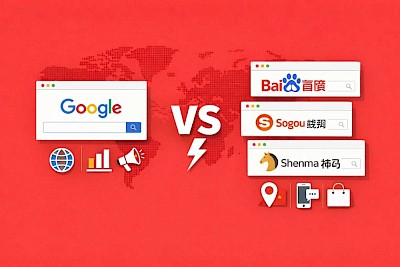
Nevertheless, one clear winner can be named: Baidu remains by far the most important search engine in China and is usually the central entry point for search engine marketing for companies. At the same time, the comparison table shows that the Chinese market is significantly more fragmented than the international search market. In addition to traditional search engines, platform searches on Taobao, Tmall or Weibo play an important role, as users search there specifically for products, brands or information.
For Western companies, the biggest stumbling blocks are language, regulation, infrastructure and platform logic. Content must be created in simplified Chinese, technically adapted and aligned with local search habits.
In the next 3-5 years, the market is likely to develop further in the direction of AI-supported search, platform ecosystems and integrated services. Providers such as Baidu in particular will integrate generative AI more strongly into their search systems and thus create new marketing opportunities. International AI systems such as ChatGPT currently only play a minor role in China, while local AI models are increasingly shaping the development of digital search.
FAQ: Frequently asked questions about Chinese search engines
The most widely used and popular search engine in China is Baidu. Sogou and Qihoo are also among the best search engines in China. Suitability always depends on the purpose and goal.
There are many local tech companies in China. The most popular search engines include Baidu, Sogou, Qihoo and Tencent qq.
Many internationally known search engines cannot be used in China, or only to a limited extent. The reason for this is the so-called ‘Great Firewall’, a system of state internet regulation that blocks or controls access to numerous foreign websites and services. Search engines that do not comply with Chinese censorship requirements or whose content is outside state control are particularly affected.
Since Google did not want to implement the strict internet censorship requirements, the search engine was blocked in 2010. The requirements include, among other things, the censorship of certain search results. Other international search engines such as DuckDuckGo, Startpage, Ecosia and Qwant are also blocked in China.
One exception is Microsoft Bing, which is still partially available. However, Bing is also subject to state regulations in China and displays filtered search results accordingly.
Sources
StatCounter Global Stats, Statista, Baidu Investor Relations, Tencent company reports and public data from the Baidu, Sogou, Qihoo 360, Taobao, Weibo, NetEase (163.com), Ifeng and Tmall platforms.

Global visibility needs strategy.
International markets rarely work according to the same rules as Google. With international SEO, GEO and cross-channel online marketing, we develop strategies that work even in complex markets. Let's work together to expand your international visibility.














About the author Matthias Kampmann
Matthias Kampmann is a partner and managing director of the digital agency DREIKON. With over 20 years of experience in search engine optimisation and more than 15 years of expertise in Google Ads, he advises companies strategically on SEO, GEO and sustainable online marketing.