


Which search engine is the best?
Why is this question more important today than ever before?
Search engines are our gateway to the digital world – whether we’re looking for information, products or news. But which search engine is the best? The answer depends on more than just market share.
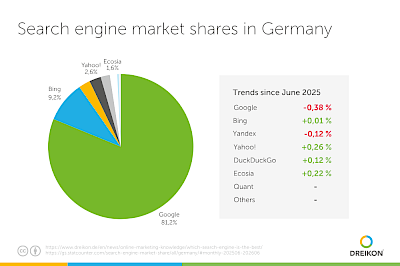
Google dominates the market in Germany with over 81.43 per cent, and globally with as much as 91.27 per cent (June 2026, statcounter.de), but data protection, sustainability and ethical standards are becoming increasingly important. In this article, we take a look at Google and its alternatives – from DuckDuckGo to Ecosia – and show what really matters when choosing the right search engine.

Our analysis of the best search engines in Germany
- What makes a good search engine?
- Google - market leader with downsides
- Bing - The alternative from the Microsoft universe
- DuckDuckGo - The search engine for the privacy-conscious
- Ecosia - The search engine that plants trees
- Qwant - European search engine with GDPR focus
- Swisscows - Family-friendly and safe
- Further alternatives at a glance
- AI-based search engines: A new era of search?
- DREIKON recommendation
- Conclusion: Which search engine is the best?
The most important facts in brief:
- Google is the market leader, but it is not the only option: it has a market shareof over 90 %, yet data protection, ethics and relevance are becoming increasingly important.
- Data protection is gaining ground: search engines such as DuckDuckGo, Startpage and Swisscows do not track users or create user profiles.
- Eco-friendly searching: Ecosia uses advertising revenue to fund global reforestation projects – ideal for sustainability-minded users.
- AI is transforming search: Perplexity and WolframAlpha provide direct, context-based answers instead of traditional lists of results.
- Specialised search engines have the edge: MetaGer , Qwant, Mojeek and Yacy offer genuine alternatives – particularly for sensitive searches.
Search engine market shares in Germany
| Search engine | Market share in Germany 06/2025 | Market share in Germany 01/26 | Market share in Germany 06/2026 | Trend over the last 6 months |
|---|---|---|---|---|
86,58% | 81,82% | 81,44% | -0,38% | |
Bing | 5,97% | 9,17% | 9,18% | 0,01% |
Yandex | 2,99% | 2,70% | 2,58% | -0,12% |
Yahoo! | 2,00% | 2,36% | 2,62% | 0,26% |
DuckDuckGo | 1,53% | 1,93% | 2,05% | 0,12% |
Ecosia | 1,00% | 1,40% | 1,62% | 0,22% |
Quant | <1% | <1% | <1% | - |
Overige | <1% | <1% | <1% | - |
What makes a good search engine?
Is user data stored? Is there tracking or personalized advertising?
Search engines such as DuckDuckGo, Startpage, MetaGer or Swisscows offer high standards - no profiles, no saved search histories, complete anonymity. These are important factors when deciding which search engine is the best for data-sensitive users.
A large and up-to-date index is crucial. Google dominates here, but services such as Mojeek and Yacy also rely on their own web crawlers for more independence. If you attach particular importance to comprehensive results, you should also take this into account when deciding which search engine is the best for in-depth research.
How is sorting done? Are there filter bubbles? Semantic sorting?
Swisscows (semantic), Qwant (neutral) or DuckDuckGo (non-personalized) rely on alternatives to the classic ranking.
Advertising revenue, transparency and sustainability are becoming increasingly important. Ecosia finances reforestation with clicks - a criterion that is becoming increasingly relevant in the question of "which search engine is the best".
Child-proof, sorted by topic or AI-based - depending on the target group, the range of functions is decisive.
Google - market leader with downsides
Google is by far the most frequently used search engine in the world. This is not least due to its powerful algorithms, which are based on years of data evaluation and user analysis. With a market share of over 90 %, it dominates the search engine market almost unrivaled. Its web crawlers continuously search billions of websites and ensure comprehensive indexing. The efficiency of Google's web crawlers contributes significantly to the topicality of the search index. So it's no wonder that many users think: Which search engine is the best? - Google, of course!
Advantages and disadvantages at a glance
| Advantages | Disadvantages |
|---|---|
Extremely fast and up-to-date search index | Extensive data storage and creation of user profiles |
Powerful algorithms that recognise search intent | Creation of filter bubbles through personalised rankings |
Integration with numerous services such as Maps, Gmail and YouTube | Partially opaque prioritisation of paid content |
Personalised search results, tailored to individual search history | Significant monetisation through advertising |
Bing - The alternative from the Microsoft universe
As a competitor to Google, Bing is often underestimated. However, anyone wondering which search engine is the best should definitely include Microsoft’s search service in their considerations for 2026. In Germany in particular, Bing has become significantly more relevant: rather than being seen merely as a minor alternative to Google, Bing now holds a market share of around 9% here, making it the second most important search engine.
One reason for this is its close integration into the Microsoft ecosystem: Bing is linked to Windows, the Edge browser, Microsoft 365 and Copilot, giving it a strong presence particularly in professional settings and for B2B research. Despite still trailing significantly behind Google, Bing is thus holding its own as one of the few serious alternatives in the search engine market.
Advantages and disadvantages at a glance
| Advantages | Disadvantages |
|---|---|
Integration with Windows & Microsoft Office | Smaller search index than Google |
Excellent image & video search | Results sometimes appear outdated or imprecise |
Rewards scheme via Microsoft Rewards | Focus on the English-speaking world |
Partnerships with other providers (e.g. Ecosia, DuckDuckGo) |
DuckDuckGo - The search engine for the privacy-conscious
DuckDuckGo is a solution for savvy users who take data protection seriously and want to avoid tracking. For anyone wondering which search engine is best when it comes to protecting privacy, DuckDuckGo is one of the most compelling alternatives.
The search engine completely avoids personalised advertising, does not store IP addresses and provides every user with identical, non-personalised results. This is precisely why it is becoming increasingly popular in data-sensitive sectors – such as medicine, the legal sector and research. Whilst many search engines rely more heavily on AI-generated answers, DuckDuckGo positions itself as more objective and less of a digital advisor, depending on the search scenario. This can be an advantage: anyone looking for neutral results without extensive profiling will find a Google alternative suitable for everyday use here.
For many standard web and image search results, DuckDuckGo draws on Bing, amongst other sources. As a result, DuckDuckGo offers solid result quality without utilising the same level of personalisation as Google.
Advantages and disadvantages of DuckDuckGo at a glance
| Advantages | Disadvantages |
|---|---|
No storage or sharing of user data | The relevance of results varies for niche topics |
No tracking, no personalised advertising | Partial use of Bing results |
Clear design and fast loading times | Fewer additional services than Google |
No filter bubbles |
Ecosia - The search engine that plants trees
Anyone who wants not only to find answers but also to do some good often asks themselves: Which search engine is best if environmental values matter too? The answer could be Ecosia – a green search engine that plants trees. According to the company, over 250 million trees have now been planted.
But Ecosia is relevant in 2026 for more than just its sustainability credentials. Together with Qwant, Ecosia is working on an independent European search infrastructure. The long-term aim is to reduce dependence on major US search providers and to create greater digital sovereignty in the European search market.
When it comes to the question of which search engine is best, Ecosia is particularly well-suited to users who are looking for a Google alternative suitable for everyday use and who prioritise sustainability, data protection and European independence over the widest possible range of results or complete personalisation.
Advantages and disadvantages of Ecosia at a glance
| Advantages | Disadvantages |
|---|---|
Carbon-neutral operation, full transparency through monthly reports | No proprietary search index |
Use of advertising revenue for sustainable projects | Quality of results dependent on Bing |
Privacy-focused handling of user data | Not a completely ad-free solution |
Search results based on Bing technology |
Qwant - European search engine with GDPR focus
In the context of European data protection standards, many users are asking themselves: Which search engine is the best when it comes to legal certainty and independence? Anyone who attaches great importance to digital sovereignty will, sooner or later, ask themselves: Which search engine is best for EU citizens, public authorities and public institutions? Qwant – a search engine from France that positions itself as a European alternative – provides a strong answer to this question.
Qwant has its own search index and is therefore technologically independent. Instead of creating user profiles or displaying personalised adverts, Qwant focuses on data protection, transparency and equal treatment. In 2026, Qwant will gain further prominence through its collaboration with Ecosia. Through the European Search Perspective, both providers are driving forward a European search index infrastructure. The aim is to reduce dependence on major international search providers and to strengthen a more independent European alternative in the search engine market.
Qwant is therefore particularly appealing to users who prefer a privacy-friendly search engine from Europe . Although Qwant remains less dominant than Google in a direct comparison and does not perform equally well in every search scenario, it offers clear added valuefor anyone who prioritises privacy, transparency and European digital sovereignty.
Advantages and disadvantages of Qwant at a glance
| Advantages | Disadvantages |
|---|---|
Complies with European data protection regulations (GDPR) | More limited search index compared to Google |
No storage or sharing of search history | Design is in some cases outdated or incomplete |
Special variants such as Qwant Music or Qwant Junior | Not yet on a par with major competitors on mobile devices |
Focus on relevance rather than commercialisation |
Swisscows - Family-friendly and safe
Here, too, the question arises: Which search engine is the best if children, families or educational institutions want to surf safely? Swisscows offers an answer to this question. The Swiss search engine combines data protection with content filters and does not store any personal data at all.
With servers located exclusively in Switzerland, a focus on semantic relevance instead of personalized results and the automatic hiding of violent and erotic content, Swisscows clearly sets itself apart from traditional providers. Which search engine is the best for parents, teachers or companies with high compliance requirements? Swisscows provides many arguments.
Advantages and disadvantages of Swisscows at a glance
| Advantages | Disadvantages |
|---|---|
No storage of user data | Limited range of features |
Server locations exclusively in Switzerland | Less suitable for adult content |
Automatic filters for harmful content | Low brand awareness and market share |
Focus on semantic relevance |
Further alternatives at a glance In addition to the special search engines mentioned, there are other providers that work in a data protection-friendly and target group-specific manner.
- Open source metasearch engine
- No creation of user profiles
- Results come from several sources, as a form of metasearch MetaGer bundles these results in a standardized display
- Particularly suitable for neutral &
- Provides anonymized Google results, but draws on the market leader's comprehensive search index
- High anonymity, no personalized advertising
- Ideal for users who appreciate Google's quality but want to protect their user data
- Despite lower market share, Startpage gains relevance due to data protection advantages
- Independent search index without reference to Google or Bing
- No tracking, no results based on advertising revenue
- Still limited hit density, but technologically exciting
- Lycos is one of the oldest search engines on the web, active since the 1990s
- In addition to web search, also offers e-mail services and a web portal
- Today with a focus on niche users and legacy user groups
- Less well known in Europe, but still online
- AI-supported search engine with a focus on direct, context-related answers
- Uses modern language models instead of classic web crawlers
- Combines web search with generative AI &
- Calculation-based answer engine
- Particularly strong in mathematics, statistics, physics &
- Searx is a meta search that obtains its results from various sources such as Google, Bing or DuckDuckGo
- The platform does not use its own web crawlers and instead relies on external data sources
- The decentralized structure enables particularly privacy-friendly use without central control
- This makes Searx one of the most flexible open source search services available.
- Peer-to-peer search engine with distributed search index
- Completely independent, but technically sophisticated
- Ideal for developers, research environments and net activists, although lacking a classic metasearch, it offers similar benefits through its decentralized infrastructure.
- Yacy uses a distributed network of nodes that collect content collaboratively
- Oscobo is a privacy-oriented search engine without securing IP addresses or user data
- No tracking, no user profiles, no personalized advertising
- Ideal for users who are looking for maximum identity protection and at the same time value ease of use

Ready for the next step?
Which search engine is the best? You may have already answered this question for yourself, but if you want to be found better yourself, we will be happy to help you.
Arrange a non-binding initial consultation now!
AI-based search engines: A new era of search?
With the advent of artificial intelligence, the question ‘Which search engine is the best?’ takes on a whole new dimension. Alongside traditional search engines, AI-based search systems will become significantly more important by 2026. Traditional web crawlers and algorithmic indexes are reaching their limits – modern AI models not only analyse web pages, but also understand context, user intent and language patterns. They therefore do not merely provide a list of links, but formulate direct answers, summarise information and help users make sense of complex questions more quickly. This fundamentally changes the search experience: users will need to compare fewer individual results, but should scrutinise the answers provided more closely in terms of source quality, timeliness and transparency.
The key AI search solutions for 2026
The most important AI-powered search solutions include Google, with AI features in its search function ; Bing, with Copilot integration; ChatGPT Search; Perplexity; and specialised answer systems such as WolframAlpha. Whilst Google and Bing are increasingly integrating AI into traditional search, providers such as Perplexity and ChatGPT Search are focusing more on dialogue-based research with source references. You.com and Andi also rely on AI-powered answers and are said to be particularly helpful for academic or creative research. Anyone who carries out research regularly will find themselves asking more and more often: which search engine is the best when it’s no longer just about links, but about content?
When are AI search engines particularly helpful?
AI search engines are particularly well-suited when users need quick guidance, summaries or an initial assessment of complex topics. However, when dealing with legal, medical, financial or highly topical issues, it remains important to check the sources and not to accept every AI response at face value.
Another advantage is that many of these services are privacy-friendly. They do not store any personal information and do not track users – a plus for anyone who, when considering ‘which search engine is the best’, wants to rely not only on performance but also on ethical standards.

DREIKON recommendation
If you are looking for an optimal search engine, it helps not to focus exclusively on the market leader. The question "Which search engine is the best?" cannot be answered universally, but it can be answered individually.
Our recommendation:
- Test different services specifically over a period of one to two weeks.
- Consider not only the user experience, but also aspects such as anonymity, data processing, transparency and user guidance.
- Use different search engines for different purposes - e.g. DuckDuckGo for research, Ecosia for everyday questions, Startpage for data-sensitive content and WolframAlpha is much better suited to technical or scientific topics than conventional standard search engines.
- For comprehensive searches, a metasearch is ideal for comparing content from different perspectives.
Because even in the digital space, diversity creates perspective.
Conclusion: Which search engine is the best?
| Target audience / Requirements | Recommended search engine(s) |
|---|---|
Efficiency & comprehensive results | Google, with the largest search index and the highest global market share, Perplexity |
The Microsoft ecosystem & career research | Bing |
Privacy-conscious users | DuckDuckGo, Startpage, MetaGer, Swisscows, Mojeek |
Sustainability-minded individuals | Ecosia |
Education, families, schools | Swisscows, Qwant Junior, FragFinn |
Technical research / developers | Mojeek, Searx, Yacy |
European data protection focus | Qwant, MetaGer, Ecosia |
Science & fact-based sources | WolframAlpha, Ahmia |
Fast, context-based answers via AI | Perplexity, ChatGPT Search, Bing Copilot, Google-zoekfunctie met AI-functies |
Even in 2026, there will still be no single ‘best’ search engine. Which solution is most suitable depends primarily on what users hope to achieve with their search. For quick, everyday searches, local queries and a wide range of results, Google remains the strongest choice. At the same time, alternatives such as Bing, DuckDuckGo, Ecosia, Qwant and AI search engines have established themselves more clearly, depending on the area of application.
As a general guide:
- Google is the best all-round search engine for most everyday search queries.
- Bing is particularly appealing to users within the Microsoft ecosystem, for example through its integration with Windows, Edge, Microsoft 365 and Copilot.
- DuckDuckGo is suitable for anyone who wants greater data protection, less tracking and a less personalised search experience.
- Qwant is a suitable European alternative for users who place greater emphasis on privacy and digital sovereignty.
- Ecosia is the best choice if sustainability, reforestation and climate protection are important factors in your search.
- Startpage is suitable for users who want to combine Google-like results with greater data privacy.
- Perplexity and ChatGPT Search are useful for AI-powered research, quick summaries and more complex queries.
- WolframAlpha remains a specialised solution for calculations, fact-finding and scientific topics.
For most users, Google will therefore remain the best everyday search engine in 2026. However, those wishing to search more consciously will find useful alternatives depending on their priorities: Bing for Microsoft users, DuckDuckGo or Qwant for greater data privacy, Ecosia for sustainable searching, and AI search engines for research and guidance. The best choice is therefore not always a single search engine, but rather the right search engine for the specific purpose.

You now know which search engine is the best, but are you being found?
Whether Google, DuckDuckGo or Ecosia: Choosing the right search engine is only the first step. If you want your company to be visible in a targeted way, we can support you with the right strategies.
Let's optimize your visibility together.
Arrange a non-binding initial consultation now!
FAQ - Frequently asked questions Frequently asked questions about deciding which search engine is the best in various areas.
Services such as Startpage, DuckDuckGo, Qwant and MetaGer are considered particularly secure. They do not store user data, do not create user profiles and do not track users.
Ahmia, Searx, MetaGer and Oscobo can be used completely ad-free or largely ad-free. These search services are not funded by advertising revenue and deliberately focus on an ad-free user experience without tracking.
Startpage, on the other hand, does display adverts, but only context-based, non-personalised ones – making it a privacy-friendly alternative with moderate advert integration, whilst completely avoiding data-based user profiles, which further protects privacy.
Meta search engines such as MetaGer or Searx access multiple external sources, filter the results and present an overview – often without their own web crawlers. As meta search engines rely on third-party providers, the quality of the results displayed also depends heavily on the available links.
A metasearch engine aggregates results from several search engines simultaneously – such as Google, Bing or DuckDuckGo – and displays them in a single interface. This allows users to benefit from a broader database and a wider range of perspectives without having to search multiple platforms individually. A metasearch engine offers a real efficiency advantage, particularly for cross-platform research.
FragFinn or Blinde Kuh offer filtered and verified content for children and young people. Swisscows is also very family-friendly thanks to its content filters.
Mojeek and Yacy each operate their own search index and do not use interfaces to Google or Bing. Technically, these services may not be able to compete with the undisputed market leaders, but they offer a high level of data protection and transparency.
Unlike a traditional search engine such as Google or Bing, WolframAlpha does not provide lists of links, but instead calculates direct answers based on complex algorithms. The platform particularly excels at mathematical, scientific or data-based queries, thanks to its ability to generate precise results without resorting to a traditional web search.












About the author Timo Wormuth
Timo Wormuth is a partner and managing director of the digital agency DREIKON. His passion for digital systems began as a child and still characterises his work today. With many years of experience in digitalisation, IT and management consulting, he supports clients in strategic decisions relating to communication and digital processes.