



Enter a prompt to check the AI visibility
Reading time:10 minutes
Written by: Lea Sandmann

AI visibility: Why companies need to rethink marketing

27.05.2026 — 

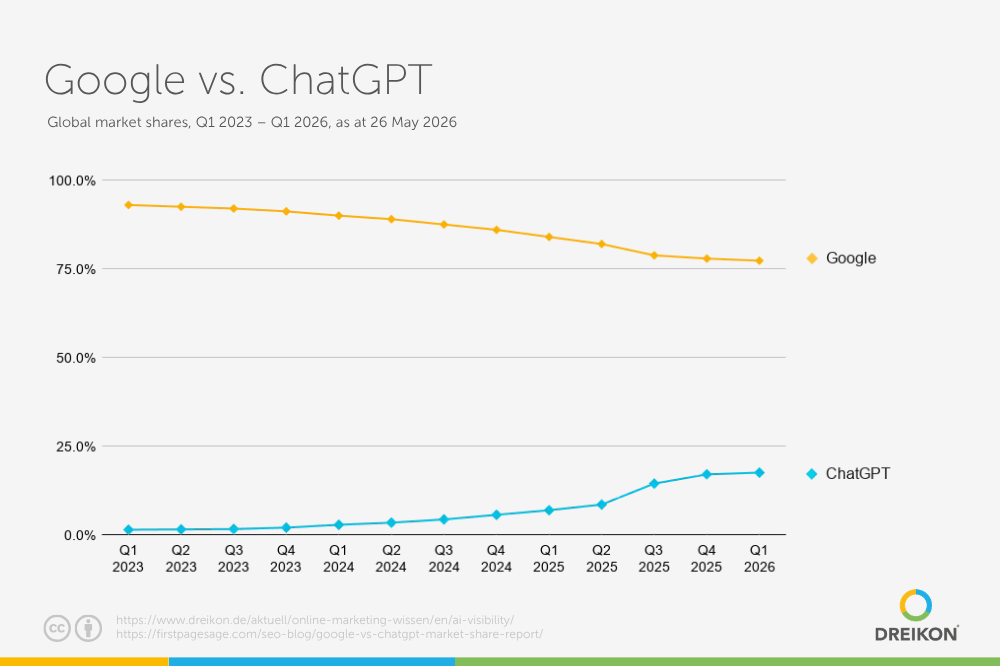
AI systems are currently changing the logic of digital visibility: anyone who wants to be digitally present today is no longer just competing for clicks - but for digital authority within AI-generated answers. While users used to primarily compare search results, systems such as ChatGPT, Gemini, Perplexity and Google AI Overviews now provide directly formulated answers, recommendations and categorisations.

For companies, this means that visibility is no longer generated exclusively through Google rankings, but increasingly through whether AI systems understand a brand at all, categorise it correctly and consider it as a relevant source.

Many companies still believe that AI visibility is simply SEO with AI texts. This is an illusion.

Lea Sandmann, strategist for AI visibility at DREIKON

The most important facts about AI visibility in a nutshell:

  • AI systems are fundamentally changing how digital visibility, relevance and digital authority are created
  • Good Google rankings alone will no longer be enough in future - AI visibility is created across all channels via SEO, PR, social media, expert profiles and external mentions
  • AI evaluates companies holistically according to structure, expertise, reputation, consistency and semantic comprehensibility
  • Knowledge silos, inconsistent communication and generic AI content are increasingly becoming a visibility and trust problem
  • New KPIs such as citation rate, share of voice, AI visibility and extractability score show that AI visibility is becoming a strategic organisational task instead of a pure SEO discipline

The next visibility crisis won't happen at Google - but in AI systems

The public discussion surrounding AI often centres on automation, efficiency or content production. However, another effect is much more relevant for marketing and digital visibility: AI is becoming the new level of orientation on the internet.
Today, many users no longer jump directly into traditional search engines, but start their research within generative systems. Instead of comparing ten websites, they have providers summarised, differences explained or market overviews created.

Lea Sandmann, SEO & GEO Strategist

Many companies are already losing visibility in AI systems - without realising it.

Good Google rankings are no longer enough when AI systems re-evaluate brands, content and expertise. In a free and non-binding consultation, we analyse together how visible your brand really is within generative AI systems - and where critical gaps arise before they become real competitive disadvantages that cannot be made up for.

Differences between classic SEO and AI visibility

Traditional searchAI-powered search

Users click on links

Users receive direct answers

Rankings are the focus

Source relevance is becoming more important

Individual landing pages dominate

Thematic connections are gaining in importance

Search volume is key

Contextual understanding is becoming more relevant

Keywords drive visibility

Entities and authority influence visibility

Clicks are the core metric

Mentions and citations are gaining in importance

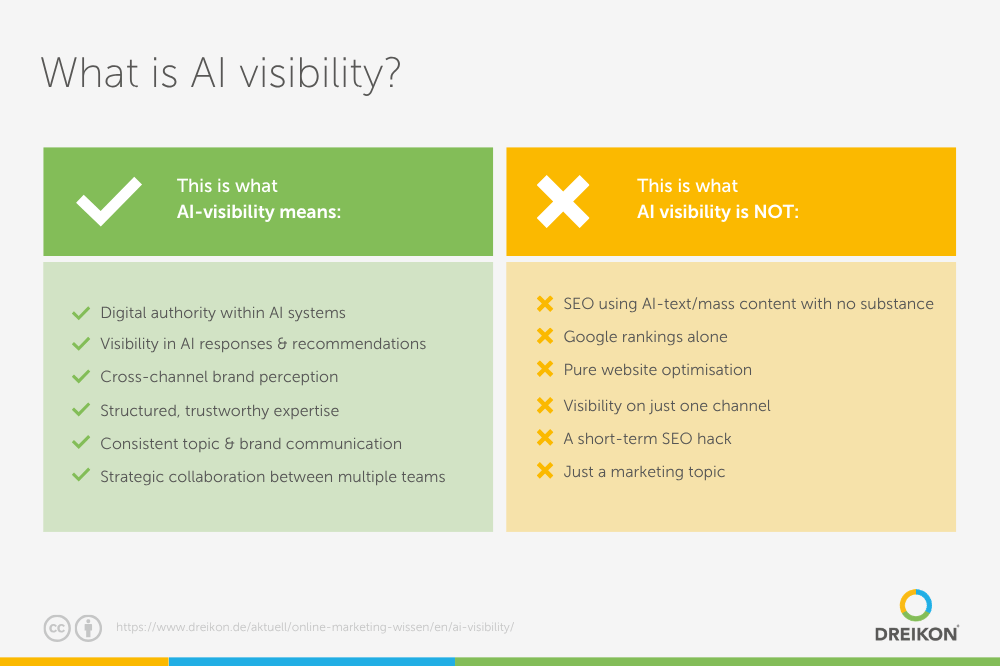
What AI visibility is NOT: These SEO reflexes are becoming a real problem

Many companies are still reacting to AI Search with classic SEO reflexes - and often even exacerbate their visibility problems as a result. This is because AI systems evaluate content in a more complex way than traditional search engines. Generic AI content mass production or pure search volume strategies become significantly less effective when AI systems attempt to recognise the actual and, above all, comprehensive expertise of an entire BRAND and no longer just a single WEBSITE.

  • More AI content does not automatically mean more AI visibility
  • Good Google rankings do not guarantee visibility in AI systems
  • AI visibility is more than SEO
  • Mass content does not replace digital authority
  • Search volume is not automatically more important than expertise
  • Your own website alone is no longer sufficient for digital visibility
  • AI systems do not automatically favour the largest amount of content
  • Thought leadership is not created by generic AI texts
  • Visibility is not just about rankings
  • AI does not understand companies via individual landing pages alone
  • More content does not automatically mean more trust
  • AI visibility is not created in isolation within a channel

What does AI visibility mean for companies?

AI systems no longer evaluate companies solely on the basis of individual pages. They try to capture an overall digital picture: Topics, reputation, expertise, external mentions and consistency suddenly become part of the same perception.

Which sectors are affected by AI (in)visibility?

In the B2B sector, information-intensive industries such as software, industry, IT, healthcare, consulting and SaaS are particularly affected. This is massively changing the customer journey of the once very long decision cycles. Recommendations from AI are increasingly replacing long research and comparison processes.

But other sectors are also coming under increasing pressure. In e-commerce, for example, AI systems are increasingly developing into active shopping assistants. Users are no longer just searching for products manually, but are also having recommendations, comparisons or complete product selections generated directly by AI. And it is becoming even more convenient: with so-called agentic commerce or agentic checkout systems, AI assistants could even prepare or carry out purchase processes independently in the future. From the digital fitting room to the checkout, everything could take place away from the company's own websites and shops. AI visibility is increasingly becoming one of the key economic factors for companies. Similar developments are also emerging in other sectors:

  • Travel and tourism through AI-supported travel planning,
  • Automotive through intelligent vehicle advice,
  • Real estate through automated market and location analyses,
  • healthcare through AI-supported information systems,
  • education through personalised learning and research assistants.

AI systems interpret companies like digital knowledge spaces

One of the biggest changes is in how AI systems process information. For a long time, search engines primarily indexed documents. Generative systems, on the other hand, attempt to structure knowledge. As a result, companies are interpreted more like digital knowledge spaces.

This becomes crucial:

  • Which topics are recognisably part of the company?
  • Which terms appear consistently?
  • Which expertise is repeatedly confirmed?
  • What connections can be derived?
  • Which sources support this categorisation?

It is not the loudest brand that automatically gains visibility, but often the most comprehensible, consistent and technically clear.

What does AI visibility mean for my website?

Traditional SEO has long been strongly website-centred. Good content, clean technology and strong rankings led to visibility. Even if the basics of good SEO remain largely relevant, AI visibility is significantly more complex. The basics of SEO are being expanded in an interdisciplinary way: unlike in classic SEO, AIs do not primarily interpret companies based on individual landing pages, but instead try to capture an entire digital picture:

  • Which topics does a company occupy?
  • What expertise is confirmed externally?
  • What content exists outside the company's own website?
  • How consistent is the communication on different channels?
  • Which sources mention the brand?
  • Which experts are visible for certain topics?
  • What do customers say about their experiences with the brand, the products/services and how problems are handled?
  • Does the company strive for customer satisfaction, do they respond to online reviews or do they tend to remain silent and passive?
  • Is the brand present on social media; if so, what happens there and how often?

This significantly shifts the relevant visibility signals. Specialist articles, studies, reviews, social media activity, podcasts, conference contributions, expert profiles or mentions in industry media suddenly become part of the same digital perception. AI visibility is therefore not created in isolation in SEO - but across all channels.

Most companies don't have a content problem. They have a structural problem.

Matthias Kampmann, Managing Partner and SEO/GEO expert since day one

The reality: In many companies, existing knowledge lies in the digital nowhere

Your company probably has significantly more expertise than AI systems can currently recognise. In many companies, relevant information is only available

  • in PDFs,
  • sales presentations,
  • meetings,
  • internal documentation,
  • individual employees.

Many organisations still work in silos. This results in contradictory messages, inconsistent topics and fragmented knowledge structures. AI systems are making these problems visible for the first time. Or rather: this knowledge does not exist in practice for generative systems. AI systems reveal the invisibility of central brand messages.

And this is precisely where the greatest potential for AI visibility lies for most companies! Because if this knowledge can be made accessible, this is a real advantage for brand authority.

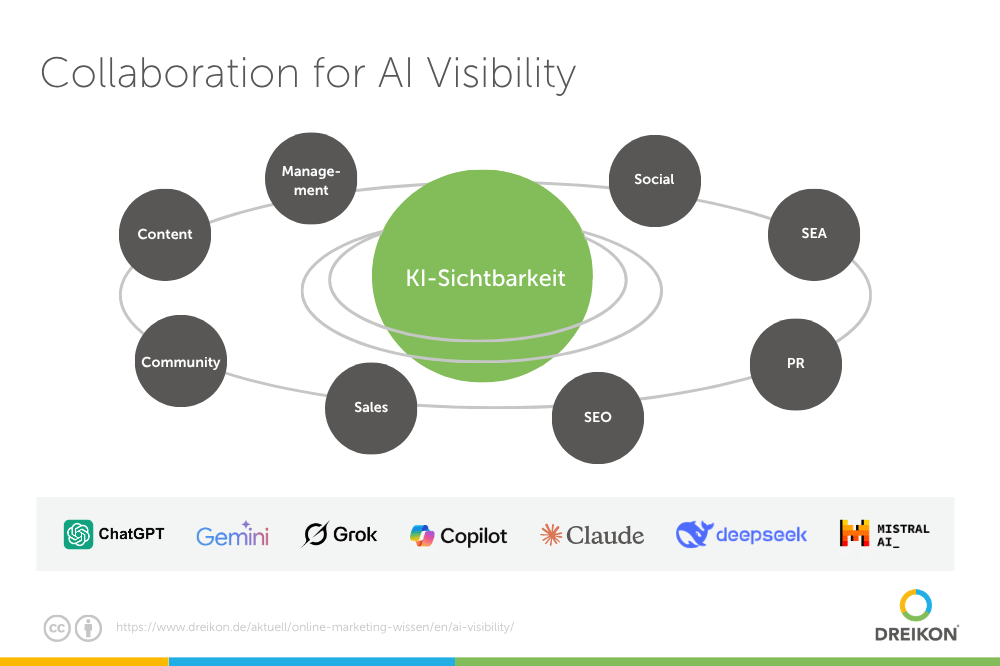
Departments responsible for AI visibility

  • Business Management
  • SEO
  • PR
  • Corporate Communications
  • Brand
  • social media
  • Personal Branding
  • Content Marketing
  • Performance Marketing
  • Product Management
  • Knowledge Management
  • Sales and Distribution
  • consulting
  • Web Development
  • Technical Marketing
  • Community Management

Platforms & formats: How can companies best spread knowledge for AI visibility?

  • Trade media
  • Industry portals
  • Studies & Whitepapers
  • Expert contributions
  • Podcasts
  • Conference appearances
  • Webinars
  • LinkedIn profiles
  • LinkedIn posts
  • PR mentions
  • Guest posts
  • Interviews
  • Community Discussions
  • Reddit mentions
  • Knowledge Hubs
  • Glossaries & Wikis
  • Case Studies
  • Customer references
  • Review platforms
  • Social Signals
  • YouTube content
  • Video formats
  • Newsletter mentions
  • Digital brand mentions
  • Specialist forums
  • Partner websites
  • Co-marketing campaigns
  • Press portals
  • Speaker profiles
  • Author profiles
  • Structured company data
  • Entities & semantic links
  • Content distribution
  • Mentions by third parties
  • Citations & references
  • Public documentation
  • Product directories
  • Comparison platforms
  • AI-optimised knowledge databases
Lea Sandmann, Team Lead Online Marketing

AI visibility is not a one-man project, but a team effort.

It is becoming clear: Internal silo structures between departments are increasingly dissolving for AI visibility. The boundaries between SEO, PR, brand, social media, content marketing and more are becoming blurred. For companies, this also means that digital visibility is becoming much more complex in terms of organisation and communication. A neutral view from the outside is helpful in mastering this challenge and finding orientation for the new requirements. Getting to know us is free and non-binding - and often shows faster than any dashboard where the actual visibility problems lie.

Which KPIs are really relevant for AI visibility

With the growing importance of generative search systems, the KPIs of digital visibility are also changing. Traditional rankings are not losing their relevance, but are increasingly no longer sufficient to evaluate actual presence within AI systems. Instead, new metrics are emerging that focus more on mentions, source relevance and topic presence. AI visibility is often used as an overarching term.

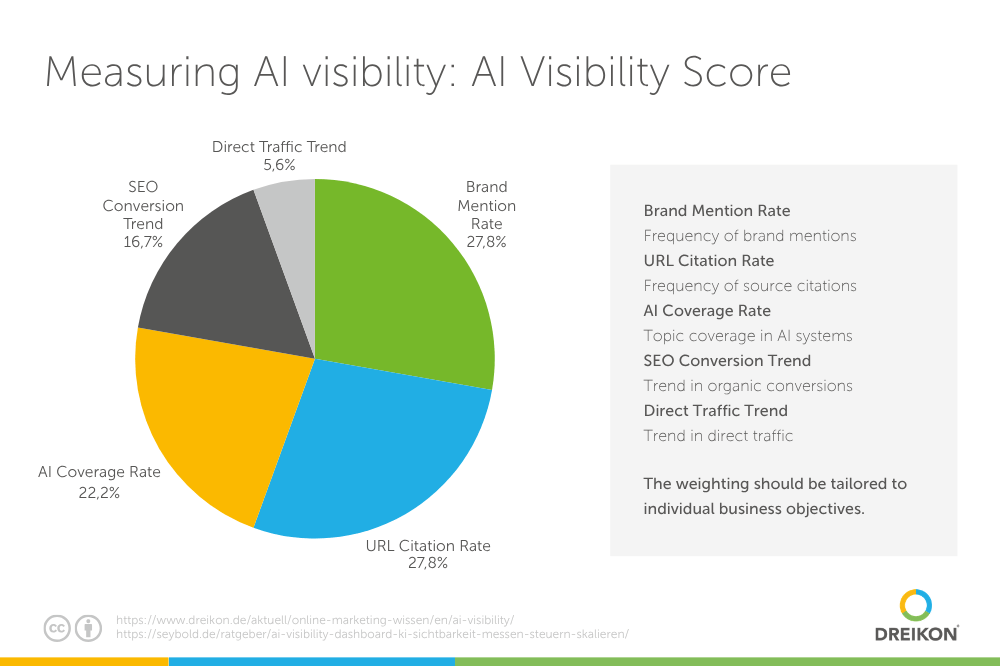
Measuring AI visibility: These are the new GEO KPIs

KPIDefinition

Brand Mention Rate

How frequently a brand is mentioned within AI-generated responses

Citation Rate

How frequently a company’s own URLs or content are cited as a source

AI Coverage Rate

The number of relevant topics for which a company appears within AI systems

Share of Voice (AI POV)

Share of visibility compared to competitors within generative responses

Visibility Score

Composite visibility score for evaluating overall presence within AI systems

Sentiment Score

Assessment of a brand’s tone and perception within AI-generated responses

Extractability Score

How well content can be processed technically and semantically by AI systems

Reviewed Mentions

How frequently content appears in curated or trusted response contexts

Entity Consistency

How consistently companies, services and topics are described digitally

Direct Traffic Trend

Trend in direct traffic driven by increasing brand awareness

Branded Search Trend

Trend in brand-related search queries

Citation Quality

Quality and authority of the citing sources

Weighting of the KPI in the evaluation of GEO & AI SEO 2.0

The so-called citation rate is particularly relevant here. This is because AI systems are increasingly source-based. Companies that are regularly referenced as a trustworthy source increase their thematic authority in the long term.
Equally important is the share of voice (SOV) within AI systems. Many companies currently only consider their own visibility - but not which competitors dominate in generative responses.

Another relevant area is the extractability score. This assesses how well content can be processed and extracted by AI systems. According to the AI Visibilty Dashboard from Seybold, the following factors, among others, play a role here:

  • clear H2/H3 structures,
  • executive summaries,
  • FAQ areas,
  • comparison tables,
  • structured data,
  • consistent entities,
  • semantically clean information architecture

Self-test: How AI-visible is your company really?

Many companies currently assume that good Google rankings automatically lead to visibility in AI systems. In practice, however, it quickly becomes apparent that generative systems place significantly higher demands on consistency, structure and digital authority. The following checklist helps to visualise typical weaknesses.

1. check strategic positioning
  • Can AI systems clearly recognise which topics your company really stands for?
  • Is your positioning consistent across all channels?
  • Are services described in the same way everywhere - or differently depending on the department?
  • Are there clearly defined topic clusters?
  • Does your company have recognisable thematic responsibilities?
  • Do competitors appear more frequently in AI responses for important topics?
2. compare content & knowledge structure actual & target status
  • Does your content answer real technical questions in depth and comprehensibly?
  • Are there structured knowledge hubs or just isolated individual articles?
  • Is the content semantically organised?
  • Do different teams use the same terminology?
  • Are there executive summaries, FAQs or comparative logic?
  • Is relevant knowledge publicly accessible - or only available internally?
  • Is specialised knowledge possibly only available in PDFs, presentations or meetings?
3. analyse digital authority, reputation & reviews
  • Is your company perceived as a relevant source outside your own website?
  • Are there any trade media mentions or expert articles?
  • Do relevant employees have visible expert profiles?
  • Does your brand appear together with relevant market players?
  • Is your content actively discussed or referenced?
  • Are there trustworthy external signals on your core topics?
  • Are you rated? If so, how? Do you respond to praise and criticism?
4. implementation of AI visibility: resources, organisation & processes
  • Are there clear responsibilities for AI visibility?
  • Do SEO, PR, content, paid media and sales work together strategically?
  • Are there processes in place to consolidate knowledge?
  • Can new findings be quickly translated into visible content?
  • Is there monitoring for AI mentions or citations?
  • Are topics strategically prioritised or produced purely campaign-oriented?
5. bundle results: Technical & semantic structure
  • Does content have a comprehensible information architecture?
  • Is content logically structured and easy to extract?
  • Is structured data used sensibly?
  • Can AI systems clearly recognise relationships?
  • Are there consistent entities and topic relationships?
  • Is your website more of a marketing flyer - or a real knowledge space?

AI visibility is no longer a pure SEO discipline

This is because AI visibility not only affects search engine optimisation, but also all digital and internal communication. Many organisations still work in silos. This results in contradictory messages, inconsistent topics and fragmented knowledge structures. AI systems are making these problems visible for the first time.

What companies should do now

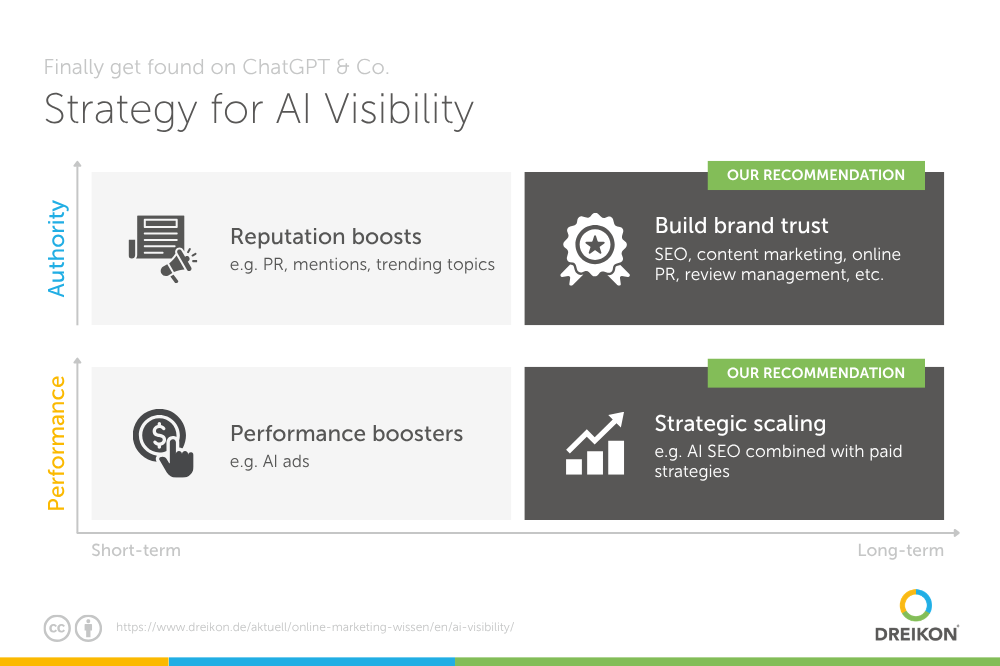
The most important step is not to produce AI content as quickly as possible. The first crucial step is to understand your own digital knowledge structure.

Companies should first analyse their current state of knowledge management and their current AI visibility score . The difference between their own perception and the reality of AI visibility quickly becomes clear here. It is important to see large discrepancies not as an attack, but as an opportunity and a wake-up call . Companies that respond openly and self-critically to this wake-up call still have the chance to gain visibility. But it is also true that the window of opportunity in which something can still be changed is getting smaller and smaller. Every month of inactivity can be costly in the future.

AI systems expose hidden brand messages and penalise them with merciless invisibility.

Lea Sandmann, strategist for AI visibility at DREIKON

Conclusion: AI visibility AI visibility is becoming a strategic corporate issue

AI visibility is much more than just a new marketing term. The development is fundamentally changing how companies are perceived, categorised and evaluated digitally. In future, visibility will no longer be based on individual rankings, but on an interplay of expertise, structure, reputation, topic authority and digital consistency.

Many companies are currently underestimating the organisational implications of this development. This is because they often lack not only technical GEO expertise, but above all

  • cross-channel coordination,
  • consistent topic architecture,
  • structured knowledge organisation,
  • clear responsibilities,
  • standardised digital communication.

This is precisely where it will be decided in future which companies will remain visible in AI systems - and which will lose their digital relevance. This presents companies with new challenges that entail structural, organisational and communicative changes. But this is precisely where the opportunity lies: companies can now build their digital presence more consciously, clearly and strategically than ever before. Consistently organising content, knowledge and brand messages not only improves visibility in AI systems, but also strengthens the trust, relevance and competitiveness of the entire brand in the long term. No matter which channel, which department in the company, which employee, which presentation. In future, the central question will therefore no longer just be: "How do we rank on Google?", but increasingly: "How does AI actually understand our brand?".

FAQ: Frequently asked questions about AI visibility

What is AI visibility?

AI visibility describes a company’s presence within generative AI systems such as ChatGPT, Gemini, Perplexity or Google AI Overviews.

What is the difference between SEO and AI visibility?

SEO focuses primarily on search engine rankings. AI visibility, on the other hand, looks at how AI systems understand, interpret and integrate companies into their responses.

Why is traditional SEO no longer enough – surely Google is still important?

SEO remains important. Technical structure, crawlability, information architecture and high-quality content continue to form the basis of digital visibility. Nevertheless, the ranking logic is changing. Whilst traditional search engines operated in a highly document-oriented manner, generative systems attempt to understand contexts. AI evaluates not only keywords or individual URLs, but increasingly:
• Topic authority
• semantic consistency
• trust signals
• entities
• source quality
• content depth
• external validation

Why is digital authority becoming more important?

AI systems attempt to identify trustworthy sources. This is why external mentions, expert profiles, specialist media and consistent topic communication are gaining in importance.

How is AI visibility measured?

Currently, there are various approaches such as AI Visibility Scores, Brand Mention Tracking, Citation Monitoring or Share-of-Voice analyses within AI systems.

What is an AI Visibility Score?

An AI Visibility Score is a composite index used to assess visibility within generative AI systems. It combines factors such as brand mentions, URL citations and AI coverage rates.

What does Extractability Score mean?

The Extractability Score assesses how well content can be extracted by AI systems. Relevant factors include structure, semantic clarity, FAQs, tables, structured data and consistent entities.

What kind of content works particularly well for AI systems?

Particularly relevant are in-depth specialist content, structured knowledge pages, use cases, technical explanations, educational content and clear problem-solving solutions.

What role do PR and social media play in AI visibility?

External signals are becoming increasingly important. Trade media, expert profiles, LinkedIn content and industry articles help AI systems categorise companies by topic and establish digital authority.

Sources

  1. Overview
  2. SEO vs. AI SEO
  3. No-Gos
  4. for companies
  5. for websites
  6. Responsibilities
  7. Platforms & Formats
  8. KPI
  9. Self-test
  10. AI strategy
  11. Conclusion
  12. FAQ