


ChatGPT Advertising - is the future of advertising in AI responses?
ChatGPT Ads are no longer just a prediction for the future. Since August 2026, businesses in Germany have also been able to place adverts on ChatGPT. Worldwide, over 100,000 advertisers have already made use of this new channel, which is now available in 89 countries (as of October 2026).
The real change lies not only in the new advertising channel, but in when and in what context companies reach potential customers. This is because users are increasingly researching, comparing and finalising their purchase intentions directly whilst conversing with ChatGPT.
This raises the question for marketing managers: how can ChatGPT Ads be used cost-effectively and meaningfully combined with SEO, GEO and traditional SEA? Digital visibility is no longer determined solely by traditional search results.
Advertising no longer simply follows search queries. It is increasingly influencing decisions.
The most important facts about ChatGPT Ads in brief
ChatGPT Ads are available in Germany. Since 31 August 2026, advertisers have been able to create and manage campaigns independently via the OpenAI Ads Manager.
Ads appear in relevant ChatGPT conversations, are labelled as adverts and are separated from the independent AI responses.
Ad delivery takes into account, amongst other things, conversational context, user intent, ad content and so-called ‘context hints’.
Various campaign and optimisation models are available to advertisers, including CPM, CPC and conversion-optimised variants.
Conversion tracking is possible via the OpenAI Pixel, the Conversions API and supplementary tracking methods.
ChatGPT Ads complement traditional SEA and organic AI visibility, but do not replace Google Ads, SEO or GEO.
Whether ChatGPT advertising is worthwhile depends on the target audience that can be reached, the campaign costs and the actual financial outcome.
What are ChatGPT Ads – and how does advertising work in AI conversations?
ChatGPT Advertising refers to paid advertising placements within the ChatGPT user environment. The adverts can be tailored to the context of a conversation and the user’s discernible intent. The aim is to make products, services and brands visible precisely when users are grappling with a relevant problem, a need or a specific decision.
Unlike traditional search adverts, the need does not have to be identifiable solely through a single search query. Users can clarify their requirements within a conversation, ask follow-up questions and compare different solutions. ChatGPT Ads thus enable advertising interactions within dialogue-oriented research and decision-making processes.
However, it is important to distinguish between advertising and independent AI responses: adverts are clearly labelled and, in accordance with OpenAI’s published advertising principles, do not influence ChatGPT’s responses. Companies are therefore purchasing a paid placement, but not a preferential organic recommendation.
Who sees adverts in ChatGPT?
ChatGPT Ads are not shown to all users. Adverts appear primarily in the ad-supported Free and Go plans. Paid plans such as Plus, Pro and Business are ad-free. Adverts are also not shown to minors. Furthermore, OpenAI avoids displaying adverts in sensitive conversational contexts. For advertisers, this means that the potential reach does not automatically encompass the entire ChatGPT user base. The key factor is whether their own target audience can be reached within the eligible user groups.
This is what the ads currently look like on ChatGPT:
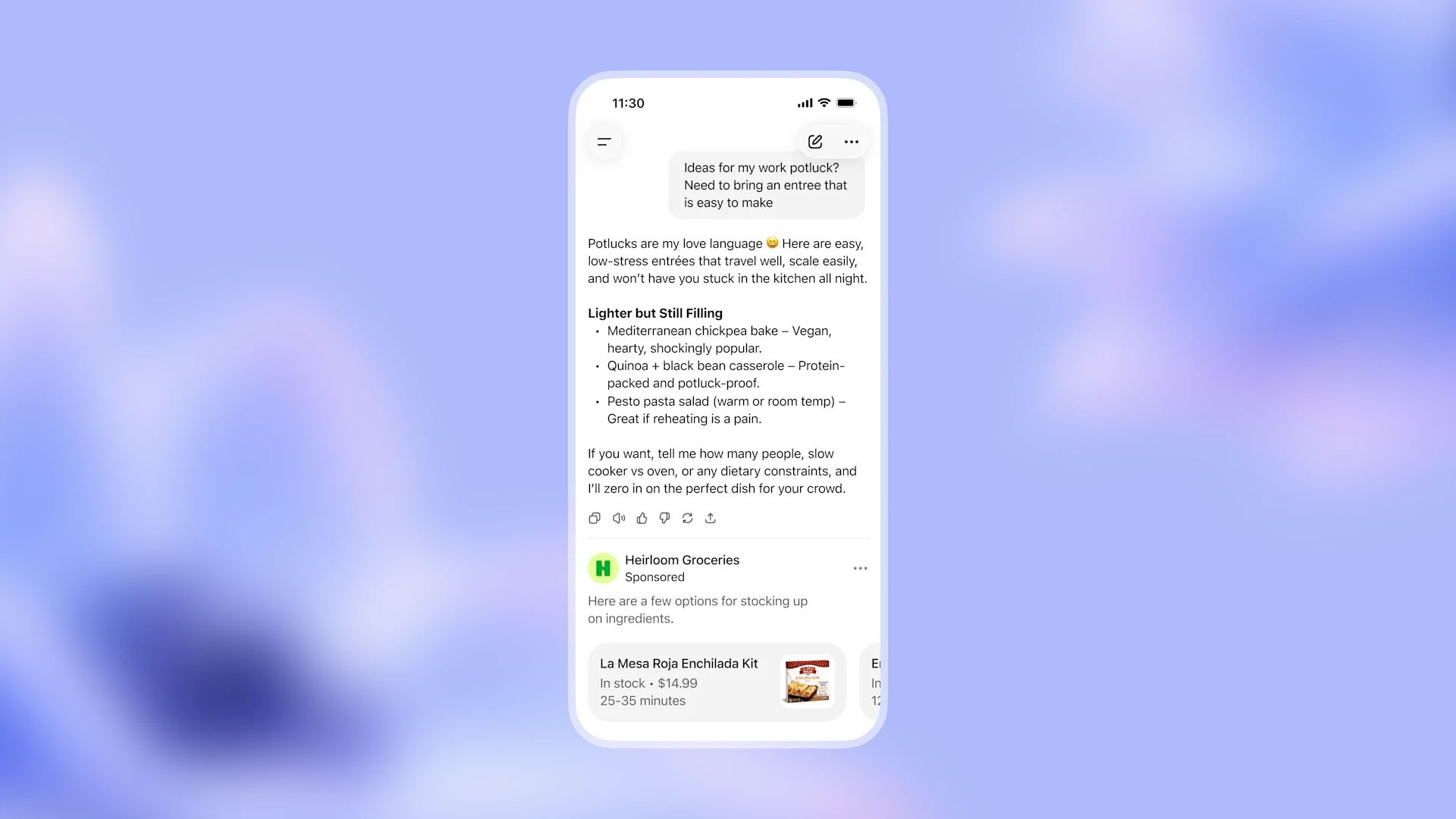
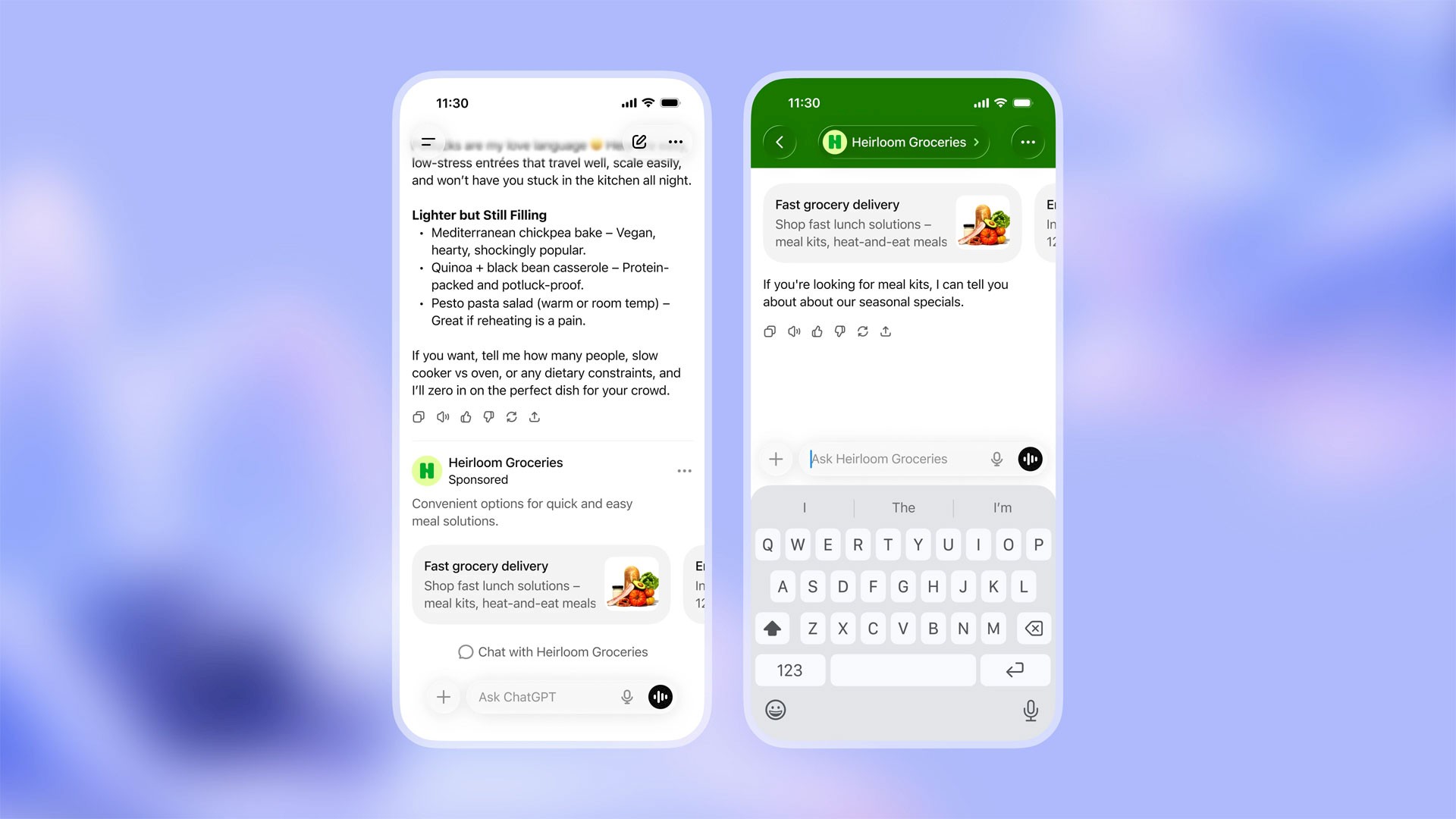
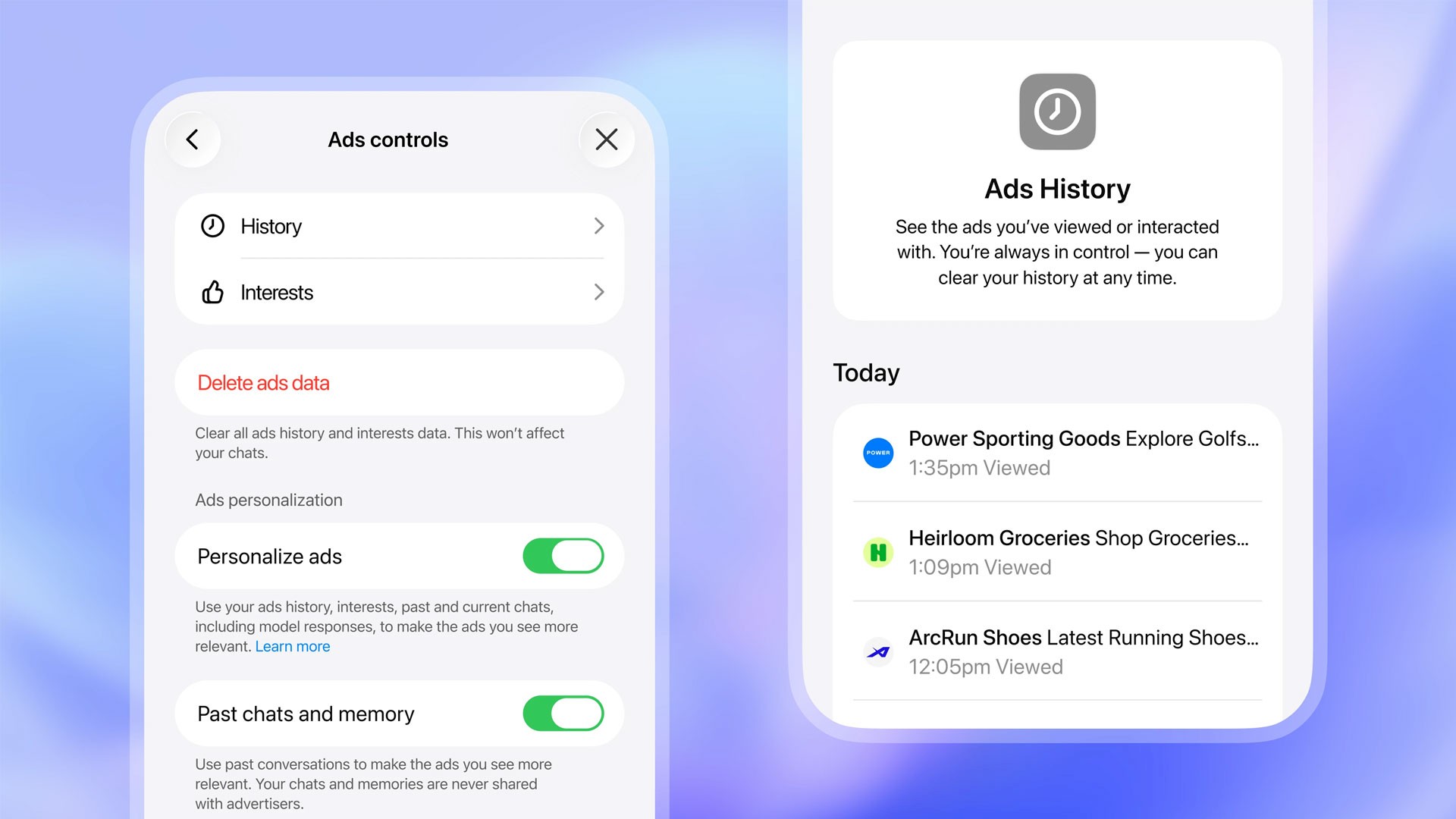

Ads alone aren’t enough; you need to use ChatGPT Advertising strategically
An advert in the right conversational context attracts attention. However, whether this results in a qualified lead or a customer depends on far more factors: an understanding of the target audience, the advertising message, the landing page and performance measurement must all align. DREIKON combines ChatGPT advertising with traditional performance marketing, SEO and GEO. We view paid advertising and organic AI visibility as distinct yet complementary components of an overarching strategy. After all, advertising presence can be booked, whilst digital authority must be built up.
Why ChatGPT Advertising is becoming relevant now
More and more people are using ChatGPT to research information, compare products and get help with decision-making. Unlike traditional web searches, they can refine their queries over the course of several conversational exchanges. This creates additional touchpoints within the customer journey where targeted advertising can be relevant.
For example, a user does not simply search for ‘CRM software for SMEs’, but describes the company size, functions and interfaces that are crucial to them. The course of the conversation therefore potentially provides more context about their needs than an isolated search query. However, this does not mean that ChatGPT replaces traditional search engines. Rather, its use is spread across additional search and response systems.
Operating high-performance AI systems incurs significant infrastructure and development costs. Advertising enables OpenAI to help fund free and low-cost access to ChatGPT, whilst at the same time tapping into new sources of revenue.
Since advertising trials began in February 2026, OpenAI has significantly expanded its advertising business. In August, the company reported an annualised revenue of one billion US dollars from ChatGPT Ads. Its international expansion indicates that advertising is set to become an integral part of its business model.
ChatGPT Ads can reach users in situations where they are actively looking for a solution, comparing options or preparing to make a purchase decision. This makes it possible to tailor advertising messages more closely to specific needs.
However, content that is rich in information is no guarantee of a high conversion rate. The decisive factor remains whether the users reached belong to the target audience and whether the advertised offer actually solves their problem.
How do ChatGPT Ads work technically?
Unlike traditional advertising systems, which are often based on individual search or usage events, ChatGPT Advertising has to deal with the flow of a conversation. Users’ intentions can change over the course of several questions. Not every conversation automatically presents a suitable opportunity for advertising. OpenAI has therefore developed its own system for ad selection. A specialised AI model supports the identification, evaluation and selection of relevant adverts. Technically, the delivery of adverts takes place separately from the generation of ChatGPT responses.
Context Hints – how does ChatGPT recognise relevant conversational contexts?
A distinctive feature of ChatGPT Ads is what are known as ‘Context Hints’. Advertisers can use these to provide additional information about products, services and relevant usage scenarios. A supplier of ergonomic office chairs could, for example, specify that its products are particularly suitable for setting up a home office workspace, for prolonged sitting or for users with higher ergonomic requirements. This information helps the ad system to recognise potential relevance patterns. However, Context Hints are not exact-match keywords and do not guarantee that an advert will appear in specific conversations. Whether an advert actually appears depends on other relevance, auction and security factors.
An example of Context Hints: A provider of accounting software could specify conversation scenarios such as ‘automating accounting for small businesses’, ‘digitising invoicing processes’ or ‘comparing accounting software for the self-employed’. These hints help ChatGPT to recognise suitable advertising contexts. However, there is no guarantee that an advert will be displayed for these specific phrases.
How does the ad system decide which adverts to display?
OpenAI uses a multi-stage selection process. First, potential adverts are identified and assessed for their suitability for the current context. The system then takes into account, amongst other things, the expected relevance, potential user reactions and the terms of the ad auction. The selection is carried out via a separate technical service. This is intended to prevent advertising expenditure from influencing the independent ChatGPT responses.

What targeting options are available with ChatGPT Ads?
ChatGPT Ads rely primarily on contextual targeting. Rather than focusing solely on individual search terms or traditional audience characteristics, the advertising system assesses, amongst other things, the current conversation context and the user’s discernible intent. Advertisers have a range of control options at their disposal:
Geographical targeting: Campaigns can be targeted at supported countries.
Context Hints: Advertisers describe relevant topics, problems and conversational contexts in which their offers might be of interest.
Platform targeting: Campaigns can be targeted at supported devices and platform environments.
Custom Audiences and Ad Personalisation: These features are subject to regional restrictions and are not currently available for campaigns in the European Economic Area and Switzerland.
Important for Germany: ChatGPT Ads can be served contextually in this country. However, personalised targeting based on previous ChatGPT usage or custom audiences is not currently possible. For German advertisers, therefore, relevant context hints, compelling ad content and suitable landing pages are particularly crucial.
What ad formats are available on ChatGPT Ads?
OpenAI is developing various advertising formats to raise the profile of businesses during the research and decision-making process. A distinction must be made between adverts that are already available as standard and new formats currently being trialled on a limited basis.
The basic format consists of labelled advertising elements that appear below relevant ChatGPT responses. They can draw attention to relevant offers and redirect users to a product, service or website. The advert remains separate from the actual response text. Placing an advert does not alter ChatGPT’s independent assessment or recommendation of an offer.
In October 2026, OpenAI announced visual adverts within the image-generation environment. This format will initially be tested with selected advertisers in the US. The adverts appear separately from the generated images. Back in September, OpenAI also introduced sponsored agents as a trial. This allows users, following an interaction with an advert, to communicate with an agent sponsored by the advertiser and receive further information. This could open up new opportunities for interaction, particularly for products that require further explanation. However, the general availability and actual performance of these newer formats must be assessed separately from the regular ChatGPT Ads offering.
How much do ChatGPT Ads cost?
The cost of ChatGPT Ads depends on competition, ad relevance and campaign settings. There is no fixed cost per click. OpenAI uses a relevance-weighted second-price auction, which takes into account not only the bid but also the expected relevance of an advert. Various billing models are available:
CPM (Cost per Mille): Billing per 1,000 impressions, particularly for reach and brand awareness.
CPC (Cost per Click): Billed per valid click, for example to generate website traffic.
oCPC (Optimised CPC): Conversion-optimised ad delivery whilst still using click-based billing.
oCPM (Optimised CPM): Conversion-optimised delivery with billing per 1,000 impressions.
The availability of individual models may vary depending on the advertising account. For CPC campaigns, OpenAI specifies an initial bid guidance range of US$3 to US$5 per click. However, this is not a guaranteed actual click price. What matters most for businesses is not just the advertising costs, but the results achieved. A higher cost per click can make economic sense if it generates qualified enquiries and new customers. ChatGPT Ads should therefore be evaluated on the basis of their conversion costs, lead quality and their actual contribution to business success.
How can the success of ChatGPT Ads be measured?
ChatGPT Ads now offer various ways to measure success. Using the OpenAI Pixel, the Conversions API and UTM parameters, businesses can track how users respond to adverts and what actions follow a click. The key metrics include:
Impressions and clicks: How often are adverts displayed and clicked on?
CTR and CPC: How do users respond to the adverts and what are the costs per click?
Conversions and conversion rate: How many users carry out a desired action, such as making an enquiry or a purchase?
Cost per lead: What is the cost of each lead generated?
However, particularly for B2B companies, it is not just clicks and conversions that are decisive, but the quality of the leads generated. Therefore, ChatGPT Ads should, where possible, also be evaluated on the basis of qualified leads, the sales opportunities generated and their economic contribution.
Integrations and attribution
ChatGPT Ads can increasingly be integrated with existing marketing and analytics systems. OpenAI supports, amongst other things, integrations with HubSpot and Shopify, as well as attribution solutions such as AppsFlyer, Triple Whale and Northbeam. Through these interfaces, businesses can consolidate conversion data and analyse the impact of their campaigns across various touchpoints. The available integrations and their scope of functionality vary depending on the provider and region.
ChatGPT Advertising in Germany
Since 31 August 2026, companies in Germany have been able to create and manage ChatGPT Ads independently via the OpenAI Ads Manager. The launch took place as part of the expansion into 31 European markets.
Legal framework in Germany and the EU
The introduction of ChatGPT Ads makes data protection and transparent advertising labelling specific requirements for campaign planning. The adverts are labelled as sponsored content and are separated from independent ChatGPT responses. Companies must also consider what personal data they themselves process in the context of tracking, audience targeting and conversion measurement. In particular, when using pixel technologies, the Conversions API and CRM data, the applicable data protection requirements must be assessed. The technical availability of a tracking function does not automatically mean that every use is permissible under data protection law. The specific implementation is decisive.
Relevance for German companies
For German companies, this creates an additional channel for reaching prospective customers during their research and decision-making processes. This can be particularly relevant for products requiring explanation, B2B services and offerings involving longer decision-making processes. However, early adoption is not an end in itself. Companies should assess whether their target audience can actually be reached via this channel and what additional business outcomes this will generate.

ChatGPT Ads boost visibility. But do they also bring in customers?
Reach and clicks alone do not justify an advertising budget. What really matters are qualified enquiries, conversion rates and business results. DREIKON helps you to use ChatGPT Ads in a targeted way, measure their success and realistically assess their potential.
What opportunities and risks do ChatGPT Ads present?
Opportunities presented by ChatGPT advertising
High user intent: Adverts reach users in a targeted manner whilst they are researching, comparing products or making specific decisions.
Enhanced brand awareness: Relevant adverts can improve brand perception and recognition during the decision-making process.
New touchpoints: Businesses can reach potential customers at various stages of the customer journey.
Performance potential: Contextual signals, bidding models and conversion tracking enable increasingly targeted campaign management.
Risks of ChatGPT advertising
Loss of trust: Inappropriate or intrusive advertising can impair the user experience and erode trust in the platform.
Data protection: The use of contextual signals raises questions regarding data processing and legally compliant tracking.
Brand safety: Companies must ensure that adverts appear in appropriate contexts that are consistent with their brand.
Limited experience: A lack of long-term data on costs, conversion rates and cost-effectiveness makes it difficult to assess the actual success of advertising.
ChatGPT Ads vs. Google Ads
ChatGPT Ads and Google Ads reach users in situations that are, in some respects, different. The differences mainly relate to the advertising environment and the opportunities to engage with users whilst they are conducting their research. ChatGPT Ads therefore do not replace traditional search engine advertising. Rather, they create an additional channel that can serve different or complementary touchpoints within the customer journey. Google Ads remains particularly relevant when users are already searching for specific products or providers. ChatGPT, on the other hand, can also play a role when users are initially grappling with a problem and only discover what solution they need as the conversation progresses.
| Feature | ChatGPT Ads | Google Ads |
|---|---|---|
Usage Environment | AI conversations and decision-making processes | Search, Shopping, Video, Display, and other environments |
Relevance Signals | Conversation context, user intent, context hints | Search queries, context, audiences, and automation |
Ad Placement | Clearly labeled ads in ChatGPT | Various Google advertising environments |
Pricing Models | Including CPC and CPM | Extensive bidding and optimization models |
Measurement | Pixel, Conversions API, and integrations | Established tracking and attribution tools |
Market Maturity | Available internationally, with ongoing expansion | Long-established advertising platform |

Get noticed now – right where your target audience makes decisions
ChatGPT Advertising expands the possibilities of digital advertising. At the same time, it remains crucial to determine which measures make financial sense for your business. DREIKON combines Google Ads, AI-SEA, SEO and GEO into an integrated visibility strategy. We help you identify new touchpoints, deploy campaigns in a targeted manner and assess their actual contribution to generating demand.
ChatGPT Ads increase visibility. AI SEO creates them.
ChatGPT Ads vs GEO: Can ChatGPT Ads replace missing organic visibility in AIs?
ChatGPT Ads cannot replace organic AI visibility. They enable paid ad placements, but do not automatically result in a brand being mentioned or recommended more frequently in independent ChatGPT responses.
GEO (Generative Engine Optimisation) extends SEO to meet the requirements of AI-generated responses. Key focus areas include relevant entities, grounding, digital authority, trustworthy sources, brand mentions and clearly structured content. GEO is not a ‘prompt hack’ and does not guarantee mentions. The aim is to strengthen a company’s digital presence and trustworthiness so that its content and offerings can be better categorised by AI systems.
Paid visibility complements digital authority
ChatGPT Ads generate controllable advertising impressions during active campaigns. GEO, on the other hand, takes a longer-term approach and improves the conditions for organic visibility. These two approaches can complement each other strategically. For example, a company can generate attention via ChatGPT Ads whilst simultaneously expanding its organic presence through high-quality content, external mentions and technical SEO fundamentals. However, the mechanisms remain separate. An advertising budget is not a direct ranking factor for independent ChatGPT responses.
ChatGPT Shopping – organic product visibility is not advertising
For e-commerce businesses, another distinction is important. ChatGPT offers shopping features that allow users to research and compare products and discover suitable offers. The organic product results displayed in this context are not automatically advertisements. A product can be found within the shopping features without the retailer having booked a ChatGPT advert. ChatGPT Ads, on the other hand, offer paid advertising placements. Organic product discoverability and paid visibility are therefore two distinct approaches that can complement one another within an e-commerce strategy.
AI Ads and AI SEO: A Direct Comparison
| Feature | Organic AI Visibility / GEO | ChatGPT Ads / AI-SEA |
|---|---|---|
Foundation | Relevance, authority, sources, and entities | Paid ad placements |
Control | Indirectly through optimization measures | Through budgets, campaigns, and settings |
Labeling | Organic responses, mentions, or source citations | Clearly labeled advertising |
Sustainability | Built over the medium to long term | During active campaigns |
Cost Structure | Investment in SEO, content, and digital reputation | Media budget and campaign management |
Funnel Impact | Research, comparison, and decision-making | Awareness, consideration, and conversion |
Measurability | Brand Mention Rate, Citation Rate, Share of AI Voice | Impressions, clicks, conversions, and cost per lead |
Strategic Role | Organic presence and trust building | Additional paid advertising touchpoints |
The table makes it clear: SEO remains the foundation. GEO enhances organic visibility in generative systems. AI-SEA creates additional opportunities for paid visibility. A successful AI marketing strategy does not view these measures in isolation, but in the context of target audiences, the customer journey and business outcomes.
Conclusion & forecast for ChatGPT Advertising
By 2026, ChatGPT Advertising had evolved from an experimental advertising format into an advertising channel available internationally. German companies are now also able to create campaigns independently and work with various booking models and conversion tracking. The key change is that advertising can increasingly be seen within dialogue-oriented decision-making processes. Users describe their problems, compare solutions and specify their requirements within a conversation. This creates additional touchpoints that companies can utilise strategically. At the same time, ChatGPT Advertising remains a complement to existing marketing measures. Google Ads remains important, SEO lays the groundwork for organic traffic, and GEO expands visibility within AI-generated responses. AI-SEA adds a new paid channel to this ecosystem.
For marketing managers, this means that getting started with ChatGPT Ads should not depend on a general ‘first-mover’ promise. What matters most are realistic audience potential, relevant campaign messages and a clear way of measuring success.
The future does not automatically belong to the companies that are the first to advertise on ChatGPT. It belongs to those who understand where their target audiences make decisions and what kind of visibility actually drives business results.

Secure competitive advantages early on: Dominate answers instead of just placing adverts
ChatGPT is becoming the go-to platform for research, advice and product comparisons. ChatGPT Ads generate additional advertising impressions during these decision-making processes. DREIKON shows you how to make strategic and cost-effective use of these opportunities.
FAQ - Frequently asked questions about ChatGPT Advertising
ChatGPT Ads are paid and labeled ad placements within ChatGPT. The ad delivery takes into account, among other things, the conversation context and the user’s discernible intent. Ads are separate from the independent AI responses.
Yes. Since August 31, 2026, companies in Germany have been able to create and manage advertising campaigns independently via the OpenAI Ads Manager.
Companies can set up campaigns via the OpenAI Ads Manager. There, they can specify ads, campaign goals, bids, and available targeting settings, among other things. It’s also possible to work with a specialized agency.
ChatGPT ads support various billing models, including CPC and CPM. The actual costs depend on competition, ad relevance, and campaign settings. There is no standard cost per click.
Ad delivery takes into account, among other factors, conversational context, user intent, and so-called context hints. Additionally, geographic settings and supported custom audiences are available. Context hints describe relevant usage scenarios but do not guarantee a specific placement.
Using the OpenAI Pixel, the Conversions API, and UTM parameters, companies can track clicks, conversions, and other campaign results. Qualified leads and the actual cost of customer acquisition are particularly crucial for B2B companies.
No. According to OpenAI’s published advertising policies, ads and independent ChatGPT responses are delivered via separate systems. Advertisers can therefore book ad placements but cannot purchase preferential organic recommendations.
No. ChatGPT Ads enable paid visibility within the AI platform. SEO and GEO, on the other hand, improve the conditions for organic discoverability, mentions, and recommendations.
Sources:
- https://help.openai.com/de-de/articles/20001207-ads-in-chatgpt-the-basics
- https://openai.com/de-DE/index/chatgpt-ads-expands-26-new-countries
- https://openai.com/de-DE/index/building-chatgpt-ad-stack
- https://help.openai.com/de-de/articles/20001210-creating-campaigns-for-chatgpt-ad
- https://openai.com/de-DE/index/new-chatgpt-ads-format-and-measurement
- https://openai.com/de-DE/index/testing-ads-in-chatgpt/
- https://ads.openai.com/de-DE














About the author Matthias Kampmann
Matthias Kampmann is a partner and managing director of the digital agency DREIKON. With over 20 years of experience in search engine optimisation and more than 15 years of expertise in Google Ads, he advises companies strategically on SEO, GEO and sustainable online marketing.