AI Overview
With AI Overviews, Google is integrating generative AI directly into search results, thereby changing the way users find information. Rather than simply linking to websites, Google already provides an AI-generated summary directly within the search results for many search queries.
Key points at a glance
- AI Overviews are AI-generated answers within Google search results that appear above the organic results.
- Google summarises information from various sources to provide users with quick and easy-to-understand answers to their questions.
- AI Overviews are changing visibility in search, as users are increasingly receiving information directly within the search results.
- For businesses, mentions and source links within AI Overviews are becoming increasingly important alongside search rankings.
- SEO remains the foundation for visibility, whilst GEO helps to optimise content specifically for AI-generated search results.
What are AI overviews?
AI Overviews are AI-generated answers that Google displays directly within the search results. They appear above the organic results and are designed to help users grasp information more quickly. Unlike traditional search results, AI Overviews do not consist solely of individual links, but of an automatically generated summary that combines information from various sources. Google’s aim is to answer complex questions more quickly and reduce the amount of research required by users.
Where do AI Overviews appear?
AI Overviews are displayed directly within the search results page (SERP). They are typically located:
- above the organic search results
- below any adverts
- visible even before the first traditional rankings
This makes them among the most prominent elements within Google Search. For many search queries, users receive the most important information in this section before they even click on a website.
What do AI overviews look like?
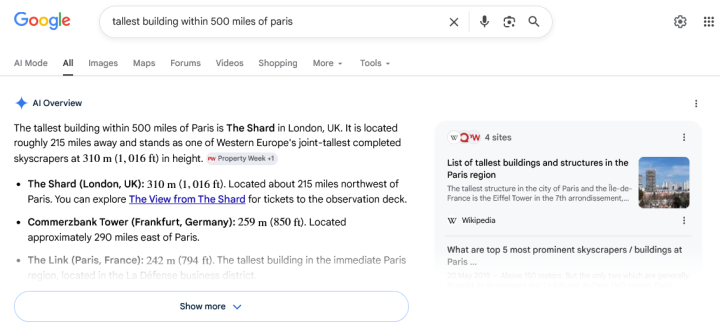
What content is included in the AI Overview?
Depending on the search query, AI Overviews can display different content:
- AI summaries, e.g. an explanation of a technical term
- Source links, e.g. links to websites
- Lists, e.g. the pros and cons of a product
- Comparisons, e.g. a side-by-side comparison of solutions
- Images, e.g. product or topic images
- Local information, e.g. places, providers or services
- Related questions, e.g. related search queries
The specific presentation depends on the search intent and the topic in question. The individual elements can also be presented in combination.
For which search queries does Google display AI Overviews?
- What is GEO?
- How does prompt engineering work?
- What does RAG stand for?
- SEO vs GEO
- ChatGPT or Gemini
- CRM systems compared
- How can I improve my visibility on Google?
- How do I write better prompts?
- How does GEO work in practice?
Why are AI overviews important for Google?
With AI Overviews, Google is responding to changing search behaviour and the growing prevalence of generative AI. Many users today no longer expect just a list of relevant websites, but rather answers to their questions that are as quick, clear and immediately actionable as possible.
Whereas search queries used to consist of just a few keywords, users now increasingly formulate their information needs as complete questions, problems or requests for advice. At the same time, AI systems such as ChatGPT, Perplexity, Claude and Gemini are gaining importance as alternative sources of information and research. This development presents Google with the challenge of not only finding suitable websites, but also processing information itself and providing it immediately. AI Overviews therefore enable Google to summarise content from various sources and display it directly within the search results.
What is the aim of AI Overviews?
The aim is to provide users with quicker guidance, present complex topics in a more understandable way and reduce the effort required for research. At the same time, Google is strengthening its position in competition with AI-powered search and answer systems and keeping users within its own search environment for longer.
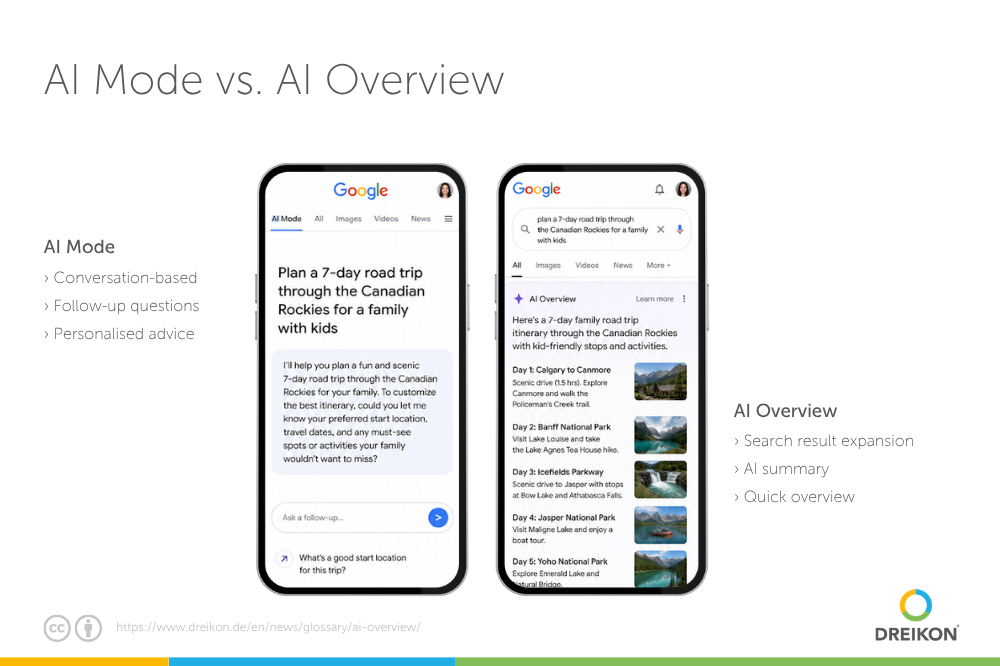
Is AI Mode a further development of AI Overviews?
AI Mode and AI Overviews have similar objectives, but differ in scope. In short: AI Overviews complement the search function, whilst AI Mode takes it a step further. The key differences at a glance:
- AI Overviews extend the traditional Google search, whilst AI Mode is a standalone search mode.
- AI Overviews provide a single AI summary, whilst AI Mode enables follow-up questions and conversations.
- AI Overviews are designed for quick orientation, whilst AI Mode also supports complex research and advisory enquiries.
- With AI Overviews, search results remain the focus; with AI Mode, the AI-generated response takes centre stage.
From a technical and strategic perspective, AI Mode can therefore be seen as a further development of the concept behind AI Overviews. Whilst AI Overviews supplement traditional search with generative AI, AI Mode evolves the search itself into an AI-powered response and advisory system.
What impact do AI overviews have on SEO? In terms of SEO, AI overviews are among the most significant developments of recent years.
In the past, the focus was almost exclusively on positions within organic search results. Today, additional visibility opportunities are emerging within:
- AI Overviews
- Featured snippets
- Knowledge Panels
- other AI-powered search features
Companies are therefore increasingly competing to be included as a source within an AI Overview.
As users receive answers directly in the search results, click-through rates may change. The likelihood of so-called zero-click searches is increasing, particularly for information-oriented search queries.
This means that users get their answer directly on the search results page and do not visit any other website.
Google must decide which sources are suitable for an AI-generated response. That is why factors such as:
- Expertise
- Trustworthiness
- Brand awareness
- Topic authority
are becoming increasingly important.
What do AI overviews mean for GEO?
AI Overviews are among the key reasons behind the emergence of Generative Engine Optimisation (GEO). Whilst SEO traditionally aims to achieve visibility in search engines, GEO also addresses the question: "How can content appear in AI-generated responses?".
AI Overviews show that search engines are increasingly moving away from simply linking to information and are instead summarising and presenting it themselves. For businesses, this means:
- Content must answer specific user queries
- Topics should be addressed holistically
- Expertise must be made visible
- Content should be structured in a way that is easy to understand
SEO remains the foundation. GEO complements this foundation with optimisation for generative search results.
Can companies be featured in AI Overviews?
In short: yes. Companies can be featured as a source within AI Overviews if their content appears relevant to the search query in question. Although there is no specific way to optimise for AI Overviews, companies can still improve their chances.
Key factors for appearing in AI Overviews:
- technical SEO basics
- high-quality content
- clear subject matter expertise
- strong brand signals
- helpful answers to user queries
- GEO measures
Those who already have a strong SEO foundation often also create the conditions for better visibility in AI overviews.
Will AI overviews reduce website traffic?
This question is the subject of intense debate within the SEO industry. In fact , AI overviews may lead to users clicking through to websites less frequently, as they can find answers directly within the search results. At the same time , new opportunities are emerging :
- additional visibility
- brand presence within the answer
- mentions as a source
- greater recognition as an expert
The actual impact depends heavily on the specific search intent. Information-oriented search queries are often affected more significantly than transactional or purchase-related search queries.
What role does copyright play in AI Overviews?
The launch of AI Overviews has also sparked a debate about the use of content from the web. As Google summarises information from various sources and presents it in AI-generated answers, questions arise regarding copyright and the fair use of content.
Critics fear that users will receive answers directly in the search results without visiting the original websites. Google, on the other hand, emphasises that AI Overviews do not reproduce content in full, but summarise it and refer to relevant sources.
How content may be used in future for AI-generated search results, and what rights authors, publishers and website operators have in this regard, is the subject of ongoing legal and societal debate. It therefore remains important for businesses to monitor these developments closely.
Conclusion
AI Overviews are among the most noticeable changes to Google Search in many years. Instead of simply directing users to relevant websites, Google now answers many questions directly within the search results.
For businesses, this marks a shift in digital visibility. Good rankings remain important, but at the same time, the importance of high-quality content – which Google may select as a trusted source for AI Overviews – is on the rise. Anyone wishing to remain visible in the long term should therefore not only rely on traditional SEO measures, but also understand how AI-generated search results work. The combination of SEO and GEO lays the foundation for a presence in both organic search results and AI Overviews.
FAQ: Frequently Asked Questions about AI Overviews
AI Overviews are AI-generated summaries within Google Search that provide users with direct answers to their search queries.
They appear above the organic search results, directly on the Google search results page.
Google draws on information from its search index and evaluates it based on various quality and relevance signals.
Yes. High-quality content, strong SEO signals and subject authority can increase the likelihood of being considered as a source.
Yes. As users receive answers directly in the search results, the click-through rate may decrease for certain search queries.
No. They complement traditional search results but do not replace them.
GEO helps businesses prepare content in a way that makes it more suitable for AI-generated answers.