AI Mode
Key points at a glance
- AI Mode is an AI-powered search mode from Google that provides direct answers to questions and allows users to continue their search as a conversation.
- Unlike traditional search, the focus is no longer on a list of websites, buton answering specific questions, addressing problems and meeting information needs.
- AI Mode combines technologies such as Large Language Models (LLMs), RAG and grounding to retrieve information from various sources, evaluate it and present it in an understandable way.
- For businesses, digital visibility is undergoing a fundamental shift: alongside rankings, presence in AI-generated answers, recommendations and source references is becoming increasingly important.
- SEO remains the foundation, whilst GEO serves as a complement: businesses should optimise their content not only for search engines but also for AI systems in order to remain visible in the long term.
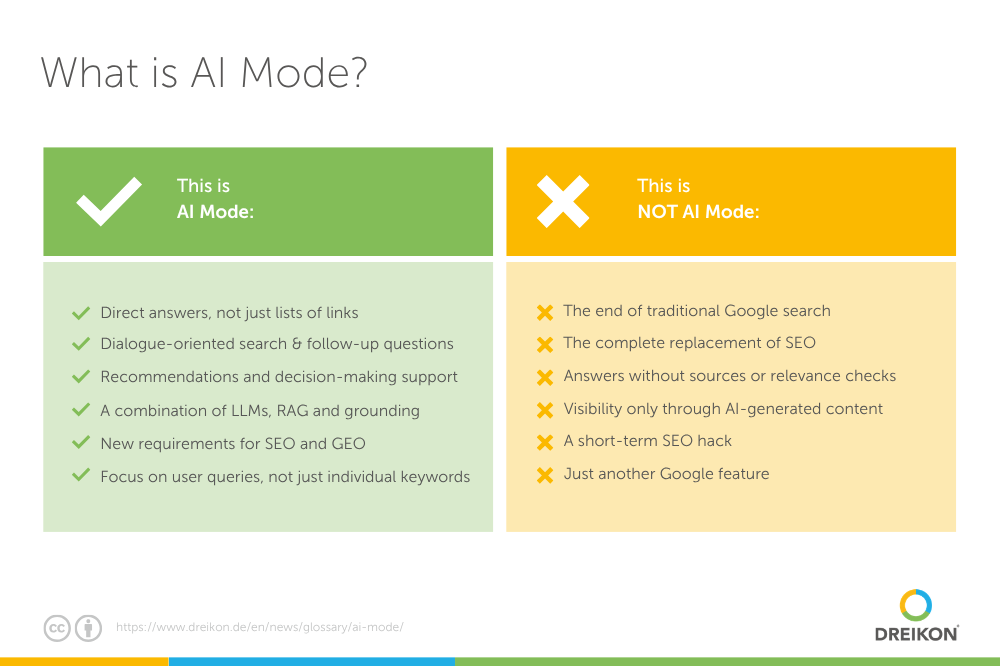
Definition: What is AI Mode?
AI Mode is an AI-powered search mode developed by Google, in which artificial intelligence analyses a user’s search query, collates relevant information from various sources, and generates a direct answer.
Instead of simply displaying a list of websites, as with traditional Google Search, AI Mode often provides a summarised answer to the question asked straight away. Information from different sources can be combined and presented in an easy-to-understand format. Users also have the option to ask follow-up questions and continue the search in the form of a conversation . As a result, Google Search is increasingly evolving from a pure search engine into a dialogue-oriented information and advice system.
AI Mode explained simply
Put simply, AI Mode is an evolution of the classic search. Whereas users previously had to piece together information themselves from various search results, the AI now takes on part of this work. In simple terms, the process works like this:
- The user asks a question.
- The AI analyses the search intent.
- Relevant information is retrieved.
- The AI generates a clear answer.
- The user can ask a follow-up question or explore the topic in more depth.
What does AI Mode look like?
How does AI Mode work?
Technology | Task |
|---|---|
Prompt | describes the user’s question or task |
LLM (Large Language Model) | understands the query and formulates the response |
RAG (Retrieval-Augmented Generation) | retrieves additional information from external sources |
Grounding | bases responses on verifiable sources |
Search index | provides up-to-date information from the web |
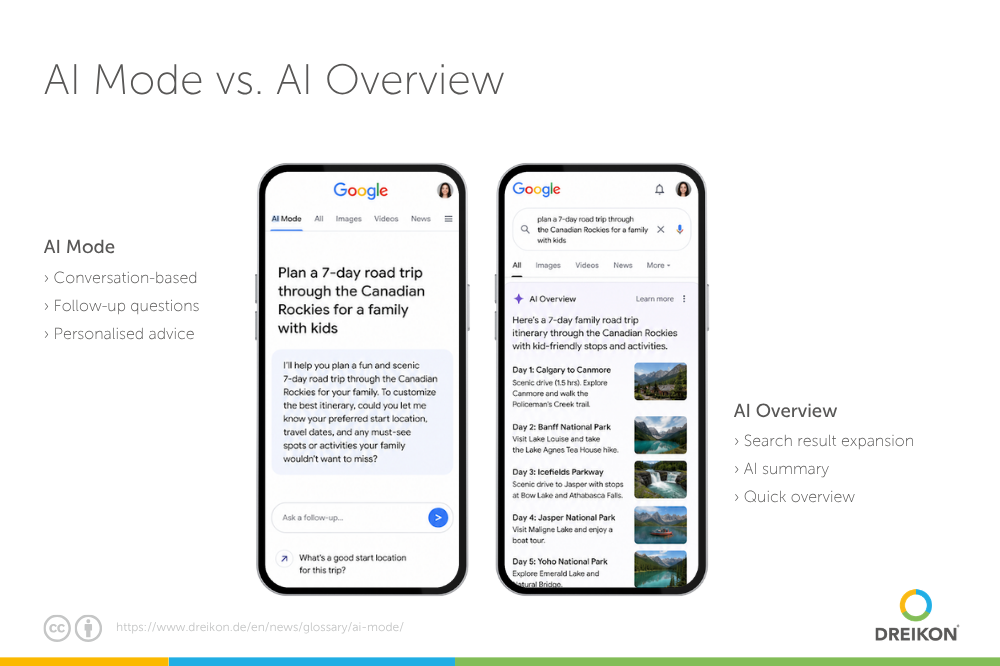
AI Mode vs. AI Overviews
The terms ‘AI Overviews’ and ‘AI Mode’ are often used interchangeably, but they describe different features within Google Search. AI Overviews are AI-generated summaries that appear within classic Google search results above the organic results. They supplement the existing search by providing a direct answer to the search query.
AI Mode goes one step further. It is a standalone AI-powered search mode in which the entire search works in a dialogue-based format. Users not only receive an answer to their original question, but can also ask follow-up questions, explore topics in greater depth and conduct the search as an ongoing conversation. Whilst AI Overviews enhance the traditional search, AI Mode fundamentally transforms the entire search experience into an interactive AI search.
At a glance: Classic search vs. AI overviews vs. AI mode
| Feature | Traditional Search | AI Overview | AI Mode |
|---|---|---|---|
How it works | Displays a list of relevant search results | Enhances traditional search with an AI-generated summary | Uses a dedicated AI-powered search mode |
Output | Organic search results, ads and other SERP features | Brief AI-generated answer above the search results plus traditional listings | Comprehensive AI-generated answer with conversational capabilities |
Interaction | Each search query is entered separately | Follow-up questions are only possible to a limited extent | Users can ask follow-up questions and continue the conversation |
Search behaviour | Keyword- and query-based | Combination of traditional search and AI-generated answers | Conversational search using natural language |
Information sources | Indexed web pages | Google index plus AI-generated summary | Google index, RAG, grounding and AI models |
User task | Research and evaluate information independently | Gain a quick overview of a topic | Receive direct answers, recommendations and guidance |
Example | “AI Mode definition” | Summary about AI Mode displayed above the search results | “Explain AI Mode in simple terms and show how businesses can benefit from it.” |
Role of SEO | Rankings and clicks are the primary focus | Visibility in search results and AI Overviews | Visibility in AI-generated answers, sources and recommendations |
Role of GEO | Limited or indirect relevance | Increasingly relevant | Central to visibility in AI-generated answers |
Google’s objective | Help users find relevant websites | Make information more accessible and faster to consume | Transform search into an AI-powered answer and advisory system |
What user needs does AI Mode address?
- Understanding technical terms
- Researching topics
- Have connections explained
- Simplifying complex content
- Compare products
- Get recommendations
- Prepare for purchasing decisions
- Weigh up the pros and cons
- Compare providers
- Find suitable solutions
- Get recommendations
- Research service providers
- Analysing challenges
- Receive recommendations for action
- Develop strategies
- Answer individual questions
- Compare options
- Assess opportunities and risks
- Prepare investments
- Prioritise alternatives
What is the significance of AI Mode for SEO?
AI Mode is changing the way users find information. Whilst traditional SEO has long focused heavily on keywords and rankings, the following factors are now also gaining in importance:
- specific user queries
- search intent
- Topic authority
- trustworthy content
- structured information
The fundamentals of search engine optimisation remain important. These include:
- Technical SEO
- high-quality content
- strong brand and authority signals
- positive user experiences
What significance does AI Mode have for GEO?
The selection of information is not random, but is based on relevance criteria, including those derived from the EEAT framework (which stands for Experience, Expertise, Authoritativeness and Trust). Modern AI systems take the following factors into account, amongst others:
- Relevance to the user’s query
- Quality of the content
- Trustworthiness of the source
- Timeliness of the information
- Authority of a brand or website
As EEAT has also played an increasingly important role in SEO in recent years, a strong SEO foundation often remains a prerequisite for being considered a relevant source at all. GEO can then help to tailor content specifically to the requirements of generative search systems.
What does AI Mode mean for businesses?
As AI-powered search becomes increasingly widespread, the digital visibility of businesses is undergoing a fundamental shift. Users are increasingly less likely to reach websites solely via traditional search results; instead, they receive answers, recommendations and decision-making tools directly within the search environment . It is therefore becoming increasingly important for businesses to understand
- what questions their target audiences are asking
- what problems users want to solve
- what information is needed to make decisions
- what criteria influence purchasing decisions
- what content AI systems classify as trustworthy
- which sources and brands are given preference in AI responses
At the same time, the requirements for digital visibility are changing. In addition to good rankings, presence in AI-generated answers, recommendations and source references is becoming increasingly important. Companies should therefore:
- meet the basics of search engine optimisation (SEO)
- tailor their content to typical user queries and search intent
- demonstrate their expertise, experience and trustworthiness
- Make targeted use of Generative Engine Optimisation (GEO)
- monitor and utilise new advertising opportunities such as AI Ads
Providing high-quality, trustworthy and user-focused content increases the chances of being featured in both traditional search results and AI Overviews and AI Mode. In the long term, it will no longer be just about ranking for keywords. What will be crucial is being visible in relation to the questions, problems and decision-making processes that users direct straight to AI systems.
Is AI Mode the future of search?
AI Mode shows the direction in which Google Search is heading: away from individual keywords and traditional search results, and towards dialogue-based answers, recommendations and digital advisory experiences. Google describes AI Mode as a particularly powerful AI search experience, allowing users to ask follow-up questions and delve deeper into topics.
This does not completely replace traditional search. Instead, it creates hybrid search experiences in which traditional search results, AI Overviews and AI Mode coexist. Whilst AI Overviews supplement traditional search with AI summaries, AI Mode is a separate search mode with a stronger focus on conversation, context and multi-step research.
For businesses, this means that visibility is no longer determined solely by rankings and clicks. It is becoming increasingly crucial whether content is considered a trustworthy source for AI answers, recommendations and further links.
Conclusion
AI Mode is more than just a new search feature from Google. It represents a fundamental shift in how we search: users are increasingly moving away from searching for individual keywords and instead formulating specific questions, problems and queries in natural language.
This is also changing the digital visibility of businesses. In future, it will no longer be simply a matter of ranking for specific search terms, but of being present in the answers, recommendations and decision-making processes of potential customers. For businesses, the fundamentals of search engine optimisation remain indispensable. At the same time, Generative Engine Optimisation (GEO) is gaining in importance, as AI systems increasingly select, evaluate and compile content into answers themselves.
Those who understand the questions of their target audiences and provide content that conveys expertise, trust and genuine added value create the conditions to remain visible both in traditional search results and in AI Mode.
FAQ: Frequently asked questions about AI Mode
AI Mode is an AI-powered search mode from Google that provides users with direct answers and allows them to continue their search by asking follow-up questions.
AI Mode uses AI models, search technologies, RAG and grounding to gather and evaluate information from the web, and to generate answers with related links.
AI Overviews appear within the standard Google search as AI-generated summaries. AI Mode, on the other hand, is a separate search mode in which the search functions in a more dialogue-oriented way.
No. ChatGPT is an AI system. AI Mode is an AI-powered search mode within Google Search.
The key benefits include faster answers, less research effort, better support for complex questions and the ability to ask follow-up questions.
Businesses need to align their content more closely with the questions, problems, recommendations and decision-making processes of their target audiences. Those who provide high-quality, trustworthy and well-structured content increase their chances of being included in AI responses.
Yes, potentially. If users receive answers directly in AI Mode, there may be fewer clicks on traditional search results. At the same time, brand mentions, source links and recommendations within AI responses can generate new visibility.
A solid SEO foundation remains essential. GEO complements SEO by tailoring content specifically to AI responses, typical user queries, RAG systems and grounding. Google itself continues to emphasise the importance of helpful, technically accessible content for AI features.