Long-tail keywords
Long-tail keywords are specific search queries with a comparatively low volume of individual searches. They play an important role in SEO because they can reflect specific information needs, problems or purchase intentions. What matters is not how many words a search query contains, but where the keyword appears within the query. This is precisely where a common misunderstanding arises: a long keyword is not automatically a long-tail keyword.
Generative AI adds an extra dimension to this topic. Users formulate much more detailed and personalised questions in ChatGPT, Gemini or Google AI Mode. At the same time, AI systems can break down a complex query into several sub-queries. The long tail is not disappearing as a result of AI search; it is becoming broader and more conversational.
The essentials of long-tail keywords at a glance
- Long-tail keywords are search queries with relatively low individual search volume.
- They are often more specific than so-called short-tail or head keywords.
- Having more words does not automatically make a search query a long-tail keyword.
- Specific search queries can have a particularly clear search intent.
- Similar long-tail variants do not automatically each require their own landing page.
- In AI searches, a conversational long tail also emerges from individual questions and sub-queries.
- A good strategy optimises topics and search intent – not as many keyword variations as possible.
Long-tail keywords are search terms or search queries that are searched for less frequently than high-demand head keywords.
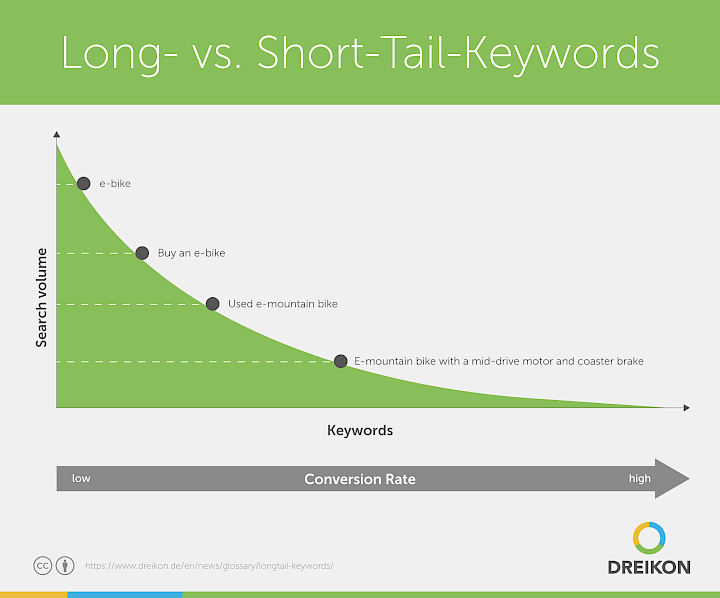
The name derives from the so-called ‘long tail’ of a search demand curve: a small number of keywords with very high demand are contrasted with a very large number of search queries, each with low demand . The long tail therefore primarily describes the distribution of demand rather than the number of words. A search query consisting of five words can be very popular. At the same time, a single word may be searched for so rarely that it belongs to the long tail. A blanket rule such as ‘anything with three or more words is a long-tail keyword’ is, technically speaking, too simplistic.
A simple example of long-tail keywords
A very general keyword could, for example, be ‘CRM software’. A more specific search query, on the other hand, would be ‘CRM software for medium-sized engineering firms’. The second query defines the problem, target audience and usage context much more precisely.
It is precisely this level of specificity that is of interest to marketing. The more context a search query contains, the easier it is often to identify the answer the user actually needs. This can be just as relevant for an information page as it is for a product comparison or a services page.
Differentiation: What long-tail keywords are not
- Long-tailkeywords aren’t necessarily long: the number of words alone does not define a long-tail keyword.
- No guarantee of easy rankings: A low search volume does not automatically mean low competition.
- Not synonymous with purchase keywords: Long-tail keywords can have informational, commercial, transactional or other search intentions.
- No call for thousands of landing pages: Variants that are semantically almost identical should not be artificially spread across individual pages.
- Not a keyword stuffing model: A page does not improve simply because numerous long-tail variations are included verbatim.
- Not a substitute for understanding the topic: Search intent, quality, authority and technical SEO fundamentals remain crucial.
Google now explicitly points out that its systems are capable of understanding synonyms and the broader meaning of search queries. Website operators therefore do not need to include every conceivable long-tail variation on a separate page or incorporate them verbatim into the content.
Long-tail keywords and short-tail keywords: What’s the difference?
Short-tail keywords – often referred to as ‘head keywords’ – usually describe topics with high search volume. Long-tail keywords are further down the search volume spectrum and are searched for less frequently on an individual basis. In practice, they are often more specific, as users formulate their problem, desired characteristics or context more precisely.
The key difference, therefore, is not ‘short versus long’, but ‘broad search volume versus more specific, smaller search volume’. This can give rise to different requirements for content and landing pages.
A direct comparison of the differences between short-tail and long-tail keywords
| Feature | Short-tail / Head Keyword | Long-tail Keyword |
|---|---|---|
Search demand | often high | relatively low |
Specificity | often broad | often high |
Search intent | sometimes ambiguous | often more specific |
Competition | often strong | may be lower, but not necessarily |
Content requirements | often a broad topic | often a clearly defined question or topic |
Conversion proximity | varies | may be higher for commercial queries |
What types of long-tail keywords are there?
Long-tail keywords can be categorised according to the role they play within a topic or search intent. Three types are particularly relevant for content planning: supporting long-tail keywords, topical long-tail keywords and conversational long-tail keywords. This classification helps to determine whether a search query can be addressed on an existing page or requires a separate piece of content.
Supporting long-tail keywords are less common variations of a broader main topic. They differ in their wording but often have the same or a very similar search intent.
For example, different ways of phrasing queries relating to a specific product or service may all boil down to the same core user query.
Topical long-tail keywords have their own distinct thematic focus. They describe a specific query that differs clearly enough from the overarching topic.
It is primarily in terms of search intent that topical long-tail keywords differ from mere variations of a main keyword.
Conversational long-tail keywords extend the traditional long tail to include naturally phrased questions and more complex search scenarios. They occur particularly frequently in AI-based search systems such as ChatGPT, Gemini, Perplexity or Google AI Mode. Users do not simply enter individual keywords there, but rather complete questions containing additional information, conditions or context. Such queries can be highly personalised and therefore have little or no measurable traditional search volume.
Why are long-tail keywords important for SEO?
Long-tail keywords help to identify specific search needs and tailor content more precisely to them. Whilst general keywords often cover several possible search intentions, more specific search queries often make it easier to identify what information users are actually looking for. This can be particularly helpful for complex products, services or topics that require explanation . Long-tail keywords highlight specific questions, characteristics, problems and decision-making criteria.
At the same time, many individual long-tail keywords can collectively account for a significant proportion of organic traffic. A single search query may have only a low search volume, but several thematically related variants can together represent a significantly higher level of demand.
Low search volume does not mean low relevance
Search volume alone says little about how valuable a long-tail keyword is to a business. A very specific search query, for example, may match exactly a service offered, a product or a target audience. When evaluating keywords, search volume, search intent and business relevance should therefore be considered together. A keyword with low search volume may therefore be more valuable to a website than a general term with a significantly higher search volume.
How important are long-tail keywords for GEO and AI search?
In AI-based search systems, search queries are often formulated in greater detail than in traditional web searches. Users can describe a specific situation, add conditions or link several questions together. As a result, the conversational long tail is becoming increasingly important.
For GEO, this does not mean incorporating as many exact questions as possible into content. The key remains to explain topics in a clear, structured and comprehensive manner. SEO remains the foundation of content planning; GEO extends this optimisation to consider whether content can also be understood, categorised and utilised by generative search systems to provide appropriate answers. In this context, the term ‘query fan-out’ is also becoming increasingly relevant for the AI visibility of content.
What is ‘query fan-out’?
In the case of complex search queries, AI search systems can break a question down into several sub-questions. This process is known as ‘query fan-out’. A comprehensive query can thus give rise to various sub-aspects for which the system seeks information. Content can therefore still be relevant even if it does not contain the original search query verbatim, provided it reliably answers an important sub-question.
For long-tail content, this means that comprehensive thematic coverage becomes more important than the frequent repetition of individual keyword variants.
How do you find long-tail keywords?
1. Research
Long-tail keywords can be identified using traditional keyword research, existing search data and real user queries. Suitable sources include , for example , keyword tools, Google Search Console, search suggestions, and queries from sales, consultancy or customer service.
2. Enriching with real user queries
Real user queries also play an important role in conversational long-tail keywords. As highly personalised phrasing does not always appear in traditional keyword databases, customer queries and typical advisory situations can provide clues to relevant topics.
3. Form clusters
It is particularly helpful not only to collect individual terms, but also to group similar search queries by topic and search intent. This makes it possible to identify which keywords are simply variations on the same topic and which represent a distinct information need. Tools that can recognise embeddings and classify them semantically can be helpful in this regard.
How should long-tail keywords be used in content?
Long-tail keywords should not lead to the creation of a separate page for every single variant. What matters is the underlying search intent, not the number of keywords.
- Several supporting long-tail keywords with the same or a very similar search intent can usually be covered together on a strong page. A separate URL for each individual variant is generally not necessary.
- In the case of topical long-tail keywords, however, a dedicated section or a separate page may be appropriate if there is a clearly defined need for information. The decisive factor here is not the length of the keyword, but whether there is a specific need for information.
- Conversational long-tail keywords also help to identify specific user queries and thematic connections without the need to create separate content for every possible phrasing. For content planning, this means covering a topic comprehensively and clearly so that even specific questions can be answered; this often does not require a separate page for each question.
As with keywords in traditional SEO, the following applies: rather than artificially optimising individual variants, relevant questions, synonyms and related aspects should be covered naturally and comprehensively within the respective topic context.
Conclusion
Long-tail keywords account for a significant proportion of search queries. They are often more specific than high-volume head keywords and can therefore highlight specific questions and information needs. Distinguishing between supporting, topical and conversational long-tail keywords helps to categorise these search queries effectively in content planning. Not every variant requires its own page. The key factor is whether the search intent and the information need actually differ.
With AI-based search systems, the long tail is further expanding to include increasingly personalised and naturally phrased questions. For SEO and GEO, a comprehensive understanding of topics and user queries is therefore becoming more important than optimising for as many individual keyword variants as possible.
FAQ: Frequently Asked Questions about Long-tail Keywords
A long-tail keyword is a search query with a comparatively low volume of individual searches. It is often more specific than a head keyword, but does not necessarily have to consist of many words.
Three relevant types can be distinguished: supporting, topical and conversational long-tail keywords. Supporting long-tails are variations on a broader topic, topical long-tails have their own distinct thematic focus, and conversational long-tails are naturally phrased, often more detailed search queries.
There is no fixed word count for long-tail keywords. It is not the length of the search query that is decisive, but above all its comparatively low individual search volume.
Long-tail keywords are not automatically easier to rank for. Some face less competition, whilst others fall within highly competitive topics and compete with the same pages as more general keywords.
No, not every long-tail keyword requires its own page. Search queries with the same or a very similar search intent can usually be covered together on a single page; a dedicated URL is particularly useful when there is a need for standalone information.
Long-tail keywords help to identify specific search intentions and concrete user needs. This allows content to be tailored more effectively to questions, problems and decision-making situations.
Long-tail keywords are particularly relevant in B2B SEO because complex products and services are often researched via very specific search queries. Such keywords can reflect specific requirements, industries, problems or decision-making criteria.
Relevant long-tail keywords can be identified using keyword tools, Google Search Console, search suggestions and real-life questions from sales, consultancy and customer service. They should then be grouped according to search intent and thematic context.
Long-tail keywords should be integrated into the content naturally and in a way that aligns with the search intent. Rather than optimising each variant individually, relevant questions, synonyms and related topics should be covered comprehensively on a suitable page.
Yes, conversational long-tail keywords in particular are gaining importance as a result of AI search. Users often formulate detailed and personalised questions in ChatGPT, Gemini or other AI search systems, which are only visible to a limited extent in traditional keyword data.
Conversational long-tail keywords are naturally phrased, often detailed search queries that provide additional context. They are particularly common in AI search systems, where users can describe problems, conditions or objectives in the form of complete questions.
Long-tail SEO optimises content for specific search queries and their search intent. GEO extends SEO to include visibility in generative search and response systems and also takes into account whether content can be understood, categorised and used as a relevant source by AI systems.
Sources:
- Google Search Central: Guide to optimising for generative AI features, https://developers.google.com/search/docs/fundamentals/ai-optimization-guide?hl=de
- Ahrefs: Long-tail Keywords: What They Are and How to Get Search Traffic From Them, https://ahrefs.com/blog/long-tail-keywords/
- Google Search Central: AI features and your website, https://developers.google.com/search/docs/appearance/ai-features?hl=de
- Google Search Central: Search Console Bubble Chart Analysis, https://developers.google.com/search/docs/monitor-debug/bubble-chart-analysis
- SISTRIX: Search Intent: A Quick Guide, https://www.sistrix.com/ask-sistrix/content-creation/search-intent-overview
- SISTRIX: Keyword Overview, https://www.sistrix.com/support/handbook/seo/keyword-overview/