




Mandatory AI labelling in online marketing: What applies from August 2026
Since 2 August 2026, the transparency requirements set out in Article 50 of the EU AI Act have been in force. This has led to growing uncertainty within marketing departments: must blog articles, Google Ads, newsletters, social media posts or AI-generated images now, as a matter of principle, be labelled as AI content?
The key point is this: the regulation does not ban the use of AI in marketing. Not every instance of using ChatGPT, Gemini or other AI systems automatically triggers a requirement to visibly label the content as AI-generated. The EU rules relate in particular to direct interactions with AI systems, deepfakes and certain AI-generated texts on matters of public interest.
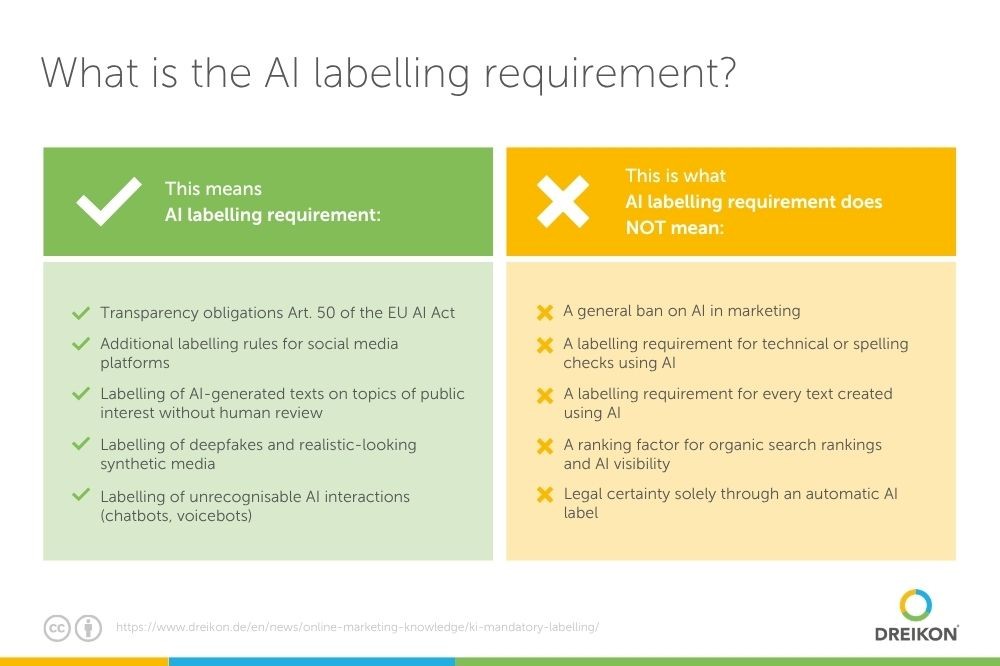
What AI content do companies actually have to label?
Companies now use ChatGPT, Claude, Gemini and other AI systems for research, drafting, translations, images, videos and automated customer communications. However, simply using such a tool does not mean that the resulting content must be visibly labelled as AI-generated.
What matters far more is what is published, the extent to which the AI has shaped the content, and how people might perceive it. A newsletter that has been linguistically edited should be treated differently from a video generated entirely by AI. A blog article reviewed by an expert should be assessed differently from an AI-generated text on a socially relevant topic that has been published without review.
The question is therefore no longer simply: ‘Have we used AI?’ The crucial question is: ‘Could this content mislead people regarding its origin, its authenticity or the nature of the communication?’
Please note: This is not legal advice! This article is intended solely to provide general information and guidance for businesses. It does not constitute legal advice and is no substitute for a legal assessment of a specific individual case. Whether labelling is required, and in what form, depends, amongst other things, on the AI system used, the nature of the content, the intended purpose, the extent of human intervention, and the legal and platform-specific requirements.

Everything you need to know about the AI labelling requirement in marketing
- The essentials of the AI labelling requirement in 60 seconds
- Where should businesses check for AI labelling in online marketing?
- Social media sets its own rules – in addition to the EU AI Act
- Image editing using AI is not automatically always a deepfake
- Breaches can cost more than just a fine
- Frequently asked questions about the AI labelling requirement in online marketing
The essentials of the AI labelling requirement in 60 seconds
- The transparency requirements set out in Article 50 have applied since 2 August 2026.
- Not all marketing content created or edited using AI requires a visible AI label.
- Of particular relevance are deepfakes, realistic-looking media, AI interactions and certain texts on topics of public interest.
- A thorough expert review may render labelling unnecessary for certain AI-generated texts.
- A simple spell-check, style check or grammar check is not sufficient for this purpose.
- Technical, machine-readable tags and visible notices serve different purposes.
- In addition to the EU AI Act, companies must check the rules of Google Ads, TikTok and other platforms separately.
Four questions to help with an initial assessment
Four points are particularly relevant for businesses:
- Was the content generated entirely or substantially by AI?
- Does an image, video or voice sound authentic, even though the situation depicted is not real?
- Do users communicate directly with an AI system?
- And has a text been subject to technical and editorial review prior to publication?
The more automated the content is and the greater its potential to mislead, the more important it is to label it transparently. A spell-check or a suggested rewording is not the same as a deepfake, a cloned voice or a fully generated specialist article.
When do I need a visible label?
A visible or audible label is particularly relevant when real people appear to be saying or doing something that never actually happened, when AI-generated media appear to be authentic recordings, or when users cannot recognise that they are communicating with a chatbot or AI assistant.
Technical origin information or automatic platform labels can support this transparency. For businesses, however, the key factor is whether the disclosure is provided to the users concerned in a timely, comprehensible and clearly perceptible manner. Information hidden within metadata, privacy policies or terms of use does not necessarily fulfil this function.
Where should businesses check for AI labelling in online marketing?
| Marketing Channel | Typical AI Use | When should a visible notice be reviewed? | What else should the company review? | Affected by Article 50 of the EU AI Act? |
|---|---|---|---|---|
SEO & GEO | Research, drafts, AI-generated text | For AI-generated text on matters of public interest | Expert review, sources, editorial responsibility | In some cases: especially for relevant informational texts without substantial human review |
Company website | Text, images, videos, AI features | For deepfakes, realistic-looking AI media, or AI interactions | Potential for deception, approval, placement of the disclosure | Yes, depending on content: especially for deepfakes, relevant AI-generated text, and chatbots |
Newsletters | Text, images, personalization | For relevant AI-generated text or realistic-looking AI media | Content, target audience, human review | Partially: depending on content, purpose, and editorial control |
Google Ads | Text, images, videos, voiceovers | For synthetic or significantly altered creatives | Google Ads policies, platform labels, ad labeling | Partially: especially for deepfakes and deceptively realistic AI media |
Social Media | Posts, Reels, avatars, cloned voices | When content appears authentic even though it is AI-generated or manipulated | Platform rules, advertising, personality rights | Yes, frequently: especially for deepfakes and realistic-looking AI content |
Chatbots & AI assistants | Support, advice, lead generation | When users cannot clearly tell that they are communicating with AI | Initial notice, clarity, handover to humans | Yes: the AI interaction must be recognisable, unless it is obvious |
Rule of thumb: It is not the marketing channel that determines whether labelling is required, but rather the nature of the content, its potential to mislead, the intended use and the extent of human testing.
Document tools, teams and service providers.
Draft, revision or complete generation?
Strikingly realistic, of public interest or interactive?
Define technical review and approval.
Align the EU AI Act with platform requirements.
Mandatory AI labelling for SEO and GEO
An SEO text prepared using generative AI does not have to be visibly labelled as AI-generated for that reason alone. This applies, for example, to draft outlines, suggested wording, summaries or linguistic revisions. The situation becomes more critical when a text is produced entirely automatically, published without being checked, and used to provide information on matters of public interest. The use of AI is therefore not a quality flaw. A lack of editorial responsibility, however, is.
When it comes to organic visibility, Google does not make a blanket assessment of whether a text was created by a human or with the aid of AI. The focus is on helpful, reliable, original content (EEAT) and compliance with the spam guidelines. Content created in large quantities primarily to manipulate rankings or AI responses, on the other hand, may be treated as ‘scaled content abuse’.
Are there specific labelling requirements for GEO and AI visibility?
AI visibility and the obligation to label AI content are two separate issues. Content does not need to be labelled as AI-generated in order to be found, cited or recommended in ChatGPT, Claude, AI Overviews or AI Mode.
For AI search, traditional SEO fundamentals remain crucial: technical accessibility, crawlability, helpful content, clear structures and verifiable expertise. ChatGPT, Claude and other systems, however, use their own crawlers and access methods. There is no universal GEO file or specific AI schema that guarantees visibility across all systems.

Your content is correctly tagged – but is it actually being found?
AI labelling and AI visibility are two distinct tasks. The key factor remains whether your content is recognised as relevant, trustworthy and citable by Google, AI Overviews, ChatGPT and other AI systems. DREIKON combines SEO and GEO to ensure that your content is not only published in compliance with the rules, but is also visible where users are looking for answers today. Do you know your AI visibility? Your most relevant prompts? No? Then let’s find them out together in a no-obligation initial consultation!
Websites and newsletters are not subject to a blanket labelling requirement
A website or newsletter text does not automatically require an AI disclosure simply because ChatGPT, Claude or AI Mode were involved in drafting it. What matters is what is published and the extent to which people have reviewed and edited the content.
In the case of AI-generated or manipulated texts intended to inform the public about matters of public interest, Article 50 generally requires disclosure. However, such a disclosure may not be necessary if the text has undergone substantial human review or editorial control and a person or organisation assumes editorial responsibility. The European Commission describes such scrutiny as content-based verification by experts. Facts, sources and key statements must be genuinely assessed. Spelling checks do not constitute expert verification. Stylistic editing does not amount to editorial responsibility.
For businesses, this means that approval should not only be given, but should also be transparent. Who carried out the review? Which sources were checked? Which statements were amended? Who bears responsibility for the publication?
AI reduces production costs. The responsibility for transparency increases.
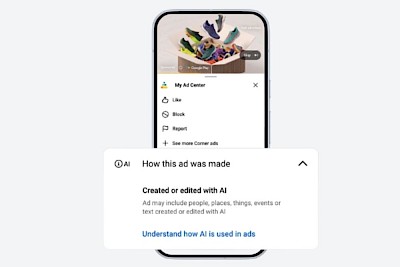
Google Ads does not label every instance of automation – but transparency is increasing when it comes to creatives
Automated bidding strategies, campaign optimisations or AI-generated ad variations do not automatically result in a visible label appearing on every advert. However, the labelling becomes more relevant in the case of AI-generated or significantly altered image and video assets.
Since July 2026, Google has been providing features that allow advertisers to declare assets as AI-generated or AI-edited. This information may then appear in the ‘How this ad was made’ section of My Ad Centre. For certain assets created using Google tools, labelling can also be applied automatically. Including your own AI disclosures in creatives will not, in itself, be treated as an unauthorised watermark or text overlay.
Particular attention must be paid to fully AI-generated product images, artificially created models, cloned voices and depictions in which real people appear to be making statements or performing actions that never took place.
AI labelling on social media: What are the rules on Meta, YouTube, TikTok, LinkedIn and Pinterest?
| Platform | When must or should companies label AI content? | What does the platform label automatically? | Practical recommendation |
|---|---|---|---|
Meta (FB & IG) | In the case of deepfakes, realistic AI-generated media and content with legal implications |
|
|
YouTube | In the case of realistic, synthetic or significantly altered content |
|
|
TikTok | In the case of realistic AI-generated images, videos and audio |
|
|
In the case of realistically manipulated or synthetic media |
|
| |
In the case of misleading or realistic-looking AI-generated content |
|
|
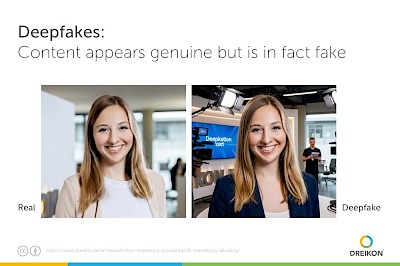

Image editing using AI is not automatically always a deepfake
According to the EU definition, a deepfake is AI-generated or manipulated image, audio or video content that resembles existing or plausibly real people, objects, places or events and may falsely appear to be authentic or true. Key factors in this regard include similarity, message, context and audience expectations. The following aspects are not classified as deepfakes:
- Ordinary colour correction: A technical adjustment to brightness or contrast does not automatically produce a deceptive synthetic representation.
- No simple quality enhancement: Noise reduction or upscaling alone does not make a piece of media a deepfake.
- No blanket equating with retouching: Minor retouching must be distinguished from significant alterations to people or situations.
- No automatically deceptive illustration: An obviously fantastical or stylised depiction is not usually perceived by the audience as authentic documentation.
- Not a technical trick: What matters is not the tool used, but whether content that appears realistic can deceive people as to its authenticity.
- No guarantee from a platform label: An automatically applied label does not relieve companies of the responsibility to examine the specific context of publication.
Labelling content that warrants labelling
Possible editorial phrasing includes, for example, ‘AI-generated image’, ‘Created using generative AI’, ‘Image significantly altered using AI’, ‘Synthetically generated voice’ or ‘Fictional, AI-generated scene’. However, these examples are not legally binding texts, but should be understood purely as illustrative examples!

AI content on social media needs more than just a label
Whether it’s Reels, adverts, AI avatars or AI-assisted creative content: correct labelling alone does not protect against generic content, poor reach or a lack of brand impact. DREIKON develops social media content and campaigns that comply with platform rules, align with your brand and translate attention into measurable results. See for yourself and get to know us and our social media management services!
Chatbots don’t need to seem human – they need to be transparent
Users must be able to recognise from the outset that they are communicating with an AI system – unless this is already obvious. The notice must be clear, comprehensible and directly accessible. Information that only appears in the privacy policy or terms of use is generally not sufficient for this purpose.
For businesses, this means that anyone using a chatbot, voicebot or AI assistant should display the transparency notice before, or at the latest at the start of, the first interaction. This applies regardless of whether the system was developed in-house or integrated by an external provider. A distinction must be made between purely automated background processes where there is no direct communication with users.
A possible notice could read: “You are communicating with an AI assistant. The responses are generated automatically and may contain errors.” The notice should also remain clearly visible on mobile devices and not be obscured by design elements, cookie banners or other features.
Breaches can cost more than just a fine
Fines of up to 15 million euros or three per cent of global annual turnover may be imposed for breaches of the relevant obligations under the AI Act. In this regard, the nature, severity and proportionality of the breach must be taken into account; special criteria apply to smaller companies. The maximum amount is therefore not necessarily equivalent to the penalty imposed in each individual case.
In addition, there may be platform-related measures: adverts may be rejected, posts removed or accounts restricted. Equally relevant are complaints from data subjects, subsequent corrections, additional documentation requirements and a loss of trust. The greatest operational risk is not an individual incorrect label. It is a company that cannot explain how it arrived at its content and its decision.
Conclusion: Mandatory AI labelling is intended to ensure greater transparency
Not every piece of text, image or advert created using AI needs to be visibly labelled as such. The requirement to label AI content becomes particularly relevant when users fail to recognise an AI interaction, might mistake AI-generated media for authentic content, or when certain informational texts are published without substantial human review.
For businesses, this does not result in a blanket labelling requirement, but rather a clear duty to verify: How was the content created? Could it be misleading? Has it been fact-checked? And what additional rules apply on the respective platform? Those who clarify these questions definitively before publication will avoid both unnecessary labelling and omissions of information. It is not the use of as many AI labels as possible that creates transparency, but transparent decision-making. Where in doubt, you should always seek legal advice to protect yourself against fines or restrictions on the relevant platforms.
Frequently asked questions about the AI labelling requirement in online marketing
No. The use of an AI tool alone does not trigger a blanket requirement for visible labelling. The decisive factors are content, purpose, human review and editorial responsibility.
Not necessarily. For texts on matters of public interest, classification is particularly relevant. Substantial human review may render labelling unnecessary.
Google does not list an AI disclosure as a general ranking factor. Visibility is primarily determined by helpful, original and reliable content, as well as compliance with spam guidelines.
Neither specific GEO markup nor llms.txt files are required for Google Search. Existing technical SEO fundamentals remain relevant.
Not necessarily. A platform label must be distinguished from legal verification, advertising labelling and any further information requirements.
People must generally be able to recognise that they are interacting with an AI system, unless this is already obvious. The disclosure should be made at the start of the interaction.
According to the European Commission’s FAQs, content generated before 2 August 2026 does not need to be labelled retrospectively. However, voluntary labelling is recommended where it is appropriate and feasible.
For certain providers of systems that were already on the market before 2 August 2026, there is a limited transition period until 2 December 2026 with regard to the technical labelling and identification requirements. This exemption does not constitute a general deferral of all transparency obligations.
- EU AI Act – Article 50 and sanctions: https://eur-lex.europa.eu/eli/reg/2024/1689/oj/eng
- European Commission – Guidelines on transparency obligations under Article 50: https://digital-strategy.ec.europa.eu/en/policies/guidelines-ai-transparency-obligations
- European Commission – FAQs on Article 50 of the AI Act: https://digital-strategy.ec.europa.eu/en/faqs/transparency-obligations-under-article-50-ai-act
- Google Search Central – Optimising for generative AI features: https://developers.google.com/search/docs/fundamentals/ai-optimization-guide
- Google Ads – Labelling AI-generated and edited assets: https://support.google.com/google-ads/answer/17140115?hl=en
- TikTok – Rules for AI-generated content: https://support.tiktok.com/en/using-tiktok/creating-videos/ai-generated-content
- https://retail-news.de/meta-ki-kennzeichnung-werbeinhalte-neue-label/
- https://onlinemarketing.de/sea/google-kennzeichnung-ki-ads-suche













Social media sets its own rules – in addition to the EU AI Act
On social media, statutory transparency obligations, platform rules, advertising labelling and personal rights all intersect. These different levels must not be treated as equivalent. TikTok, for example, requires AI-generated content to be labelled if it contains realistic images, audio or videos. The platform also recommends disclosing content that is entirely AI-generated or has been significantly edited using AI. Such disclosures can be made via the platform’s features, text within the video or contextual information in the description.
An AI label does not replace an advertising label. An advertising label does not replace a required AI disclosure. It is therefore not sufficient for businesses to simply check European legislation. Before any publication, the current rules of the respective network must also be taken into account.