1. Save the review and profile
Record the review, the author’s name or profile, the date, the star rating and the full text. A screenshot provides reliable internal documentation in case the review changes or disappears later on.




A bad Google review is quick to write. Its impact, however, can last much longer: it affects the average rating, the first impression potential customers have, and, in some cases, their decision to buy. It’s therefore tempting to think that negative reviews can simply be deleted. However, not every bad review can or should be removed. The real danger is often not the negative review itself, but the unanswered negative review. It leaves criticism unaddressed and can give the impression that a business neither recognises nor resolves problems.
The question is therefore no longer simply: ‘How do we get rid of this review?’. Rather: ‘In my case, is deletion, a response or further escalation the most sensible course of action?’ Google itself makes it clear that, whilst any review can be reported, only content that breaches its guidelines should be removed.
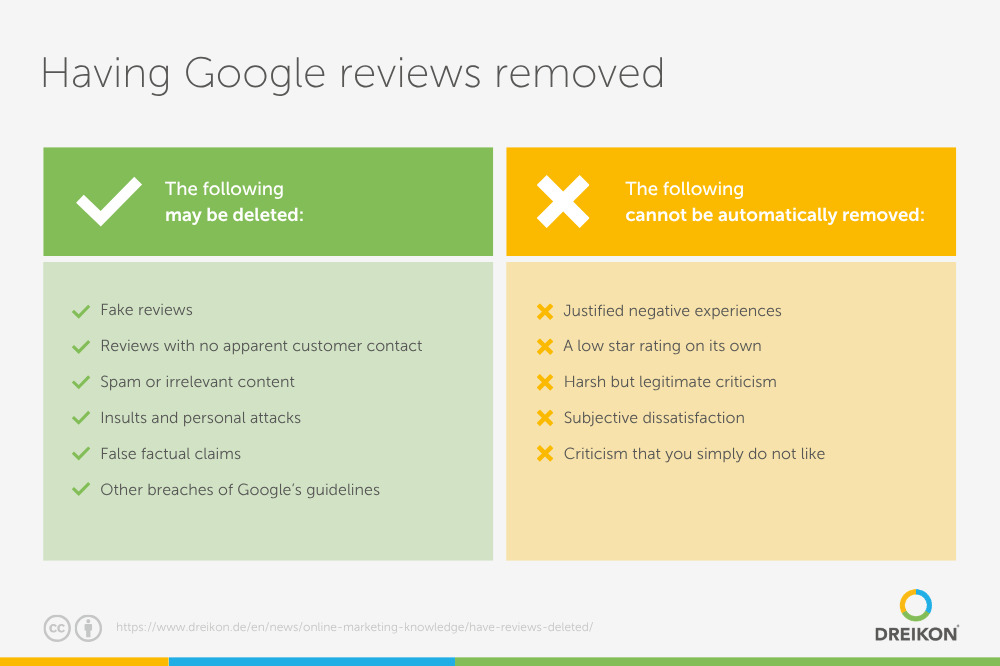
Yes, but not simply because it is negative. As the owner of a Google Business Profile, you cannot delete a third-party review yourself at the click of a button. You can report it and ask Google to review it. Reviews that breach the applicable guidelines should be removed. That sounds clear enough at first, but in practice it’s often the crucial point: a single star is not, in itself, grounds for deletion. Even harsh criticism may generally be allowed to remain if it reflects a genuine experience and does not cross the boundaries of what is permissible.

A critical review should not be left lying around for days between the marketing, sales and management departments. The first crucial step is to categorise it correctly: is it a breach of policy, justified criticism or a potential legal case? We can help you monitor reviews in a structured way and establish a clear process for reviewing and responding to them. Cases that are legally contentious should also be referred to a solicitor.
This article provides general information and is not a substitute for legal advice. Whether a specific review is unlawful or whether there is a right to have it removed must be assessed by an expert on a case-by-case basis.

Cross-checking is at least as important. A bad experience does not become invalid simply because you assess the situation differently from your customer.
Statements such as ‘I was dissatisfied with the service’, ‘I found the advice disappointing’ or ‘I wouldn’t buy from here again’ may initially appear to be subjective judgements. Google expressly points out that factually accurate reviews should not be reported simply because the company disagrees with them. Even a one-star rating alone does not automatically qualify for removal. Unpleasant is not the same as inadmissible. The decisive factors are context, actual contact, platform guidelines and, in the case of legal issues, the specific legal classification. This is precisely why you should not report a critical review on a whim. First, check which specific breach of guidelines or potential legal infringement you can cite.
Record the review, the author’s name or profile, the date, the star rating and the full text. A screenshot provides reliable internal documentation in case the review changes or disappears later on.
Was there actually any contact with a customer? Does the situation described correspond to an order, an appointment, a purchase or a conversation? Are the dates and procedures mentioned correct? The more thorough your internal review, the more accurately you can assess the situation.
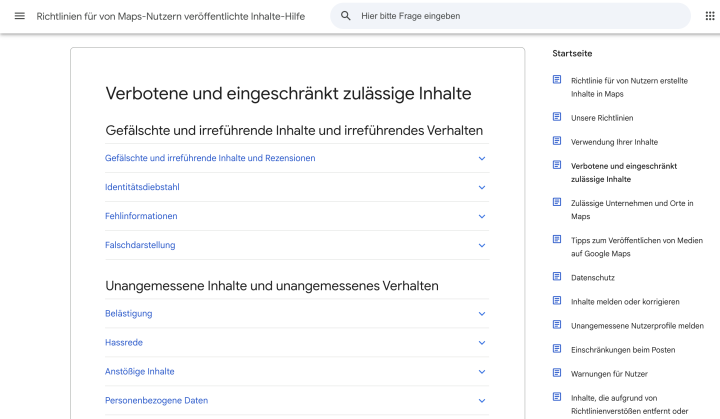
Avoid making sweeping statements such as ‘This review is false’. Instead, check: Is there fake engagement? Spam? A conflict of interest? An offensive statement? A possible misrepresentation? Or is it legitimate criticism? Google’s guidelines distinguish between various categories of prohibited or restricted content.
Open your business profile, view the reviews and report the relevant post. Alternatively, you can use Google’s review management tool. There, select the relevant review and choose the appropriate reason for reporting it.
Google usually states that the initial review will take several days. You can use the Review Management Tool to see whether a decision is still pending or whether Google has not identified any policy violations.
If no breach has been identified, Google states that you can lodge a one-off appeal. You can select up to ten reviews for this. Following a further review, Google will notify you of the outcome by email.
Google distinguishes between reports of breaches of product guidelines and reports made on legal grounds. If you believe that a review breaches applicable law or your rights, a separate legal reporting channel is available for this purpose. If you are in any doubt as to whether this route is likely to be successful in your case, you should seek legal advice.
Google itself usually states that it takes several days to review a reported review. There is no guaranteed timeframe for removal. If the review is not removed at the initial stage and you lodge an appeal, the process will be extended accordingly. Furthermore, if a legal review or further enforcement action is required, the process may take considerably longer.
You should therefore view promises such as ‘guaranteed removal within 24 hours’ with a critical eye. The decision on whether a review is removed is not made by your service provider, but depends on Google’s procedures or, in the event of a dispute, the relevant legal authority.
Cost: free
Suitable for: clearly identifiable breaches of guidelines and individual reviews
Advantage: quick to get started, direct official process
Limitation: You must assess compliance with guidelines and the facts of the case yourself
Cost: depends on the provider
Suitable for: multiple assessments, ongoing monitoring and structured processes
Advantage: reduced workload, clear overview and straightforward processing
Limitations: legal advice depends on authorisation and the service model
Costs: depending on the case, scope and fee structure
Suitable for: potential infringements, false allegations and complex cases
Advantage: legal review and potential further enforcement
Limitations: greater effort and, where applicable, higher costs
You do not automatically need to consult a solicitor in the event of an obvious breach of the guidelines. Google provides businesses with its own free reporting and appeal process. Costs only arise if you engage external support – and there is no standard market rate for this. Even the publicly advertised entry-level prices vary significantly, which is why simple price comparisons are of little use. Current providers operate using a wide variety of models:
Particularly where reviews are received on a regular basis, professional reputation management can be more cost-effective than seeking legal assistance for every single negative review. Not every case needs to go to a solicitor – many can be resolved at an earlier stage through monitoring, rapid response and structured platform processes.
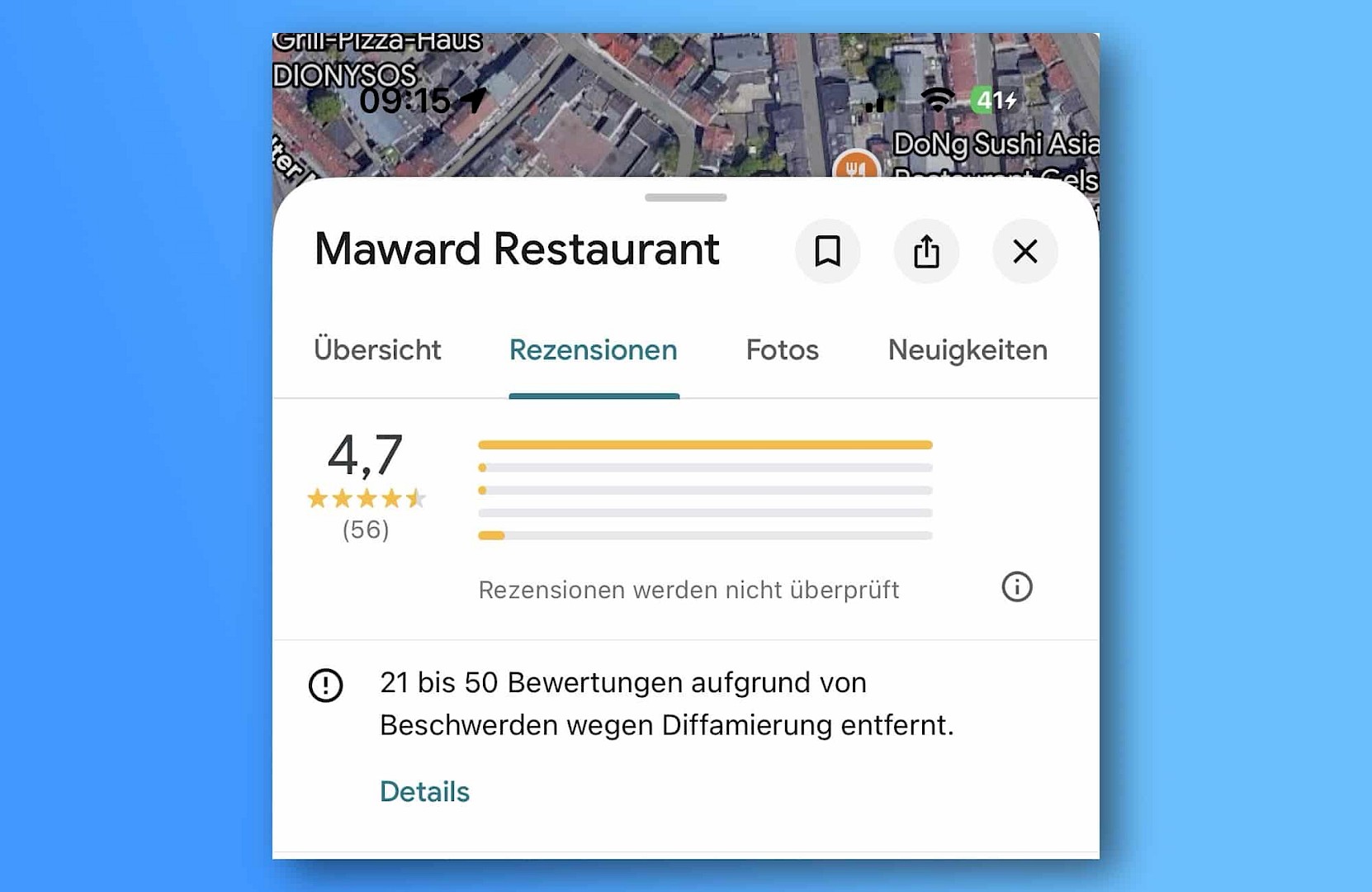
Since 2026, another factor has come into play: Google now indicates on business profiles in Germany whether any reviews have been removed within the past 365 days following successful complaints of defamation. The figure is displayed as a range . Reviews may therefore disappear from the profile. At the same time, the way they are handled is becoming more transparent.
The key question is therefore no longer simply: “How can we delete a negative review?” The new question is: Which reviews should we challenge, which should we respond to professionally – and which approach will strengthen our digital reputation in the long term?
| Situation | Recommended action | Responsible |
|---|---|---|
Spam or fake review | Document it, report it and have it removed if appropriate | Reputation Management / Marketing |
No traceable customer interaction | Investigate internally and consider filing a complaint | Customer Service / Sales / Reputation Management |
False statement or potential legal violation | Secure the facts and seek legal review if necessary | Legal Department / Management |
Legitimate negative customer experience | Respond professionally and evaluate internally | Reputation Management / Customer Service |
Recurring criticism | Analyse the underlying issue in the product, service or process | Relevant Department / Management / Quality Management |
Positive review | Respond individually as well | Reputation Management / Marketing |
Too few reviews | Improve systematic review generation | Marketing / Sales / Customer Service |
Unclear perception in AI systems | Review reputation and source landscape as part of a GEO audit | Marketing / SEO / GEO |

A rejection does not automatically mean that all options have been exhausted. However, you should not keep resubmitting the same report without making any changes. Google will inform you in the Review Management Tool if no policy violation was found during the initial review. You can lodge a single appeal against this decision.

DREIKON combines review management, local SEO, local listings, citation building and GEO into a systematic approach to reputation management. Our review management tool allows you to keep a centralised overview of your reviews. Through local SEO, listings and business profiles, we lay the foundations for greater visibility and more authentic reviews. And with a GEO audit, we assess the image that ChatGPT, Gemini and other AI systems derive from your digital presence.
The key question is not whether a negative review can be deleted, but rather what response is actually appropriate to the situation. Incorrect or inappropriate content should be systematically reviewed and reported. Justified criticism, on the other hand, offers an opportunity to take a public stance whilst simultaneously identifying internal weaknesses.
A false review is investigated. A justified complaint is addressed. Recurring complaints are analysed. It is precisely this distinction that turns review management into genuine reputation management.
A well-maintained review profile should reflect trust, not feign perfection. A profile consisting solely of five-star reviews can quickly come across as too polished, too contrived or simply unrealistic. People know that not every customer experience goes perfectly.
In the 2026 BrightLocal study, only 10 per cent of respondents said they would only use businesses with a perfect five-star rating.
They also pay attention to how recent reviews are, which comments are repeated, and whether a company responds to criticism. It is precisely this mix of positive experiences, reasonable criticism and professional responses that can therefore come across as more credible than a seemingly flawless profile.
So what this means is that an objective three-star review accompanied by a confident response can say more about service quality than the twentieth five-star rating left uncommented. The best reputation, then, isn’t flawless. It’s credible. And it shows how confidently a company handles criticism.
| Platform | Especially relevant for | Importance |
|---|---|---|
Almost all local and regional businesses | Visibility in Google Search and Maps, local SEO, first impression of reputation | |
Trustpilot | E-commerce, service providers, digital businesses, larger brands | Public company feedback and external trust signals |
ProvenExpert | Service providers, consultants, agencies, experts | Aggregation and presentation of customer reviews |
Trusted Shops | Online shops and e-commerce businesses | Shop reviews, trust building and buyer protection environment |
Local businesses, restaurants, leisure businesses, communities | Recommendations within a major social platform | |
Yelp | Local service providers and restaurants | Local business reviews and recommendations |
kununu | Employers and recruiting | Employer reputation and employer branding |
Jameda | Doctors, medical practices and healthcare professionals | Patient feedback and provider selection in the healthcare sector |
Tripadvisor / HolidayCheck | Hotels, restaurants and tourism businesses | Travel and hospitality reputation |
OMR Reviews | B2B software and business services | Software selection and B2B reputation in the DACH market |
G2 / Capterra | SaaS and international B2B software providers | Product reviews and software comparisons |
After all, the relevant platform is the one on which your target audience finalises their decision. For many businesses, this involves several platforms at once. Alongside review sites, directories such as Apple Maps, Bing Places, Yellow Pages, Das Örtliche, 11880, Cylex, HERE and TomTom also play a role. They create additional touchpoints, boost local visibility and ensure consistent business data. Many directories also integrate review scores from Google and other platforms.
This makes reputation management more complex, but also more manageable: those who identify, standardise and continuously maintain relevant profiles are significantly less at the mercy of individual critical reviews.

Your own average star rating does not answer this question. With a GEO audit from DREIKON, we examine how your brand is perceived in relevant AI systems, which sources and external signals influence this perception, and where gaps in reputation, entity management or visibility arise. This transforms a vague question like “Are we visible in AI?” into a concrete analysis of your digital reputation. Find out what AI systems say about your brand when your customers search for you during a no-obligation initial consultation with us.
Having Google reviews removed can be a sensible option if they are fake, breach the guidelines or are legally challengeable. Google provides a clear reporting and appeal process for this purpose. Not every negative review meets these criteria – and not every one should be removed.
False reviews are investigated and reported. Valid criticism is addressed professionally. Recurring complaints are analysed. In this way, the immediate desire to have a review removed is transformed into robust reputation management. After all, a single review may disappear, but your reputation remains. Those who continuously monitor reviews, react quickly and highlight genuine positive experiences protect their reputation more effectively in the long term than by relying on individual removal procedures.
No. A negative review does not automatically qualify for removal. Google removes reviews, in particular, if they breach the guidelines for user-generated content. Objectively worded negative experiences, on the other hand, may generally remain.
Examples include fake reviews, paid or manipulated reviews, reviews resulting from conflicts of interest, spam, personal attacks, or certain misleading and irrelevant content. The decisive factor is always the specific breach of the guidelines or, in legal cases, the individual legal assessment.
Yes, fake reviews can be reported. Google requires that reviews are based on an actual experience with the business and are authentic and unbiased. Purchased reviews and those published, for example, by competitors with the aim of damaging a business’s reputation also breach the guidelines.
First, check internally whether there is indeed no record of any contact with a customer, patient, guest or other service recipient. The Federal Court of Justice has ruled, in relation to review portals, that even a complaint regarding a lack of actual contact can, in principle, trigger a duty of verification on the part of the portal operator. However, this does not mean that every unknown person has automatically submitted a fake review.
Not simply because it contains only one star. Google’s guidelines explicitly apply to ratings without review text as well. The decisive factor therefore remains whether the review is based on a genuine experience or contravenes other Google guidelines.
There is no fixed timeframe for removal. Google points out that the review of reported reviews can take several days. If an appeal is subsequently required, the process is extended accordingly.
Yes. You can report problematic reviews yourself via your Google Business Profile or the Review Management Tool, and then track the processing status there. External assistance is therefore not automatically required for a clear breach of the guidelines.
If Google does not initially find a breach of guidelines, you can appeal the decision or request a review via the designated process. If there is a potential legal infringement, Google also provides a separate channel for legal removal requests. Expert legal advice should be sought, particularly in the case of complex legal issues.
That depends on the case. In the case of normal criticism, a factual response may be advisable, as potential customers can still see the review whilst it is being reviewed. However, in the case of potential legal infringements or disputed facts, you should not rush to respond publicly if doing so could confirm certain statements or complicate your subsequent arguments. The basic rule is: respond to legitimate criticism. Report policy violations. Thoroughly investigate legally sensitive cases first.

Matthias Kampmann is a partner and managing director of the digital agency DREIKON. With over 20 years of experience in search engine optimisation and more than 15 years of expertise in Google Ads, he advises companies strategically on SEO, GEO and sustainable online marketing.