1. Original meaning
The English word ‘boilerplate’ originally referred to metal plates used in the construction of steam boilers.


A boilerplate is a standardised element that is reused in the same or a similar form. What exactly this refers to depends on the specific context: in programming, the term usually refers to reusable standard code; in HTML documents, to predefined basic structures; in PR and press relations, to standardised text blocks; and in contract drafting, to recurring clauses.
A boilerplate is a standardised, recurring element of texts, documents or code. It is not essential that it remains completely unchanged every time it is used. Individual details may be adapted, whilst the basic structure or wording remains the same.
This distinguishes a boilerplate from content developed specifically for a single use case. Whether it is useful depends on the specific context: a boilerplate can simplify processes and ensure consistency, but at the same time it may be out of date or unsuitable for a particular purpose.
There is no single standard German translation for ‘boilerplate’. Depending on the field, various terms may be used:
Which translation is most appropriate therefore always depends on the specific context and subject area.
The English word ‘boilerplate’ originally referred to metal plates used in the construction of steam boilers.
In the newspaper industry, the term was later used to refer to prepared printing plates with reusable content.
This led to the term being used to refer to sections of text that could be reused several times without major changes.
As software development became more widespread, the term ‘boilerplate’ eventually came to be applied to recurring code and configuration structures as well.
| Area | Meaning of “Boilerplate” | Typical Example |
|---|---|---|
Programming | Recurring standard or foundational code | Basic structure of an application |
HTML | Predefined basic HTML structure | doctype, html, head, and body |
PR and Media Relations | Standardized company description | Company profile at the end of a press release |
Contract Law | Recurring standard clause | Provisions on written form or choice of law |
The specific content varies considerably depending on the field. The only thing these uses have in common is that certain components are not created from scratch for every application.
Boilerplate code refers to recurring code components that are regularly required or used in a similar form and usually contain very little project-specific logic. Typical examples include recurring declarations, configurations, class structures or basic technical elements.
The amount of boilerplate code generated depends heavily on the programming language, framework and architecture. Some technologies require a comparatively large number of formal structures, whilst others abstract or automate these tasks to a greater extent.
In a developer context, the term ‘boilerplate’ is therefore occasionally used critically. In such cases, it often refers to repetitive code which, whilst occurring regularly, contains only a limited amount of specific information. Nevertheless, the term is not inherently negative. Standardised code components can, for example, standardise conventions or represent recurring technical structures.
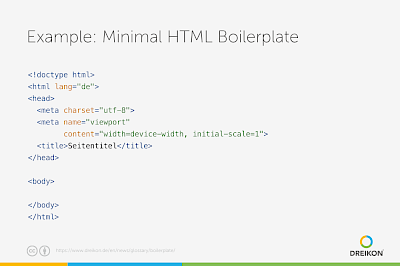


A minimal HTML boilerplate is a basic starting framework for an HTML document. It contains typical structural elements that are required in a similar form on many websites. The individual elements serve different technical functions.
An HTML boilerplate thus merely provides the basic technical structure. It is not yet a complete website and generally contains neither a custom layout nor the actual page content.
In public relations, the term ‘boilerplate’ usually refers to a short, largely standardised section containing basic information about a company, an organisation or a brand. It is often found at the end of a press release. Typical details included in this section are, for example:
Unlike the press release itself, this section does not usually relate directly to the current news story.
A simplified example:
“Muster GmbH, based in Cologne, has been developing software solutions for industrial manufacturing companies since 2012. The company employs around 120 staff and operates in Germany, Austria and Switzerland.”
In the field of contract law, the term ‘boilerplate’ can refer to standardised provisions that appear in a similar form in numerous contracts. These provisions often relate to general legal or organisational framework conditions rather than the specific subject matter of a contract.
These may include the following provisions:
Which clauses are actually included depends on the type of contract and the legal system.
The standardised nature of these provisions does not mean that they are legally insignificant. Even regularly recurring contractual clauses can have significant legal consequences.
Boilerplate and templates overlap to some extent, but have different focuses.
In the case of a website, an HTML boilerplate, for example, may contain only the technical document framework. A website template can additionally provide navigation, layout, components, placeholders and design guidelines.
The situation is similar with texts: a consistent company description appearing in several press releases corresponds to a boilerplate. A template with designated sections for a headline, date, quote, main text and contact details is more of a template.
The terms are therefore not always clearly distinguishable. ‘Boilerplate’ emphasises reusable content above all, whilst ‘template’ places greater emphasis on the reusable structure.
The term ‘boilerplate’ therefore initially describes only the method of reuse . Whether a particular boilerplate is appropriate can only be assessed on the basis of its content and the specific context in which it is used.
The term ‘boilerplate’ is used in several specialist fields, where it takes on a slightly different meaning in each case. In programming, it describes recurring code; in HTML, a basic technical framework; in public relations, a standardised company description; and in contract law, recurring clauses.
What is therefore crucial is not so much a single German translation as the specific context in which the term is used. The common feature remains the standardised reuse of existing components.
The appropriate translation depends on the context. Possible terms include text block, standard text, template, framework, standard code, closing line, or standard clause.
Boilerplate code consists of code components that are regularly used in a similar form and often contain very little project-specific logic. The amount of boilerplate code required depends, among other things, on the programming language and framework.
In a press release, a boilerplate is usually a brief, standardized description of the company or organization. It often appears at the end of the press release and contains basic background information.
Not necessarily. An HTML boilerplate usually provides only the basic technical framework. A template can also include layouts, components, design guidelines, and placeholders.
No. “Boilerplate” initially refers simply to standardized, recurring elements. The term can take on a negative connotation, for example, in a developer context, when it refers to unnecessarily lengthy or repetitive code.