RAG(Retrieval-Augmented Generation) is a technology that combines generative AI with external information sources.
The most important facts in brief
- RAG (Retrieval-Augmented Generation) combines generative AI with external information sources such as websites, databases, documents or company knowledge.
- Instead of relying exclusively on training data, the AI can retrieve and analyse additional information before generating an answer.
- This means that answers are often more up-to-date, more precise and easier to understand than with traditional language models.
- RAG is already used in many AI applications, including ChatGPT Search, Perplexity, Gemini, Microsoft Copilot and corporate chatbots.
- In combination with grounding, answers can be based on specific sources, while fine-tuning adapts the behaviour and response style of a model.
- RAG is becoming increasingly important for companies in the context of Generative Engine Optimisation (GEO ), as high-quality content is increasingly being used as a source of information for AI-generated answers.
Definition: What is RAG?
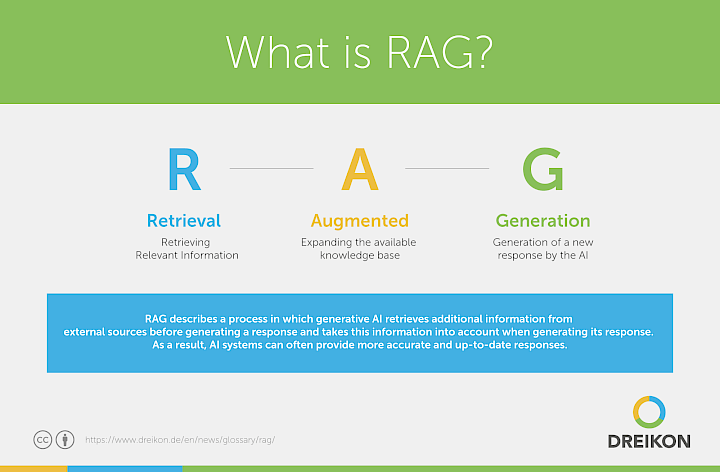
RAG comes from the English and stands for Retrieval-Augmented Generation. The term is made up of three components:
- R = Retrieval: Retrieval of relevant information
- A = Augmented: Enrichment of the available knowledge base
- G = Generation: Creation of a new answer by the AI
RAG describes a process in which a generative AI retrieves additional information from external sources before generating an answer and takes this into account when generating its answer. While classic language models are based solely on their trained knowledge, RAG combines this knowledge with currently available information. As a result, AI systems can often provide more precise and up-to-date answers.
How does RAG work?
Put simply, RAG works according to the following principle:
- A user asks a question or formulates a prompt.
- The AI system searches for suitable information in a data source.
- The content found is analysed.
- The AI creates an answer based on this information.
In contrast to old methods, RAG can analyse additional information from sources such as training data:
- Websites
- databases
- documents
- knowledge databases
- company information
- search engines
and integrate them into their response. With RAG, AIs are therefore not solely reliant on their training knowledge, but combine information search, knowledge retrieval and generative response generation.
How do RAG systems find content?
RAG systems can retrieve information from
- Search engine indices
- websites
- company databases
- Product documentation
- knowledge databases
can be called up. This is why structured, up-to-date and trustworthy content is becoming increasingly important in GEO.
What are the limits of RAG?
RAG improves AI systems, but does not solve all the challenges of generative AI. The quality of the answers depends largely on the available information and its relevance. RAG reaches its limits in particular with incomplete, outdated or incorrect data.
Typical disadvantages and challenges are
- poor or outdated data leads to poor answers
- irrelevant sources can impair the quality of the results
- the technical infrastructure is more complex than with a classic language model
- the quality depends heavily on the available information sources
- not all information is findable or accessible for retrieval
- Additional search steps can increase the response time
- Hallucinations can be reduced, but not completely prevented
- contradictory sources can lead to inconsistent answers
- Data protection and security requirements must be given special consideration for sensitive data
RAG can significantly improve the timeliness and accuracy of AI systems, but is no substitute for high-quality data sources and careful quality control of the information provided.
RAG vs. classic AI: What's the difference?
Traditional language model | RAG system |
|---|---|
based on training data | uses training data and external sources |
knowledge is limited | knowledge can be expanded |
does not recognise new information | can retrieve up-to-date information |
greater risk of outdated answers | greater timeliness |
no additional sources required | external data sources are integrated |
RAG vs. grounding vs. language model vs. fine-tuning: What are the differences?
Modern AI systems often utilise several technologies to generate answers that are as relevant, up-to-date and reliable as possible. The prompt, language model (LLM), RAG, grounding and fine-tuning take on different tasks:
- Prompt = defines the user's question or task
- Language model (LLM) = thinks with what it has learnt during training
- RAG = searches for additional information
- Grounding = bases the answer on concrete and comprehensible sources
- Fine-tuning = permanently adapts the model's behaviour, expertise or response style
Put simply, the prompt determines what is being searched for. The language model processes the information and formulates the answer. RAG provides additional information from external sources, grounding ensures that the response is based on these sources, and fine-tuning influences how the model responds.
The differences between RAG, fine-tuning and grounding using the same example
Suppose a user asks (prompt): "What are the current warranty terms for product X?"
- Example without RAG, fine-tuning or grounding:
The AI answers solely on the basis of its training knowledge. If the warranty conditions have been changed after the time of training, the answer may be outdated, incomplete or even incorrect. - Example with RAG (Retrieval-Augmented Generation):
The AI first searches the current product documentation, knowledge database or website and uses this information for its answer. This allows it to access new or changed information without having to be retrained. - Example with grounding:
The AI answers the question based on the information found and can ideally substantiate this with specific sources or documents. This makes answers more comprehensible and reduces the likelihood of hallucinations. - Example with fine-tuning:
The warranty conditions are not retrieved automatically. Instead, the model was previously trained with specific information, expertise or communication guidelines. If the warranty conditions change later, the model must be trained or updated again. Fine-tuning is therefore particularly suitable for adapting behaviour, tonality or specialised knowledge.
While a language model forms the foundation, RAG ensures up-to-date knowledge, grounding ensures a comprehensible source reference and fine-tuning ensures adapted response behaviour. In modern AI systems, these approaches are often combined in order to generate answers that are as precise and trustworthy as possible.
Why was RAG developed?
Generative AI systems reach their limits when information
- was created after the time of training
- is very specific
- is only available in internal documents
- is regularly updated
RAG was developed to solve precisely this problem: Instead of having to constantly retrain a model, up-to-date information can be retrieved dynamically. This makes answers more up-to-date, more relevant, more precise and easier to understand.
Where is RAG used today?
RAG is already being used in numerous AI applications. Typical areas of application are
AI search engines: Modern AI searches often draw on external sources of information before generating answers.
Examples: ChatGPT Search, Perplexity, Gemini, Microsoft Copilot etc.- Internal company knowledge databases: Companies use RAG to make it easier for employees to access internal knowledge. For example, information from manuals, guidelines, product documentation, contracts and more can be searched in real time.
- Customer service: RAG enables chatbots to access up-to-date product information or support documents. This allows customer enquiries to be answered more precisely.
What significance does RAG have for GEO?
RAG plays an important role in the field of Generative Engine Optimisation (GEO). Many generative search systems today use external information sources to compile answers to user questions. This is changing the way content is found and processed.
While traditional search engines index and rank websites, RAG-based systems can use content directly as a source of information for AI answers.
Why is RAG relevant for companies?
More and more users are asking their questions directly to AI systems. And they expect
- specific answers
- personalised recommendations
- comprehensible explanations
- up-to-date information
- support with decisions
RAG systems often draw on external content. For companies, this means that anyone who provides relevant information can potentially be considered as a source for AI-generated answers.
How can companies improve their chances in RAG systems?
The basis for RAG remains the same as for GEO. This means for companies:
- SEO basics fulfil
Technically clean websites, high-quality content and strong brand signals remain important prerequisites. - Use GEO in a targeted manner
Companies should prepare content in such a way that it: answers specific user questions, makes expertise visible, explains contexts in an understandable way, is kept up to date and appears trustworthy - Treat topics holistically
In the context of semantic search, RAG systems often favour content that answers questions comprehensively and provides sufficient context.
Conclusion
RAG extends generative AI with the ability to retrieve additional information from external sources and incorporate it into answers. This makes AI systems more up-to-date, more relevant and better able to answer complex user questions.
RAG is becoming increasingly important for companies, particularly in connection with Generative Engine Optimisation (GEO). As more and more people use AI systems to search for information, make recommendations and make decisions, the relevance of high-quality content that can be used by RAG-based systems as a trustworthy source is increasing.
FAQ: Frequently asked questions about RAG
RAG stands for Retrieval-Augmented Generation.
RAG combines generative AI with external information sources, thereby enabling more up-to-date and accurate responses.
RAG helps to expand an AI system’s knowledge base and incorporate up-to-date information into its responses.
No. RAG is not a standalone AI model, but a method that can be used by various AI systems.
The key benefits include:
- more up-to-date answers
- greater relevance
- better information quality
- access to external knowledge sources
- less reliance on training data
RAG increases the likelihood that corporate content will be used as a source of information for AI responses. This is why optimising content for generative search systems is becoming increasingly important.
A search engine primarily provides a list of relevant sources or websites in response to a search query. The user must open the results themselves, evaluate them, and compile the required information. RAG (Retrieval-Augmented Generation) goes one step further: the technology retrieves relevant information from various sources, evaluates it, and uses it to generate a coherent response directly. Put simply: a search engine shows where the answer can be found, whilst RAG attempts to formulate the answer itself.
Yes. Modern versions of ChatGPT can use RAG-like methods to retrieve information from the web, uploaded documents or connected data sources. This allows answers to be based on current or external information and means they are not limited solely to the language model’s training data.
Google does not fully describe the exact technical implementation of its AI Overviews. However, modern AI search systems are generally based on similar concepts such as retrieval, grounding and generative response generation. It is therefore generally assumed that AI Overviews retrieve information from the search index, evaluate it and use it to generate AI-generated responses. The principle is thus similar to a RAG approach.
RAG is used wherever up-to-date, comprehensive or company-specific information is required. Typical use cases include:
- AI search engines such as ChatGPT Search, Perplexity or Copilot
- Internal corporate knowledge bases
- Customer service and support chatbots
- Document and contract search
- Product information and technical documentation
- Research and analysis tools
- Healthcare, financial or legal applications with large knowledge bases
No. RAG can reduce hallucinations, but cannot prevent them entirely. By accessing external information sources, the AI gains a better basis for its responses. Nevertheless, faulty sources, inappropriate search results or misinterpretations can still lead to incorrect statements. The quality of the response therefore depends heavily on the quality of the underlying data.
Not necessarily. Above all, RAG requires a source from which relevant information can be retrieved. These can be databases, but also documents, knowledge bases, websites, search engine indexes, product catalogues or internal company systems. Many professional RAG systems use specialised vector databases, as they make information particularly easy to find. In principle, however, a traditional database is not a prerequisite for RAG.