Prompt Engineering
Prompt engineering refers to the targeted development and optimisation of prompts for AI systems. With the increasing spread of generative AI, prompt engineering is becoming more and more important. Those who understand how prompts are constructed and optimised can use AI systems in a more targeted manner and achieve better results.
The most important facts in brief
- Prompt engineering refers to the targeted development and optimisation of prompts for AI systems.
- Well-formulated prompts help to obtain more precise and relevant results.
- Clear instructions, context and targets improve the quality of AI responses.
- Prompt engineering is used in numerous areas such as marketing, content creation, software development and data analysis.
- With the increasing use of generative AI, prompt engineering is becoming an important digital competency.
Definition: What is prompt engineering?
Prompt engineering refers to the targeted design and optimisation of prompts for generative AI systems such as ChatGPT, Gemini, Claude or Copilot. This involves systematically formulating and refining input in order to obtain results that are as precise, helpful and targeted as possible. While a prompt represents the actual instruction or question, prompt engineering describes the process of systematically developing and improving this input.
In simple terms, this means
- Goal: Obtain better results from AI systems
- Method: Create and optimise prompts in a targeted manner
- Benefit: More precise, more relevant and higher quality answers
- Basis: Clear instructions, context and targets
- Effect: More effective collaboration between humans and AI
Examples of prompt engineering
A simple example shows why prompt engineering is so important.
- Simple prompt: "Write a blog article about SEO."
- Optimised prompt: "You are an SEO expert. Write a 1,500-word blog article about technical SEO for small and medium-sized businesses. Use subheadings, practical examples and a checklist. The target audience is marketing managers without in-depth SEO expertise."
The problem with the first prompt: the AI only receives a rough instruction and has to interpret a lot of information itself. This increases the risk of incomplete, inaccurate or less relevant results. Although hallucinations can also occur with well-formulated prompts, more precise input often helps to reduce misunderstandings and misinterpretations. The second prompt delivers much more precise results, as the objective, target group, scope and format are clearly defined.
This example illustrates the core of prompt engineering: the better the input is formulated, the more relevant and helpful the AI's response will be.
Prompt vs. prompt engineering: what's the difference?
| Prompt | Prompt Engineering |
|---|---|
Single input to an AI system | Systematic development of prompts |
Specific question or task | Method for optimizing inputs |
One-time interaction | Continuous improvement process |
Focus on the request | Focus on the quality of results |
Example: “Explain SEO to me.” | Developing a prompt for a target-audience-specific SEO explanation |
How does Prompt Engineering work?
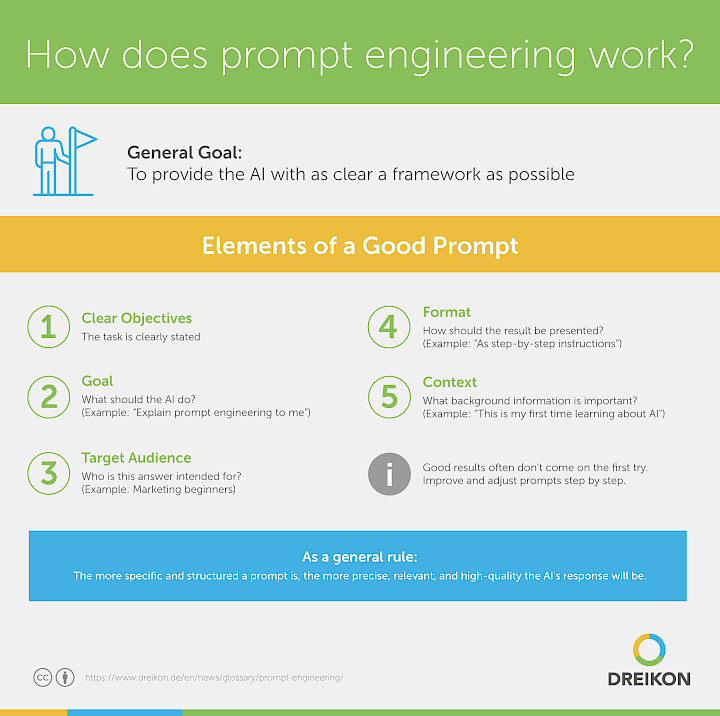
Essentially, the aim is to give an AI the clearest possible framework conditions. A good prompt often contains the following elements:
- Clear objective: The task is clearly formulated.
- Goal: What should the AI do, for example: "Explain prompt engineering to me."
- Target group: Who is the answer intended for? Example: "For marketing beginners."
- Format: How should the result be presented? Example: "As a step-by-step guide."
- Context: What background information is important? Example: "I'm dealing with AI for the first time."
Recommendation: Good results are often not achieved on the first attempt. This is why prompts are often adapted and improved step by step in practice. This iterative approach helps to optimise answers in a targeted manner and adapt them to the desired task.
Basically, the more specific and structured a prompt is formulated, the more precise, relevant and high-quality the AI's response will be.
What are the limits of Prompt Engineering?
Prompt engineering can significantly improve the quality of AI results. Nevertheless, there are limits. Even very good prompts cannot prevent AI systems from
- generate incorrect information
- use outdated data
- misinterpret facts
- produce hallucinations
Furthermore, prompt engineering does not replace specialised knowledge. Users must continue to check and critically evaluate results. Prompt engineering improves communication with the AI, but cannot change the fundamental capabilities and limitations of a model.
Prompt engineering and fine-tuning - what's the difference?
Prompt engineering and fine-tuning take different approaches to optimising AI results. While prompt engineering improves communication with an existing model, fine-tuning changes the properties and behaviour of the model itself.
- Prompt engineering improves the results through the targeted design and optimisation of inputs (prompts). It can be used immediately, requires no changes to the AI model and is accessible to almost any user. In addition, it usually only incurs low costs.
- Fine-tuning goes one step further and adapts the AI model itself. To do this, the model is trained with additional data to better fulfil certain tasks. This approach is technically more complex, incurs higher costs and is primarily used by companies and developers.
Why are good prompts becoming increasingly important?
With the increasing spread of generative AI, the importance of high-quality input is growing. Well-developed prompts enable
- more precise answers
- better solutions to problems
- more personalised recommendations
- greater efficiency
- less correction effort
Will prompt engineering become more important in the future?
With the increasing spread of generative AI, the importance of prompt engineering is also growing; prompt engineering is therefore increasingly developing into an important digital skill. The more frequently AI systems are used for information, recommendations and decisions, the more important the ability to formulate precise and targeted input becomes.
What is Prompt Engineering used for?
- Develop blog articles
- Generate content ideas
- Create social media posts
- Optimise texts
- Plan campaigns
- Analyse target groups
- Support keyword research
- Analyse search content
- Structuring information
- Create summaries
- Interpreting data sets
- Preparing reports
- Generate code
- Analyse errors
- Create documentation
- Develop test cases
- Prepare answers
- Support processes
- Use knowledge databases
- Classify customer enquiries
- Create learning content
- Preparing specialised knowledge
- Develop training materials
- Support learning processes
- Researching information
- Analysing technical contexts
- Analysing studies
- Develop hypotheses
- Formulating e-mails
- Summarising meetings
- Preparing presentations
- Structuring documents
- Optimise workflows
- Automate standard processes
- Utilise knowledge more efficiently
- Prepare the basis for decision-making
What does Prompt Engineering mean for companies?
Prompt Engineering is increasingly developing into a strategic competence. Among other things, companies benefit from
- more efficient work processes
- better AI results
- faster information processing
- higher productivity
- better utilisation of existing knowledge
In addition, Prompt Engineering helps to better understand the mindset of AI users and to align content more closely with their actual information needs.
What significance does prompt engineering have for SEO?
Prompt engineering is not only changing the way we work with AI, but also search engine optimisation (SEO). SEO experts use prompt engineering to analyse search intentions, content research, keyword clustering, content briefings and competitor analyses, for example.
Prompt Engineering also helps to better understand which questions users actually ask and how they interact with AI systems. As a result, content can be better targeted to the information needs of the target group.
What significance does Prompt Engineering have for GEO?
Prompt engineering is also becoming increasingly important in the field of Generative Engine Optimisation (GEO). As more and more people are using AI systems as a source of information, search behaviour and user expectations are changing.
Instead of individual keywords, users are increasingly formulating complete questions and specific tasks. Companies therefore benefit from better understanding typical user queries, language patterns and information needs.
Prompt Engineering helps with this,
- Identify frequent user questions,
- analyse natural language patterns,
- develop dialogue-oriented content,
- recognise relevant topics and entities and
- optimise content for AI-supported search and response systems.
This allows content to be more closely aligned with modern search and response experiences.
Conclusion: Will better AI models make prompt engineering superfluous?
With each new generation of AI models, systems become more powerful and can also better understand imprecise inputs. Nevertheless, prompt engineering remains relevant. Complex tasks, business-critical processes and high-quality content still require clear objectives, contextual information and structured instructions.
However, the role of prompt engineering is changing: instead of optimising individual formulations, strategic tasks such as process design, knowledge structuring and AI workflows are coming more to the fore.
FAQ: Frequently asked questions about Prompt Engineering
Prompt engineering refers to the targeted development and optimisation of inputs for AI systems in order to achieve better results.
A prompt engineer develops, tests and optimises prompts so that AI systems can perform tasks as accurately as possible.
No. Prompt engineering does not require traditional programming, but rather the structured formulation of instructions for AI systems.
Because the quality of AI responses depends largely on the quality of the input.
Yes. Through practical application and an understanding of best practices, users can learn to develop better prompts.
Prompt engineering is used in ChatGPT, Gemini, Claude, Copilot, Perplexity and many other generative AI systems, amongst others.
Not necessarily. However, an understanding of prompt engineering helps to better understand typical user queries and interaction patterns, which in turn can be helpful for GEO strategies.
One example is refining a simple instruction such as “Write a blog article about SEO” into a detailed prompt that specifies the target audience, format, scope and context. This usually yields significantly better results.
Key skills include analytical thinking, strong communication skills, specialist knowledge in the relevant field, and a good understanding of generative AI systems.
Yes. Although modern AI systems are becoming increasingly powerful, the ability to formulate tasks precisely and guide AI in a targeted manner remains important.
Prompt design describes the creation of individual prompts. Prompt engineering, on the other hand, encompasses the systematic development, optimisation and evaluation of prompt strategies.
Sources
- OpenAI Prompt Engineering Guide: https://platform.openai.com/docs/guides/prompt-engineering
- Anthropic Prompt Engineering Overview: https://docs.anthropic.com/en/docs/build-with-claude/prompt-engineering/overview
- Google Gemini Prompting Guide: https://ai.google.dev/gemini-api/docs/prompting-intro
- Microsoft Learn - Prompt Engineering: https://learn.microsoft.com/en-us/azure/ai-foundry/openai/concepts/prompt-engineering
- Wikipedia - Prompt Engineering: https://de.wikipedia.org/wiki/Prompt_Engineering