Prompt
A prompt is an instruction, question or input that is addressed to an AI system. It is used to tell the artificial intelligence what task it should solve and what information or content is required.
The term comes from the English language and means "request", "impulse" or "input". In the context of generative AI, a prompt describes all the information that is made available to a language model so that it can generate a suitable response or output.
Well-known AI applications such as ChatGPT, Gemini, Claude, Perplexity or Midjourney work on the basis of prompts.
The most important facts in brief
- A prompt is the input for an AI system such as ChatGPT, Gemini or Claude and largely determines the quality of the generated response.
- Prompts differ from traditional search queries: while search engines provide suitable sources, AI systems generate direct answers or content based on prompts.
- Good prompts contain clear instructions, context, target group information and desired output formats in order to obtain the most precise results possible.
- Prompting is becoming an important competence in online marketing, as AI is now used for content marketing, SEO, GEO, SEA and social media, among other things.
- Prompts are gaining strategic importance for companies because they make work processes more efficient and help to optimise content for AI-supported search systems and generative search results.
Definition: Prompt explained simply
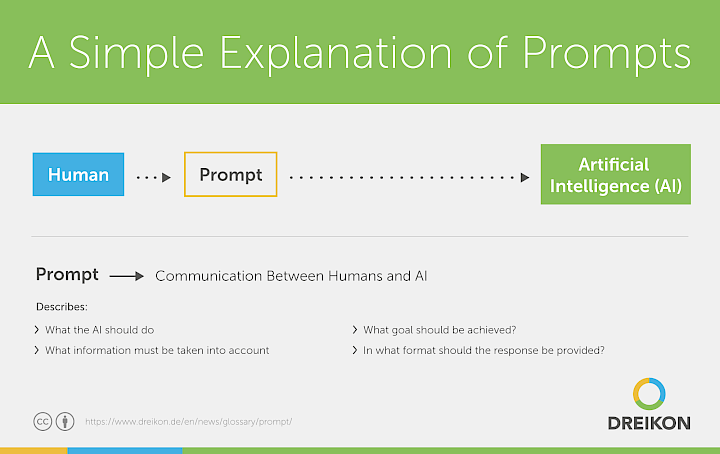
A prompt is the communication between humans and AI. It describes
- what the AI should do
- which goal is to be achieved
- what information needs to be taken into account
- what format the response should take
Examples of prompts:
- "Write a blog post about search engine optimisation."
- "Explain to a child how an electric car works."
- "Create a table with the advantages and disadvantages of GEO."
- "Formulate a professional email to make an appointment."
The more precisely a prompt is formulated, the better the AI can fulfil the desired task.
Prompt meaning: Why are prompts so important for AI?
Generative AI systems have extensive knowledge, but cannot automatically recognise a user's intention. The quality of the results therefore depends largely on the quality of the input. This is why the following principle also applies to AI systems: the better the input, the better the output.
A good prompt helps with this:
- Avoid misunderstandings
- obtain more relevant answers
- provide the desired context
- save time during post-processing
- generate consistent results
Search query vs. prompt: What's the difference?
| Search Query | Prompt |
|---|---|
directed at a search engine | directed at an AI system |
Goal: find relevant sources | Goal: generate a direct answer |
often based on keywords | usually based on natural language |
User clicks on search results | User receives a generated response |
Example: "Prompt definition" | Example: "Explain what a prompt is in simple terms and provide three practical examples from marketing." |
From the search query to the prompt
With the spread of AI-supported search systems such as ChatGPT Search, Gemini, Perplexity or AI Overviews, the search behaviour of many users is changing. For example, a search query used to be: "Prompt definition"; today, users are more likely to say: "Just explain to me what a prompt is and give me three practical examples from marketing."
The search is thus increasingly developing from a keyword-based input to a conversation-orientated interaction.
Why are good prompts becoming increasingly important?
The more precisely users formulate their questions, the more relevant AI systems can respond. At the same time, prompts help companies to better understand what information, recommendations and assistance their target groups actually expect.
Well-formulated prompts enable
- more precise answers
- more personalised recommendations
- a better basis for decision-making
- more efficient problem solving
- more relevant search results
Prompting is thus developing into an important competence in dealing with generative AI and at the same time changing the requirements for digital content.
| Component of a Good Prompt | Example |
|---|---|
Goal of the Task | “Show me how to write better prompts for ChatGPT.” |
Target Audience | “Explain the topic for beginners.” |
Format | “Create a step-by-step guide.” |
Context | “I mainly use AI for work and studying.” |
What does prompting mean?
Prompting refers to the targeted formulation of inputs for AI systems in order to achieve a specific result. While a prompt describes the actual input, prompting refers to the process of creating and optimising this input. Prompting is increasingly becoming an important digital skill as companies use AI systems more and more for marketing, content production, analyses and strategic tasks.
What does prompting mean for marketing?
Prompting is changing the way marketing teams create, analyse and optimise content. Instead of performing many tasks manually, marketers can use AI systems to make their activities more efficient with the help of targeted prompts.
What do people use AI systems for today and what is being prompted?
More and more people are using AI systems such as ChatGPT, Gemini, Claude or Perplexity as digital assistants for information, recommendations, decisions and creative tasks. They are not just asking questions, but increasingly formulating specific tasks, problems and goals. In contrast to traditional searches, users often expect direct answers, individual recommendations and personalised assistance tailored to their specific context. As a result, AI systems are increasingly evolving from pure sources of information into digital advisors.
What user needs are covered by prompts today?
- Explain technical terms
- Summarise complex topics
- understand interrelationships
- research current developments
- answer individual questions
Typical prompts:
- "What is Generative Engine Optimisation?"
- "Explain the differences between SEO and GEO."
- "Summarise the topic in simple terms."
- Compare products
- Prepare purchasing decisions
- Evaluate advantages and disadvantages
- Find suitable solutions
- Receive personalised recommendations
Typical prompts:
- "Which smartphone is suitable for professional photography?"
- "Which CRM software is right for a medium-sized company?"
- "Compare the best e-bikes for commuters."
- Research agencies
- Compare service providers
- Evaluate software providers
- Find suitable partners
- Obtain recommendations
Typical prompts:
- "Which SEO agencies specialise in B2B companies?"
- "Which project management software is suitable for small teams?"
- "Recommend a provider for email marketing."
- Analyse challenges
- Receive recommendations for action
- Optimise processes
- Eliminate errors
- Develop strategies
Typical prompts:
- "How can I increase the conversion rate of my online shop?"
- "Why are my website rankings dropping?"
- "How do I develop a content strategy for my company?"
- Compare alternatives
- Evaluate opportunities and risks
- Prioritise options
- Prepare investments
- Compare strategies
Typical prompts:
- "Should I invest in SEO or SEA?"
- "Which marketing measures bring the highest ROI?"
- "Which solution is more economical in the long term?"
- Preparing learning content
- Deepen topics
- Prepare exams
- Structuring knowledge
- Use individual learning aids
Typical prompts:
- "Explain the basics of Google Ads to me."
- "Create a learning plan for SEO."
- "Test my knowledge with ten quiz questions."
- Create texts
- Develop ideas
- Plan campaigns
- Preparing presentations
- Revise content
Typical prompts:
- "Write a LinkedIn post on the topic of AI in marketing."
- "Develop ten blog ideas for an online shop."
- "Optimise this text for better readability."
- Formulating e-mails
- Summarising meetings
- Structuring concepts
- Analyse documents
- Automate workflows
Typical prompts:
- "Formulate a professional customer email."
- "Summarise the most important points of this meeting."
- "Create an agenda for a strategy workshop."
How is it decided what is output in AI responses to prompts?
The content that appears in an AI answer depends on various factors. Among other things, generative AI systems evaluate information according to how relevant, trustworthy and helpful it is for the question posed.
Particularly important factors are
- the relevance of the content for the prompt in question
- the quality and comprehensibility of the information
- the expertise and trustworthiness of the source
- the thematic depth and completeness of the content
- the general visibility and authority of a brand or website
For companies, this means that the basics of search engine optimisation (SEO) remain an important prerequisite for visibility, even in the age of generative AI. Technically clean websites, high-quality content, thematic authority and strong brand signals often form the basis for being considered as a relevant source by AI systems in the first place.
Building on this, Generative Engine Optimisation (GEO) can help to align content specifically to the requirements of AI systems and typical user prompts. GEO complements SEO, but does not replace basic SEO measures. In addition, new advertising formats such as AI ads are becoming increasingly important for building visibility in generative search environments
What do prompts mean for companies?
Prompts have long been more than just a technical AI topic. They provide companies with valuable insights into the actual information, consulting and purchasing needs of their target groups. While search engines often only visualise individual keywords, prompts often show the full context of a question.
This makes it clear
- which problems users want to solve
- which questions are on their minds
- which criteria influence purchasing decisions
- what information is required for decisions
- what expectations exist for recommendations
Companies that understand typical user prompts can develop content that is more closely aligned with the actual needs of their target groups. This becomes particularly relevant when users use AI systems not only to search for information, but increasingly also for advice, product selection and decision support.
Conclusion
Prompts are the basis of every interaction with generative AI systems. They determine what information an AI processes, how tasks are understood and what answers users receive.
With the increasing spread of ChatGPT, Gemini, Perplexity and other AI applications, the way in which people search for information is also changing. Instead of short search queries, users are increasingly formulating specific questions, problems and requests for advice in the form of prompts.
It is therefore becoming more important for companies to understand the underlying user needs and provide content that answers relevant questions in an understandable, trustworthy and comprehensive manner. In addition to the classic SEO basics, Generative Engine Optimisation (GEO) is also becoming increasingly important.
Those who understand how prompts work and what users expect from AI systems can utilise the potential of generative AI in a more targeted manner and improve their visibility in future search and response systems.
FAQ: Frequently asked questions about prompts
‘Prompt’ can be translated as ‘prompt’, ‘instruction’ or ‘input’.
A prompt might, for example, read: ‘Show me how I can write better prompts for ChatGPT.’
A good prompt describes as precisely as possible what result is desired. Information about the objective, the target audience, the desired format and the context of the task is helpful here.
The more precisely the input is formulated, the better the AI can understand the task. Good prompts contain clear instructions, relevant background information and specific expectations regarding the response.
Prompting refers to the targeted formulation and optimisation of inputs for AI systems in order to obtain the most relevant and high-quality results possible.
Prompt engineering describes the systematic development and optimisation of prompts. The aim is to improve the quality, accuracy and usefulness of AI responses.
Even small differences in the wording, context or requirements of a prompt can influence an AI’s response. That is why the quality of the input plays an important role.
A search query is designed to find relevant sources of information. A prompt is designed to generate a specific answer, recommendation or solution to a problem.
Almost all generative AI applications use prompts. These include, for example, ChatGPT, Gemini, Claude, Perplexity and Midjourney.
Because more and more people are using AI systems for information, recommendations, purchasing decisions and advisory services. Businesses therefore need to understand what questions their target audiences are asking and what answers they expect.