1. Start with the business objective
It is not ‘more rankings’ but growth, qualified leads, turnover, reach or market share that form the starting point.



Search engine optimisation provides a wealth of data – from rankings and impressions to conversions and turnover. The challenge lies in selecting the right metrics from the total number available and using them to inform concrete decisions.
The most important SEO KPIs include organic conversions, qualified leads, revenue, non-brand clicks and relevant rankings.
However, Google AI Overviews, AI Mode and AI response systems such as ChatGPT or Perplexity are changing the way success is measured: visibility no longer necessarily leads to website clicks. Traditional SEO metrics and new GEO metrics must therefore increasingly be considered together.
“Good SEO reporting isn’t about showing more figures. It’s about making better decisions.”
SEO KPIs need to be linked to specific targets. It is only when they are tied to concrete business objectives that metrics become meaningful KPIs.
The most important SEO KPIs measure impact. Rankings and impressions indicate visibility; clicks indicate usage; conversion rates and turnover indicate business success.
Fewer SEO KPIs are often better. A focused set of KPIs makes it easier to derive specific actions.
AI is changing the way success is measured. Visibility and organic traffic may increasingly diverge.
GEO expands reporting. AI Visibility, Brand Mentions and Citation Rate complement traditional SEO metrics.

SEO KPIs are key performance indicators used to assess defined objectives in search engine optimisation. It is not the metric itself that is crucial, but how it relates to the objective. 200,000 impressions are, at first, merely a metric. If the reach of a relevant topic cluster is to grow by 30 per cent within six months, impressions can become an SEO KPI.

A higher ranking increases a URL’s visibility index. However, whether this translates into business value depends on search intent, demand and the rest of the customer journey. A number 1 ranking for a largely irrelevant informational keyword may be less valuable than a number 4 ranking for a search query closely related to an enquiry or purchase. It is therefore not just rankings that are crucial, but also topic relevance and business potential.
The better question is therefore: “For which relevant topics are we gaining visibility – and what impact does this have?”
Not every metric deserves a place in SEO reporting. The key factor is which SEO KPIs actually reflect visibility, usage, conversion and business impact. For management, three to five key SEO KPIs are often sufficient. Operational teams require additional diagnostic metrics.
A prioritised SEO KPI matrix is recommended for the selection process. It organises key terms and their role in reporting. The priorities listed are general guidelines and must be adapted to the business model.
| SEO KPI | KPI Role | Typical Use Case |
|---|---|---|
Organic Conversions | Outcome | Lead Generation, Online Stores |
Organic Revenue / Pipeline | Business | E-Commerce, B2B |
Non-Branded Clicks | Performance | Customer Acquisition |
Organic Sessions | Performance | All Business Models |
Relevant Rankings | Leading Indicator | Building Search Visibility |
Impressions | Leading Indicator | Reach Growth |
Organic CTR | Diagnostic | Click Performance |
Visibility Index | Leading Indicator | Competitor Monitoring |
Engagement | Diagnostic | Content Analysis |
Backlinks / Referring Domains | Diagnostic | Authority, Link Profile |
Indexing / Crawling | Diagnostic | Technical SEO |
Core Web Vitals | Diagnostic | Technical User Experience |

. However, trends within key topic clusters and search intent are more meaningful than the individual rankings of a website’s subpages. If search engine rankings improve, impressions should also be taken into account. They indicate organic reach and may already be growing before there is an increase in clicks or conversions. If there is no further impact, it is worth looking at demand, intent and the structure of the search results pages. Based on this, specific subpages can then be optimised.
The click-through rate shows what percentage of impressions leads to a click:
CTR = Clicks ÷ Impressions × 100
A falling CTR is not automatically a snippet issue. Rankings, brand share, user intent and SERP features on the search results pages also influence the click-through rate. These factors should be examined before optimising the title and description in order to target potential visitors more effectively.

Whilst Google Search Console tracks visitor numbers from the Google search results page, GA4 measures subsequent website usage. These two metrics are not identical. Segmentation by, for example, sub-pages, user intent, device, and brand versus non-brand traffic helps to assess the quality of organic traffic.
Engagement rate, average session duration and bounce rate help to assess user behaviour. However, a short session duration is not automatically a negative factor. If searchers find the information they are looking for straight away, they may already have achieved their goal. It is therefore crucial to determine whether the user behaviour aligns with the website’s purpose.

Backlinks can signal digital authority and topical relevance. The key factors for a strong link profile are quality, topical relevance and the growth of referring domains – not just the number of links. A few high-quality links from relevant specialist sites can be more valuable than numerous links from websites unrelated to the topic. Tools such as Ahrefs help you to check your link profile regularly.
Conversions link search engine optimisation to business-relevant actions such as purchases, enquiries or registrations. They show what percentage of organic traffic converts:
Conversion rate = Conversions ÷ organic sessions × 100
The quality of the conversion is crucial. A download is not automatically as valuable as a qualified lead or a purchase. The total number of conversions should therefore always be assessed alongside their quality.
At a business level, it is no longer just a question of whether users convert, but of the economic value generated by search engine optimisation. In e-commerce, organic revenue can often be measured relatively directly. In B2B, customer journeys are longer, which is why qualified sales opportunities and the sales pipeline may also be relevant. SEO ROI compares revenue with investment and can be used as an SEO KPI:
SEO ROI = (SEO revenue – SEO costs) ÷ SEO costs × 100
The challenge lies in attribution. If only last-click revenue is considered, search engine optimisation may be underestimated; if all subsequent revenue is attributed to it, the channel is overestimated. A weak ROI may therefore be a performance issue or a measurement problem.
Indexing status, crawl errors, Core Web Vitals and page load time are, first and foremost, operational diagnostic metrics. They help to identify whether technical issues are affecting organic performance or the user experience. Page load time should not be considered in isolation. It becomes particularly relevant when slow pages coincide with a poorer user experience, technical issues or lost conversions. Here, too, the same principle applies: a technical metric only becomes a meaningful key performance indicator when linked to a specific objective and its impact on performance.
SEO metrics become problematic when figures are viewed without any objective, context or consistency. It is not the metric itself that is a vanity metric, but the significance attributed to it. A high visibility index, for example, is not an end in itself. Nor do rising rankings or visitor numbers automatically prove commercial success.
Typical mistakes include:
Evaluating rankings without reference to relevant search intent.
Equating traffic growth with business success.
Treating tool estimates as actual user data.
Ignoring seasonality and changes in demand.
Comparing the total number of GEO metrics without a consistent measurement methodology.
A good KPI system therefore links different levels of impact:
Visibility → Click or mention → Interaction → Conversion → Business value
Not every customer journey follows this sequence. However, this framework helps to distinguish operational signals from financial outcomes.
It is not ‘more rankings’ but growth, qualified leads, turnover, reach or market share that form the starting point.
The selection of SEO KPIs should reflect the topics and search terms that appeal to searchers and guide them from seeking information towards making a decision.
Rankings and impressions often respond sooner. Conversions, qualified sales opportunities and revenue follow later. Both aspects go hand in hand.
Detailed technical or behavioural metrics become relevant where they explain trends in KPIs.
‘Increase traffic’ is too vague. ‘Increase non-brand clicks on commercial landing pages within twelve months’ is a measurable objective.
If a value changes, it should be clear what analysis or action should follow.

Not every business needs the same metrics. What matters is which Key Performance Indicators are suited to the business model, the customer journey and the specific objectives of search engine optimisation.
DREIKON helps you select relevant SEO KPIs, correctly categorise existing metrics and develop a manageable measurement model based on them.
Good SEO reporting is tailored to the recipient. Management, the SEO team and specialist departments all need the same data set, but at different levels of detail. Monitoring shows what has changed. Reporting explains the implications. That is why there is no one-size-fits-all list of key performance indicators – what matters is how well they align with the business model and objectives.
The reporting table immediately highlights where action is needed. At the same time, changes compared with the previous period and the same period last year should be taken into account.
Fictitious example figures. PP = percentage points. Variance = actual minus target.
| KPI | Actual | Target | Variance | Action |
|---|---|---|---|---|
KPI | Actual | Target | Variance | Action |
Non-Brand Clicks | 5,6 | 5,8 | −200 | Review keyword performance |
Organic Sessions | 9,2 | 9,5 | −300 | Analyze landing pages |
Qualified Leads | 105 | 130 | −25 | Review conversion funnel |
Conversion Rate | 1.14% | 1.60% | −0.46 pp | Optimize forms |
AI Citation Rate | 16% | 18% | −2 pp | Analyze source visibility |
Generative AI is changing where digital visibility arises and how users access information. A brand may be mentioned in Google AI Overviews, ChatGPT or Perplexity without this immediately resulting in a visit to its website. Even links in AI responses do not necessarily lead to clicks.
Zero-click search refers to search queries that do not result in a subsequent click on an external website. Searchers receive their answer directly in the results view. This phenomenon existed even before generative AI. Featured snippets and knowledge panels had already been providing direct answers. What is new is the ability of generative systems to answer even more complex questions directly. As a result, research and decision-making processes can take place to a greater extent within the search or AI interface.
A SISTRIX study of German keywords found an average CTR of around 11 per cent for the top organic position on search results pages featuring an AI Overview, compared with around 27 per cent on pages without one. On 6 November 2026, the SEO tool also recorded AI Overviews for 57.9 per cent of the German keywords analysed, thereby exceeding the 50 per cent mark for the first time. These results are not universal benchmarks for every website. However, they illustrate why traditional rankings and click-through figures need to be interpreted in a more nuanced way.
A decline in organic traffic therefore does not automatically mean that digital visibility is falling to the same extent.
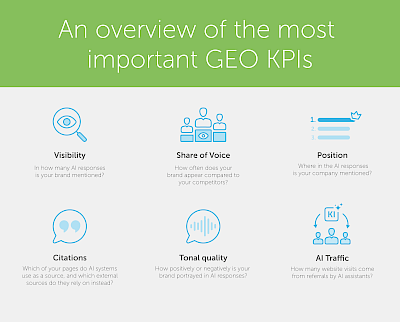
Systematic monitoring is required to assess the success of GEO (Generative Engine Optimisation). This is based on a defined set of prompts that reflects typical questions and search queries from the relevant target audience in relevant AI search systems. Specialised GEO tracking tools such as Peec.ai can be used to continuously analyse a brand’s presence in AI-generated responses. The analysis can focus on the following key metrics:
Visibility: How often is a brand mentioned in AI-generated responses?
Share of voice: How prominent is a brand compared to its competitors?
Position: Where does a brand appear within the AI responses?
Citations: Which of the brand’s own and external websites do AI systems cite as sources?
Tone: How positively, neutrally or critically is a brand described by AI systems?
AI traffic: How many visitors reach the company’s own website via AI assistants?
Based on these metrics and the overarching business objectives, specific KPI targets and projected timeframes for achieving them can be defined. Regular reporting makes progress transparent, enables the evaluation of the effectiveness of GEO measures and highlights areas where optimisation is required. This allows the GEO strategy to be managed on a data-driven basis and continuously refined. As GEO metrics are not standardised across platforms, reliable year-on-year comparisons require a consistent measurement methodology.
Since June 2026, Google Search Console has been providing separate performance reports for generative AI features. These have been available worldwide since 31 August 2026. Among other things, the reports show impressions of URLs in AI Overviews and AI Mode. Analyses by subpages, countries, devices and time periods allow for a more nuanced view. The data forms part of the overarching Google performance data and must not be double-counted without being noticed.
External systems such as ChatGPT or Perplexity are not captured by this. Supplementary GEO monitoring is required for this.
OpenAI is also making AI visibility increasingly measurable. On 10 November 2026, Businesses in ChatGPT , a beta version through which companies can verify their profile, manage information and, for the first time, receive an aggregated performance report on their presence in ChatGPT via the Business Hub.
The analytics include, amongst other things, brand mentions, website clicks and so-called ‘Discovery Topics’ – that is, topics where ChatGPT refers to the company or its website.
This creates a rudimentary version of a Search Console for ChatGPT. However, the system is not yet on a par with Google Search Console: the data is aggregated, subject to minimum thresholds and, as yet, does not provide complete insights into individual search queries or competitive rankings.
Nevertheless, this represents an important step forward for measuring SEO and GEO performance: for the first time, companies are receiving direct platform data on their ChatGPT presence, rather than having to rely exclusively on external GEO tools or referral traffic. In future, such data could enable an even more precise link between AI visibility, website visits and business outcomes.
AI responses can vary depending on the model, prompt, timing and context. Therefore, AI Visibility should not be interpreted as a universal market share. It describes a clearly defined sample.
GEO is not a prompt hack. A sustainable online presence is built on relevant content, subject-matter authority, clear entities and trustworthy sources of information. Engaging, well-structured content makes it easier for searchers and AI systems to grasp key information.
A modern measurement model combines traditional SEO KPIs with additional signals from generative search systems.
The following overview provides an example:
Rankings, impressions and AI visibility show how visible a brand is in traditional and generative search systems.
Clicks, CTR, organic traffic and AI referrals provide a measurable indication of how often searchers engage with your content.
Backlinks, brand mentions and citations provide insight into a brand’s presence and how it is referenced in relevant sources.
Leads, purchases and conversion rates show the extent to which organic visibility results in specific target actions.
Revenue, the sales pipeline and SEO ROI help to assess the financial contribution made by SEO and GEO initiatives.
Crawling, Core Web Vitals and engagement metrics help to identify technical and usage-related causes of changes.
The modern measurement model combines traditional SEO metrics with additional signals from generative search and response systems. New key performance indicators are not simply added, but categorised according to their function.
Important: The six areas do not necessarily form a linear sequence. Authority and technical quality can influence several metrics simultaneously. A strong backlink profile, for example, can affect both organic visibility and, indirectly, presence in AI responses.
Furthermore, not every metric carries the same weight. A crawl error is not a business KPI, and an AI mention is not automatically more valuable than a qualified lead. The crucial question is therefore: “How visible are we across search and answer systems – and what impact does this have?”
| Traditional KPI | Impact of AI Search | Recommended Additional Metric |
|---|---|---|
Rankings | Do not capture all forms of visibility | AI Visibility |
Impressions | Generative Google features create additional visibility | Impressions in generative Google features |
Organic Clicks | May evolve differently from visibility | Brand Mention Rate / Citation Rate |
CTR (Click-Through Rate) | Is increasingly influenced by answer formats and the structure of search results pages | SERP / Feature Segmentation |
Traffic | Does not capture the full impact on brand perception | Brand Search and AI Referrals |
Backlinks | Are increasingly viewed in the context of digital authority | Mentions and Source Presence |
Share of Voice | Traditional rankings cover only part of the search landscape | Share of AI Voice |

Search engine rankings and visitor numbers are now only part of the picture. AI visibility, brand mentions and source references broaden the scope of measurement – but they must be defined and interpreted just as clearly as traditional SEO KPIs.
DREIKON combines SEO, GEO and business metrics into a single measurement model and highlights which changes actually require action.
| Data Source | Suitable For | Limitations |
|---|---|---|
Google Search Console | Clicks, impressions, rankings, visibility in Google's generative search features | Limited to Google |
Google Analytics 4 | Website usage, key events, conversion rates | No comprehensive search visibility |
SISTRIX / Semrush / Ahrefs | Rankings, visibility, backlinks, competitor analysis | Partially modeled data |
CRM / E-commerce Platform | Leads, pipeline, revenue | Attribution required |
GEO Monitoring | AI mentions, citations, competitor comparisons | Results depend on methodology |
Looker Studio / BI | Data integration and consolidation | Depends on data quality |
Semrush, SISTRIX, Ahrefs – no single tool can fully capture SEO success. The key factor is which data source is required for which part of the measurement model used to gauge success.
Measuring SEO KPIs in practice
The tool does not determine which metrics are important. The business objective does.
Effective SEO performance measurement begins with clearly defined business objectives. Rankings and impressions indicate visibility. Clicks and traffic make website usage measurable. Conversion rates, qualified leads and revenue demonstrate the resulting financial impact.
AI overviews, zero-click search and generative response systems are making this assessment more challenging. Visibility can be achieved without immediately triggering a click on the website. GEO metrics therefore supplement traditional reporting by including brand presence and source references in AI responses.
What matters is not the number of SEO KPIs, but their significance: which metrics show whether search engine optimisation is reaching the right target audiences – and what decisions can be drawn from this? Stop just measuring. Start making better decisions.

DREIKON helps companies align SEO performance measurement with business objectives, effectively integrate relevant data sources, and evaluate traditional search performance alongside GEO visibility. This results in reporting that not only documents figures but also enables concrete decisions to be made.
For many companies, qualified leads, organic revenue or pipeline, non-brand clicks, organic sessions, and relevant rankings are key. The selection must align with the company’s goals. The total number of available metrics is not necessarily relevant in this context.
No. Rankings remain important leading indicators. However, they do not reflect every form of organic visibility and do not guarantee a specific number of clicks.
Yes. If, for example, qualified leads and revenue are increasing, search engine optimization can be financially successful. Nevertheless, declines in traffic should be investigated to determine their causes.
Google Search Console and GA4 provide numerous basic metrics such as clicks, impressions, CTR, organic sessions, and conversion rates. For additional competitive analysis, tools like Semrush and Ahrefs offer their own reports.
Monthly reporting is suitable for many companies. Monthly reporting is suitable for many companies. Long-term trends also require longer comparison periods. In the event of technical issues—such as significant deviations in load time or bounce rate—a short-term review may be necessary.
To do this, you compare attributable SEO revenue with SEO costs. Clear attribution and a consistent time frame are crucial.
AI Visibility, Citation Rate, Brand Mention Rate, and Share of AI Voice help analyze presence in generative responses. They complement traditional SEO and business metrics.

Matthias Kampmann is a partner and managing director of the digital agency DREIKON. With over 20 years of experience in search engine optimisation and more than 15 years of expertise in Google Ads, he advises companies strategically on SEO, GEO and sustainable online marketing.